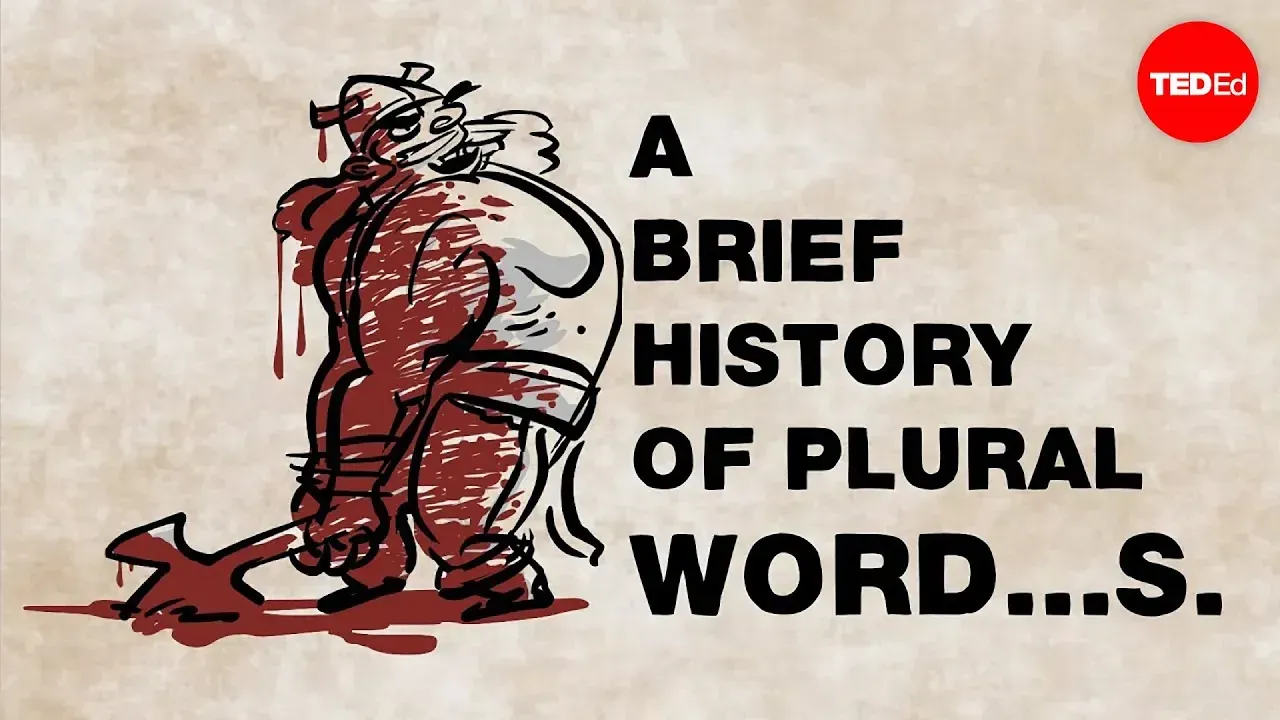
A brief history of plural word...s - John McWhorter
All it takes is a simple S to make most English words plural. But it hasn't always worked that way (and there are, of course, exceptions). John McWhorter looks back to the good old days when English was newly split from German -- and books, names and eggs were beek, namen and eggru!
Mon Jul 22 2013 - Written by:
TED-Ed
There are a lot of ways this marvelous language of ours, English, doesn’t make sense. For example, most of the time when we talk about more than one of something, we put an S on the end. One cat, two cats. But then, there’s that handful of words where things work differently.
Alone you have a man; if he has company, then you’ve got men, or probably better for him, women too. Although if there were only one of them, it would be a woman. Or if there’s more than one goose, they’re geese, but why not lots of mooses, meese? Or if you have two feet, then why don’t you read two beek instead of books. The fact is that if you were speaking English before about a thousand years ago, beek is exactly what you would have said for more than one book.
If Modern English is strange, Old English needed therapy. Believe it or not, English used to be an even harder language to learn than it is today. Twenty-five hundred years ago, English and German were the same language. They drifted apart slowly, little by little becoming more and more different. That meant that in early English, just like in German, inanimate objects had gender. A fork, gafol, was a woman; a spoon, laefel, was a man; and the table they were on, bord, was neither, also called neuter. Go figure! Being able to use words meant not just knowing their meaning but what gender they were, too.
And while today there are only about a dozen plurals that don’t make sense, like men and geese, in Old English, it was perfectly normal for countless plurals to be like that. You think it’s odd that more than one goose is geese? Well, imagine if more than one goat was a bunch of gat, or if more than one oak tree was a field of ack. To be able to talk about any of these, you just had to know the exact word for their plural rather than just adding the handy S on the end.
And it wasn’t always an S at the end either. In merry Old English, they could add other sounds to the end. Just like more than one child is children, more than one lamb was lambru, you fried up your eggru, and people talked not about breads, but breadru. Sometimes it was like sheep is today—where, to make a plural, you don’t do anything. One sheep, two sheep. In Old English, one house, two house. And just like today, we have oxen instead of oxes. Old English people had toungen instead of tongues, namen instead of names, and if things stayed the way they were, today we would have eyen instead of eyes.
So, why didn’t things stay the way they were? In a word, Vikings.
In the 8th century, Scandinavian marauders started taking over much of England. They didn’t speak English, they spoke Norse. Plus, they were grown-ups, and grown-ups aren’t as good at learning languages as children. After the age of roughly 15, it’s almost impossible to learn a new language without an accent and without slipping up here and there as we all know from what language classes are like. The Vikings were no different, so they had a way of smoothing away the harder parts of how English worked.
Part of that was those crazy plurals. Imagine running up against a language with eggru and gat on the one hand, and then with other words, all you have to do is add ‘s’ and get days and stones. Wouldn’t it make things easier to just use the ‘s’ for everything? That’s how the Vikings felt too. And there were so many of them, and they married so many of the English women, that pretty soon, if you grew up in England, you heard streamlined English as much as the real kind. After a while nobody remembered the real kind any more. Nobody remembered that once you said doora instead of doors and handa instead of hands.
Plurals made a lot more sense now, except for a few hold-outs like children and teeth that get used so much that it was hard to break the habit.
The lesson is that English makes a lot more sense than you think. Thank the ancestors of people in Copenhagen and Oslo for the fact that today we don’t ask for a handful of pea-night instead of peanuts. Although, wouldn’t it be fun, if for just a week or two, we could?