Many games come with the promise of letting the player live out some kind of awesome, aspirational fantasy. Maybe that’s to become a comic book superhero. Perhaps it’s the opportunity to wield a lightsaber. Or become the member of a secretive assassin’s guild. To be rock god, a samurai, a rally car driver, or a no-nonsense yakuza. And from my experience of playing this sort of game, it feels like there’s two, distinctly different ways of delivering this fantasy.
The First Way: Giving the Fantasy
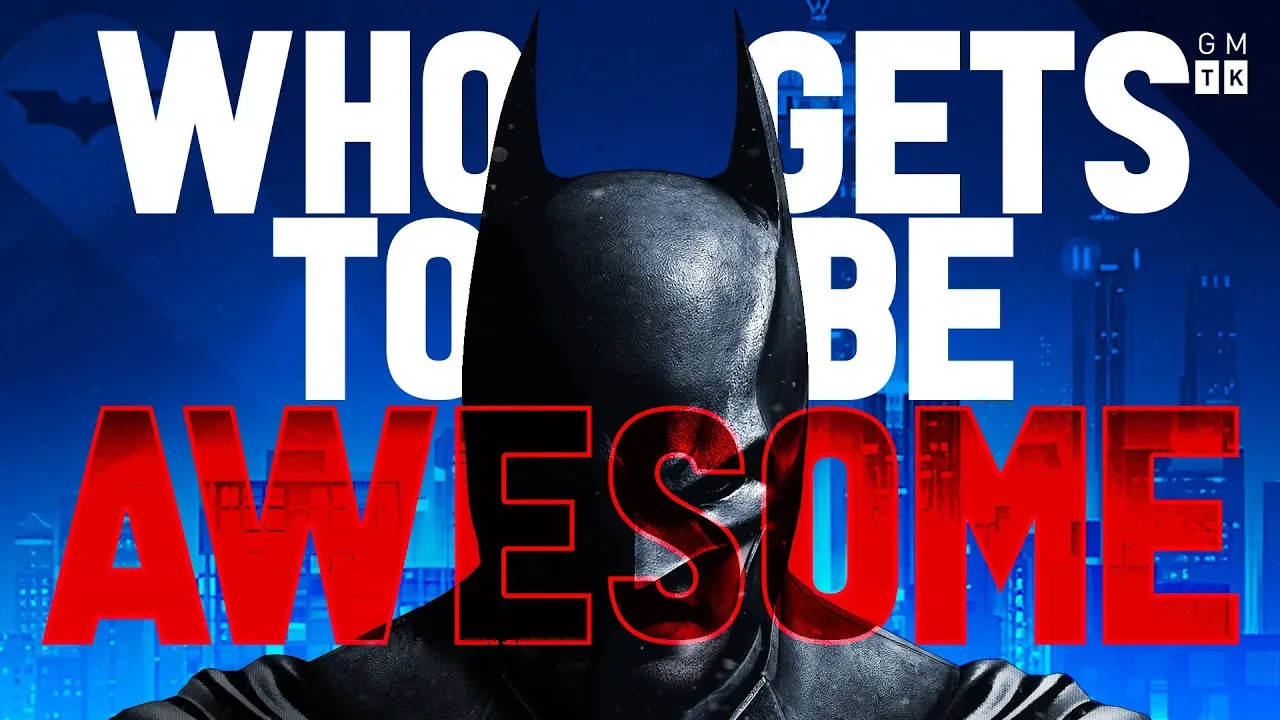
The first way is to simply give the fantasy to the player. Easily and immediately. Which is something we see in a number of recent super hero games: in the Batman Arkham games, the free-flow combat system makes it effortless to beat up baddies. And in Spider-Man, we don’t need a lengthy tutorial to swing around the city with ease and grace.
This is usually achieved by providing the sensation of being powerful, which happens through simple inputs that get translated into big, flashy animations. Cinematic set-pieces with pop-up buttons. Lenient systems that subtly fix your mistakes. Magnetic snapping towards enemies. Big, obvious indicators that tell you when to counter. Dopey AI that waits patiently to attack. And so on. These games work really hard to make you feel awesome, by translating your simple intentions into impressive feats on screen.
Troy Skinner, producer at Batman-publisher WB Games, explains it like this:
TROY SKINNER: “When people come in they spam the punch-in-the-face button. In a lot of games you get punished for that. It makes you look bad. You fail. In this game you spam the punch-in-the-face button and you look awesome! You are in fact Batman effectively punching people in the face.”
The Second Way: Earning the Fantasy
The second way is to make the player earn the fantasy. Through skill and mastery. Which is the approach of this year’s DOOM Eternal. That game has a very stiff learning curve with all sorts of mechanics and systems to figure out - including resource management, enemy weak points, weapon switching, lighting-fast movement, the flame belch, the chainsaw, the blood punch, and more. And until you master all of them, you’re going to fail - and you certainly won’t feel like the bad-ass demon slayer in the game’s marketing. Which means that the opportunity to live out the power fantasy is withheld until you’ve proven that you have real skill and mastery over a complex set of mechanics.
Hugo Martin, is the creative director on DOOM Eternal, and explains it like so:
HUGO MARTIN: “Hey man I’m dying to these characters because I’m not doing certain things. I don’t feel strong. It’s like yeah: but you’re gonna feel strong when you master how to beat them.”
Why Choose One Over the Other?
So we can give the fantasy to the player, or we can make them earn it. But why would a developer choose one over the other? Well, Hugo Martin puts it very succinctly when he says:
HUGO MARTIN: “We wanna give you something to master. Because the power fantasy that is earned is far more satisfying than the one that is just handed to you”.
By making the player actually overcome challenge, failure, and frustration, the end result will be way more rewarding. He compares the experience of mastering DOOM Eternal to that of climbing a mountain - it’s much more satisfying, he says, to climb it yourself than to simply take an elevator to the top.
It’s a fair point. And many of these superhero games do end up feeling shallow and patronising because they give the fantasy away too easily. But - when designers tie the attainment of a power fantasy to a certain level of skill - they ultimately end up having to ask who gets to live out the fantasy, and who gets left behind?
As Troy Skinner explains…
TROY SKINNER: “Because we are expert gamers, we say that mastery should come from overcoming challenge. You earn it. But remember everyone paid $60 and the majority of them aren’t going to push through those barriers to get to the mastery. And mastery is tied to motivation so if they’re not masterful, they’re demotivated, they walk away”.
He argues that there are plenty of players who simply aren’t willing to suffer through failure and frustration in order to experience the game’s core fantasy. For example, Troy points to the bro gamer - casual players who have a very low threshold for suffering and want to feel competent immediately. And because they make up 60% of the console market, you ignore them at a cost.
More importantly, however, there are players who simply aren’t able to reach that level. In the book Glued to Games, behavioural scientist Scott Rigby talks about “control mastery” - which is the time and energy needed to learn a game’s inputs and be able to turn intention into action. He compares this to to paying for admission to get into a theme park: both are necessary steps in order to access the actual fun inside.
But, Scott says, “when people are discouraged by a game’s controls, they don’t have the chance to feel competent at gameplay, because they can’t even get to the real game. For them, the price of admission to the fun of games is so high, they often stay outside the turnstile”.
And that’s not even mentioning those with disabilities who may be physically unable to reach that level of skill. Shouldn’t they get to experience the power fantasy, too?
Ultimately, then, we end up with a conundrum. If we make the power fantasy easily attainable, the game is accessible to all but can end up feeling shallow to more seasoned players. And if we force the player to earn the fantasy, the experience might be significantly more satisfying - but we lock out a considerable number of people. By making one type of player feel awesome, we lose the other.
But, maybe, it doesn’t have to be a choice. And so, I’m going to explore a number of ways that games can make both types of player feel awesome.
Solution One: Provide Options
The first solution is to provide options. But not the type you might be thinking about. Because, yes, difficulty options will allow players to tune the game to their ability level. But they rarely fix the actual issue: the inherent complexity of the game. Making DOOM Eternal easier will let you make a few more mistakes, but it doesn’t reduce the number of buttons you need to remember - and making Spider-Man harder doesn’t actually change the web-swinging at all.
So more important are gameplay and accessibility options. And for a strong example, take Forza Horizon 4. Here, you can enable things like assisted brakes and steering, automated gear shifting, and a racing line. With these options turned on, the game helps players reach the fantasy of being a racing driver - by reducing the need for precision, limiting the number of things you need to juggle, and providing lots of information. With these options, you can essentially switch the game from being a rather hardcore simulation racer to a fun and casual arcade romp. And best of all, this is all independent from the difficulty level of your rival racers - so you can reduce the complexity of controlling the car, but without also dumbing down the competition.
Other examples of gameplay options include the automatic combo mode in Devil May Cry, the way Jedi Fallen Order makes parry timing windows bigger on easy mode, and how some of the Arkham games let you turn off those counter indicators so you have to pay attention to the enemy animations.
Solution Two: Reward Mastery, But Don’t Require It
A second solution is to reward mastery - but not actually require it. For this one, let’s look at Bayonetta. This is a game where you almost immediately feel empowered and awesome: thanks to great animation, absurd finishing moves, a very forgiving dodge, and a reasonably low level of challenge. You can basically just mash the controller against your face and Bayonetta will pull off a huge variety of awesome-looking attacks. It’s easy to feel fluid, cool, and competent in this game.
But there’s so much hidden mastery in this game for those who are willing to put in the work. Things like the dodge offset system, and the huge number of possible moves - means that those who want to get combo mad can express their skill and mastery. That ends up being the real power fantasy which is, indeed, more satisfying… because it’s earned.
If we think about this by borrowing terms from e-sports: there’s skill floor, which describes the base-line level of skill needed to be effective with that character. And skill ceiling, which describes the highest level of skill you can potentially express. If Spider-Man has a low skill floor, but low skill ceiling - and DOOM Eternal has a high skill ceiling and a high skill floor to match, something like Bayonetta strikes a better balance by having a low skill floor and a high skill ceiling.
Solution Three: Layer On Complexity Over Time
Solution three is to layer on complexity over time. In a lot of Metroidvanias, such as the Ori games, you start the game with a very simple set of controls. You can really just focus on movement and jumping, so players who are unfamiliar with platformers only need to wrestle with the absolute basics at this point.
As you play on, the game gives you upgrades - like additional jumps, new attacks, more complex moves, and so on. By the end of the game, Ori has become a complex game with a huge moveset: but without overwhelming anyone in the process. By stretching the learning curve out to encompass pretty much the entire game, players can gradually get used to more and more complex gameplay.
We do see some of this in DOOM Eternal, with weapons and enemy types being introduced throughout the campaign. And in Spider-Man, where the skill tree lets you add new mechanics that let you swing faster - but also increase the complexity of the controls.
Solution Four: Prime Players for Failure and Learning
Solution four is to simply prime players for failure and learning through the narrative and marketing. One of the issues with DOOM Eternal is that the game suggests that you are the most powerful, demon slaying bad-ass in the universe. I mean, you just ripped your way through hell in the previous game. And now, you’re falling at the feet of the game’s most basic demons?
Ultimately, when games promise to let you play as Batman or Spider-Man, or the Dragon of Dojima, or the God of War it’s priming us to be powerful and skilful: and so it does make sense that we immediately get to feel awesome. Anything else would just be discordant.
And so if a game wants to make us earn the fantasy, it needs to explain that up front. A good example of this is Skate: a skateboard simulation game with a significant learning curve just to do a kickflip. But it doesn’t suggest that you’ll immediately start playing as a pro skater - instead, you’re just a lowly amateur trying to get their photo on the 37th page of a magazine. The game’s narrative - which is about slowly becoming more successful as a skater, neatly mirrors the game’s challenging learning curve.
Solution Five: Provide Multiple Ways to Win
And finally, solution five, is to provide multiple ways to win. I’ve been playing a lot of Hades lately. And in each run of this mythological roguelite, you pick a weapon - perhaps a sword, or maybe a bow and arrow. Some of these weapons are far easier to use than others: the shield, for example, lets you absorb enemy attacks and play in a very defensive and reactionary manner. Whereas the fists force you to get up close and personal with your enemies, which puts you at a significant risk. By having different ways to succeed, players can gravitate towards the weapon, the character, or the build - that works for them.
Hades also lets you unlock additional power, health, and help - so it’s possible to succeed not by getting better - but by simply playing the game for a long time. That’s not my personal preference for how roguelikes should work: but I can see the advantage in giving players a different way to succeed. Through time and effort, rather than skill and mastery.
Conclusion: Everyone Gets to Be Powerful
Most of these solutions are about the same exact thing: letting players find their own way to feel powerful. That might mean using accessibility options and tuning down the difficulty, or it might mean ramping the game up to hard, playing with the most challenging character, and exploring the game’s most complex rules. Both of those might be the optimum challenge for two completely different people.
And something else that a lot of these solutions have in common is that they encourage players to always be pushing themselves to be better. To be moving towards more challenging and complex gameplay. In Forza, using those assist options reduces the amount of XP you gain, so you’re encouraged to eventually turn them off as you get better at the game. In Bayonetta, scrappy play leads to rubbish trophies, so you’re motivated to be more thoughtful with your actions. In Hades, there are rewards for trying out weapons you haven’t used in a while. And in Ori, the game just naturally gets more complex, the further you go.
Because the power fantasy, it turns out, is not one specific point on the learning curve: it’s something more dynamic, that can move and grow as you do. You might feel the power fantasy immediately, and then feel it even more strongly as you challenge yourself to do better, to explore more of the game’s systems, and to increase the challenge of the game.
So ultimately, if the question is: who gets to be powerful? My answer would be: everyone. Not just those who are skilful. And not just those who want to feel immediate empowerment. But games should use design and systems to ensure that at every skill level, the player feels powerful and masterful. But always with room to grow and improve.