The search term “Aztec religion” will reveal dozens of bloody pictures: dismembered bodies, hearts carved out of the chests of human sacrificial victims, their blood spilling down pyramids like a waterfall. For many modern readers, human sacrifice is the defining feature of Aztec religion. And the Aztecs did practice human sacrifice, a lot of it, as did other ancient Mesoamerican cultures. But no religion can be understood through one ritual. So, what do we know about Aztec religion? And why did they practice human sacrifice?
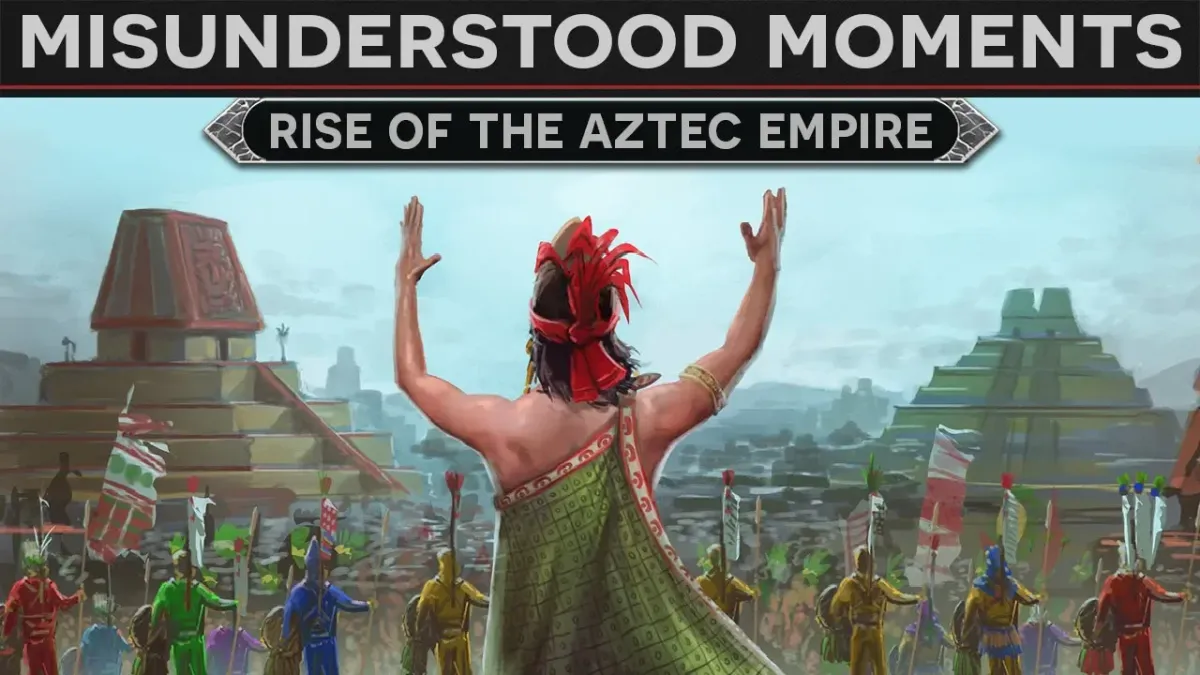
When modern scholars say Aztec Empire, they’re usually referring to a political entity living in the central Mexican highlands from around 1300 to the 1500s. Aztec is actually a name introduced by modern historians in about the 1800s, based on their semi-mythical homeland, Aztlan. These people did not call themselves Aztecs. The Aztecs were an alliance of three indigenous people groups: the Acolhua, the Tepanec, and the Mexica. And when we talk about Aztecs, we’re generally referring to that last group, the Mexica, because they were the dominant group living in the capital city, Tenochtitlan, a huge city on an island in the middle of Lake Texcoco, which over the centuries dried up and is now occupied by Mexico City.
These indigenous ethnic groups making up the Aztec Empire spoke the Nahuatl language, which is why many scholars today prefer to use the term Nahua to describe all of these Nahuatl-speaking ethnic groups. And to be clear, Nahuas still exist today. Contemporary Nahua religion is heavily influenced by Catholicism, but they still practice indigenous religious expressions that deserve their own article. But in this article, I’ll be focusing primarily on the Mexica when they ruled the Valley of Mexico roughly between 1300 to 1521, when it fell to Spanish invaders.
Much of what we know about Aztec religion comes from 16th century Spanish sources like those composed by Bernardino de Sahagún, a Franciscan friar and missionary who wrote huge studies on Aztec culture while living in Mexico. His work, the Florentine Codex, is an important ethnographic study based on reports from native informants and includes a bunch of illustrations made by indigenous artists. If you’ve done even a brief study into the Aztecs, you’ve almost certainly seen some of the images from the Florentine Codex. But as important as these studies are, we need to realize that all of the information is being filtered through a European and Christian lens.
Another caveat is that much of what we know about Aztec religion could technically be called Aztec state religion, the religious expressions mandated and upheld by the ruling elite of Tenochtitlan. We know very little about Aztec domestic religion or folk religion, the type of religion I typically research. So, to be accurate, most of this article focuses on the large-scale state religion of the Mexica, or what the scholar of Mesoamerican religion, David Carrasco, calls the mystical military religion of the Aztec warrior class. This includes the sacrifices conducted by elite priests at their temples and the mythology recorded by their educated nobility. So keep in mind while reading this article that we are examining a relatively narrow slice of time, a relatively narrow slice of Aztec society filtered through the lens of Catholic writers like Bernardino de Sahagún.
With all of those caveats, let’s get into it.
Aztec Gods and Cosmic Cycles
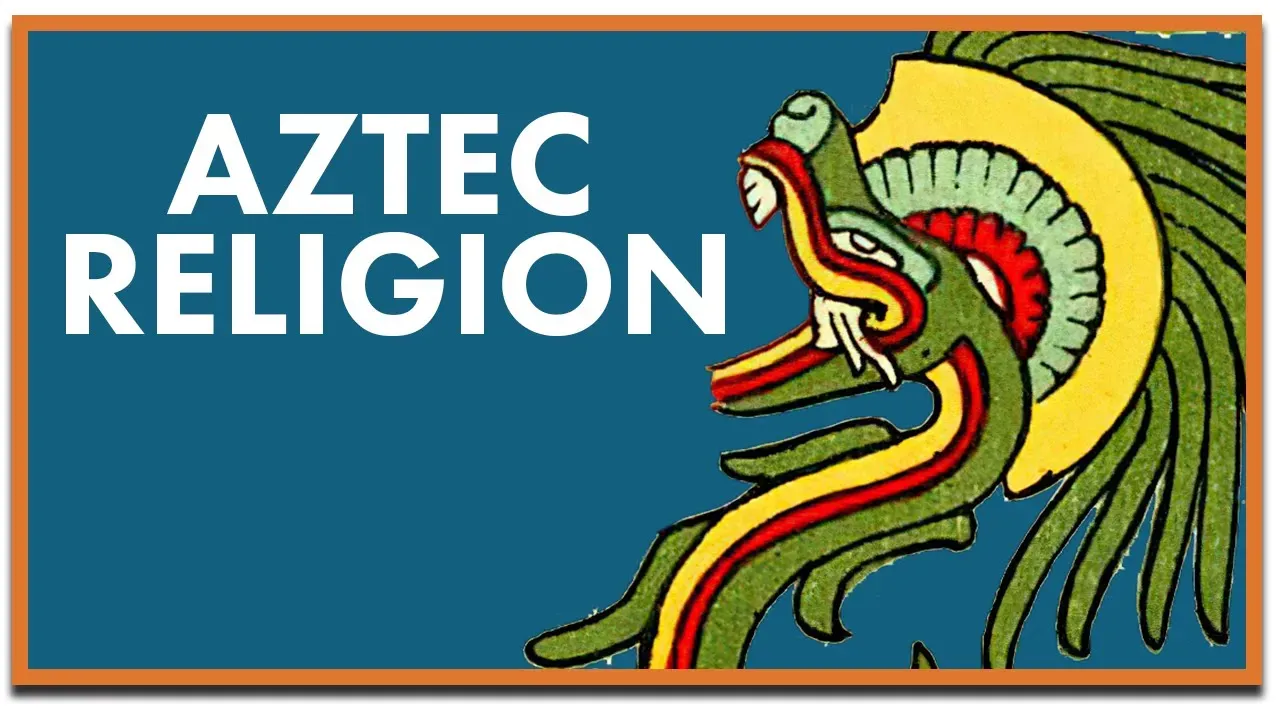
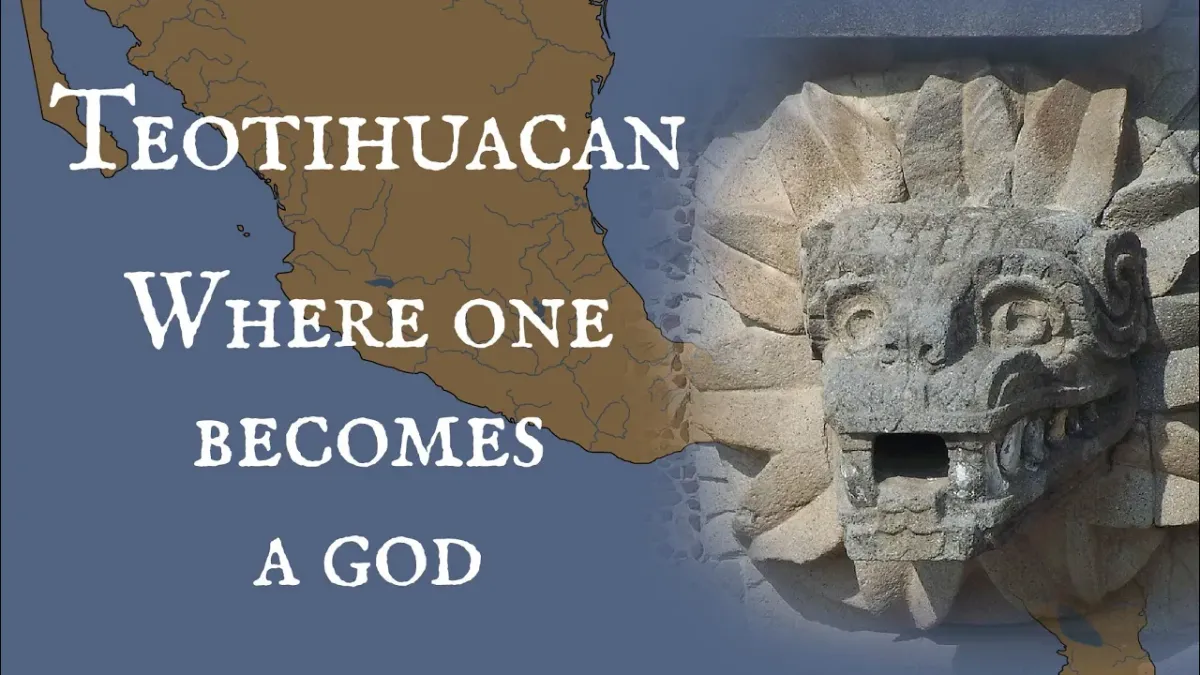
Aztec religion was polytheistic. There are way too many gods in the Aztec pantheon to cover thoroughly in this article—as many as 200 according to some sources—but we’ll focus on a few major ones. The scholar H.B. Nicholson argues that the Aztec gods can be categorized into three loose clusters. First, what he calls celestial creativity/divine paternalism gods. This would include the divine couple that created the universe, sometimes conceptualized as a dual supreme god called Ometeotl. The second category of gods is rain and agricultural fertility, which includes most importantly the rain god Tlaloc. The third is war, sacrifice, nourishment of the sun and the earth gods, which includes the feathered serpent Quetzalcoatl, underworld gods like Mictlantecuhtli, and Huitzilopochtli, who was basically the Aztec patron god. Aztec lore remembers him as the one to lead the Aztecs from their homeland to Tenochtitlan. Quetzalcoatl is known from other Mesoamerican religions, including Mayan and Toltec.
So what do I mean by war, sacrifice, nourishment of the sun and the earth gods? The Aztecs believed that the universe throughout cosmic history had passed through four ages, each time ending in the collapse and recreation of the cosmos. An amazing archaeological discovery, a massive Aztec sunstone, depicts these four ages. It dates to the early 1500s, right before the Spanish arrival, and had been buried in Tenochtitlan after the city fell before being discovered a few hundred years later in 1790. In the center is the sun god Tonatiuh, who presides over the fifth age, and around him are four boxes depicting the four previous ages.
We now live in the fifth age, which needs to be maintained and stabilized by nourishing the sun, earth, and rain via rituals such as processions, fasting, purification, dressing in costume as the gods, and famously practicing blood sacrifices, which we’ll return to later. The Aztecs also followed a 365-day solar cycle and a 260-day ritual cycle. These two calendars aligned every 52 years, at which time they celebrated the New Fire ceremony to renew the cosmos, which involved destroying their household goods and extinguishing all fires before lighting a new fire on a sacrificed victim. So this category of war, sacrifice, and nourishment gods reflects this Aztec vision of the cosmos and the associated rituals performed to maintain the cosmos during the fifth age.
The Fluid Identities of the Gods
Okay, so those are the three main categories in the Aztec pantheon. But even these categories are too simplistic. Some scholars might even say misleading. See, we’re very accustomed to talking about gods as specific persons with discrete powers, domains, or attributes, partially because Western pop culture feeds us a lot of stereotypes about the Norse and Greek gods. Everyone knows Thor. He’s the god of thunder. Ares, he’s the god of war. Specific human-like beings with specific domains: thunder and war. But this is not necessarily the most accurate way to talk about Aztec gods.
The identities of Aztec gods, their functions, and their attributes were fluid. We see this in the Nahuatl word teotl, which is translated as “god.” We have already seen this word in the names of certain Aztec gods like Ometeotl, the dual creator god. But teotl can also be translated as “sacred power.” Because of this, some scholars of Aztec religion argue that we shouldn’t even categorize these gods as personalities, but more in a pantheistic sense: gods are forces and powers moving through the cosmos rather than discrete personalities.
So, let’s take Tlaloc as an example. Sure, he is associated with rain and storms, but it would be way too simplistic to call him the god of rain. We could also say he is the force or power manifested in things associated with rain, like moisture, fertility, or the destruction caused by storms. Related to this, yes, we could say that Quetzalcoatl appears as a feathered serpent, but his identity sometimes blends in with Ometeotl as a creator god. Quetzalcoatl also appears in the persona of the wind god, whose persona also blends in with Tlaloc. Quetzalcoatl also appears as human wisdom and skill and in the night sky as the planet Venus. So we can see that Aztec gods had multiple aspects that, according to the scholar Isabel Laack, blend into each other and defy any clear identification.
Gods could also take the form of humans in the ritual of deity impersonation. Some Aztec rituals involved humans impersonating a god by dressing in costume. But as David Carrasco argues, deity impersonation was not like pretending to be a god in a Shakespearean play. The Aztecs believed that the person actually became the god.
The Aztec pantheon was also very adaptive. When they would conquer a village, they would take the statue of the village god and store it in one of their temples, which scholars interpret as the Mexica constantly adding new gods to their pantheon. After the Spaniards conquered the region and started forcibly converting the indigenous people to Catholicism, many Nahua people adapted the new religion to their cultural frame of reference, referring to Saint Mary and Saint Anne by indigenous mother goddess names. It seems that gods gained or lost popularity over the centuries too, probably tied to the ebb and flow of political change.
So, for example, right before the Spanish invasion, Aztec state-sponsored rituals revolved around Huitzilopochtli and Tlaloc. These two gods were enshrined in temples on top of a huge 90-foot-tall pyramid-shaped building in the center of Tenochtitlan, now called the Great Aztec Temple or the Templo Mayor. (An artist’s representation of the Templo Mayor based on historical descriptions is shown.) And although it was destroyed following the Spanish conquest, you can still see the foundations preserved. Archaeologists have discovered similar dual-staircase temples in other major Aztec cities.
The Templo Mayor symbolizes one of the greatest myths associated with Huitzilopochtli. According to Aztec mythology, when he was still in his mother’s womb, his sister Coyolxauhqui tried to attack his mom in league with her 400 brothers. But as soon as Coyolxauhqui attacked, Huitzilopochtli emerged from the womb, armed for battle to defend his mother. According to the myth, he killed Coyolxauhqui, decapitated her, and then threw her down Mount Coatepec, Serpent Mountain, her body breaking apart at the bottom.
In 1978, while digging at the foot of the staircase leading up to Huitzilopochtli’s shrine, electrical workers discovered a huge monolithic stone depicting Coyolxauhqui, decapitated and dismembered. Chemical analysis has revealed it was painted something like this, with Coyolxauhqui in a pool of blood. This huge monolith of the dismembered Coyolxauhqui, situated at the base of the stairs leading to Huitzilopochtli’s temple, seems to reflect this myth, symbolically transforming the staircase below his shrine into the slopes of Serpent Mountain itself. And sure enough, the Aztecs called this temple Coatepec, and to this day we can see stone serpents built into the stairways’ base. Thus, the temple was an axis mundi, the center of the Aztec’s world and mythology.
The Sacred Human Body and Human Sacrifice
So, now that we’ve talked about the gods or divine forces in the Aztec pantheon, what about humans? According to David Carrasco, one of the most pervasive notions in Aztec religion is the sacrality of the human body and its potential to return its energy to the cosmos.
What does he mean by the energy of the human body? Well, the Aztecs believed that the human body was a sacred reservoir of divine forces called tonalli and teyolia. Tonalli was an energy or gaseous substance that the Aztecs thought resided in the head and hair. They believed the creator god Ometeotl sends it into the head of a fetus while in utero. Tonalli derives from the verb “to make warm with the sun” or “to irradiate,” and the Aztecs associated it with warmth as well as solar heat. Tonalli was also responsible for your body’s strength and health, which is why Aztec warriors are portrayed grasping prisoners of war by their hair, literally holding the person’s reservoir of vigor and strength.
Teyolia, on the other hand, was thought to reside in the human heart and is tied to human reasoning, perception, and understanding. Scholars describe this like a divine fire, a divine spark, or light matter, a force that was particularly strong in priests and people close to the gods. When a person dies, their teyolia leaves the body. And when a warrior dies, their teyolia rises to the sun. Both of these powers were thought to permeate and saturate reality. They were not just housed in the human body but resided in nature, like mountains and lakes, as well as temples, animals, plants, and objects.
So to summarize, the Aztecs viewed the human body as a composite of forces or energies literally residing in the body. We’ve also learned about Aztec cosmology: the universe is cyclical, going through phases of cataclysm and renewal. So now that we know about these two concepts, let’s turn to the infamous ritual of human sacrifice, which Isabel Laack calls a form of energy recycling, a way to nourish the gods with energy that the human body provided.
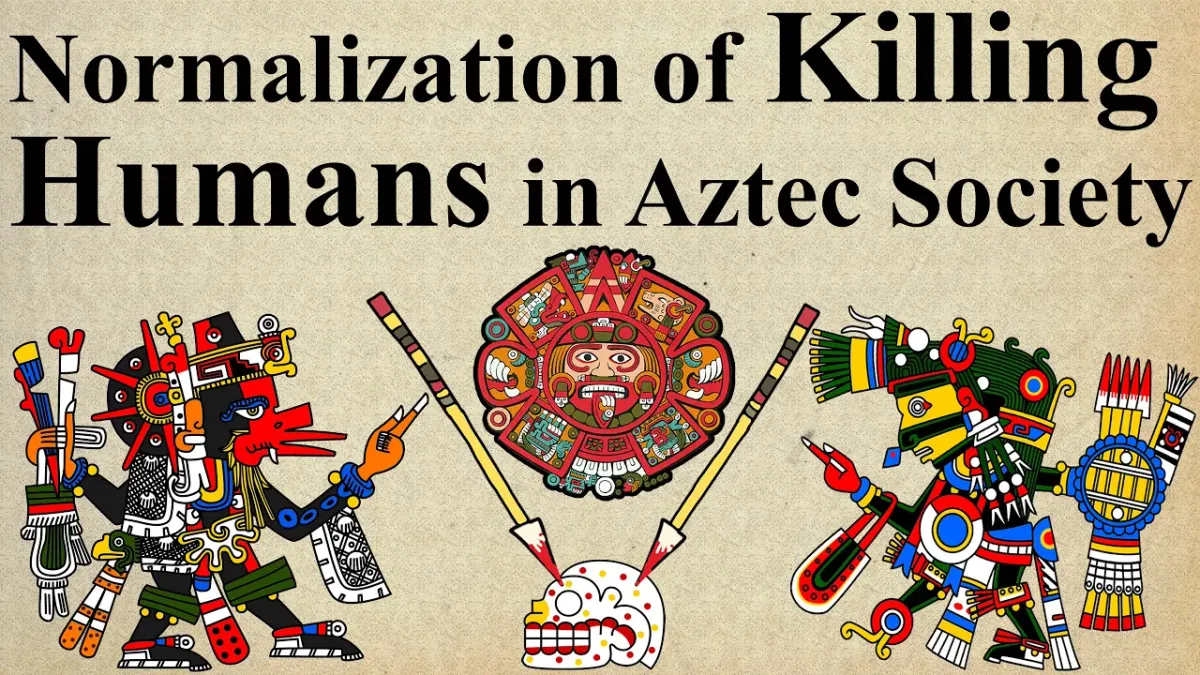
Human sacrifice was widely practiced in Mesoamerica, but seems to have increased in popularity between the 12th and 16th centuries among the Aztecs. As David Carrasco says, human sacrifice was not a random or occasional ritual. It was practiced every single month. Scholars estimate that around 20,000 people were sacrificed per year. But these rituals were not all the same. There were upwards of 18 different ceremonies that involved human sacrifice, sometimes involving elite nobles eating the flesh of the sacrificed victims. According to the Spanish soldier Bernal Díaz, who was part of Hernando Cortés’s army, some sacrifices mimicked the dismemberment of Coyolxauhqui, with the victim having their arms and thighs cut off.
But the most famous sacrifice was practiced during the yearly festival of Toxcatl, which celebrated one of the creator gods, Tezcatlipoca, the Lord of the Smoking Mirror. This was a god-impersonating festival. The priests chose a young captured warrior who needed to be in perfect physical condition. They dressed him as an impersonator of the god and made him live among the people for a year. Then, after one year, the god impersonator was sacrificed at the temple. The priest would cut out his heart and display his skull on a rack, which not only is depicted in a 16th century codex but has also been discovered in recent years by archaeologists. While excavating at the Templo Mayor in Mexico City, archaeologists found hundreds of skulls perforated on the sides, direct evidence of the skull rack. 75% of the skulls were from men between the ages 20 and 35, but 20% were also from women too.
Remember the importance of the head and the heart. The head functioned as the reservoir of the divine force tonalli, while the heart was the reservoir of teyolia, which they believed to rise up and replenish the sun after a warrior dies. Also keep in mind that the Aztecs believed that humans impersonating a god literally became the god. So during that year, the god Tezcatlipoca was thought to literally live among the people and was literally sacrificed as a god.
Scholars have offered many different interpretations of Aztec human sacrifice over the years, often viewing it through a political lens as an institution that the elites of the empire upheld to exert power. So, because the Aztecs frequently sacrificed prisoners of war, some scholars tie the practice to an expansionist imperial ideology, a warning to conquered neighbors or to intimidate rivals. Sahagún reports that rulers and nobles from neighboring cities were summoned to witness the rituals. So we can imagine the political ramifications of witnessing these rites. Others, like the archaeologist Michael Smith, suggest that human sacrifice was a form of propaganda by terror: public spectacles that intended to terrify the people and warn them against any sort of social unrest against the ruling elite. Still others view it as a form of civic religion, a form of social cohesion in urban centers, as the common folk frequently participated in the ritual itself by preparing the victims for sacrifice.
How to Think About the Unthinkable
How then shall we begin to think about Aztec human sacrifice as students of religion? 40 years ago, the scholar of religion, Dr. Jonathan Z. Smith, asked the exact same question, but for another ugly chapter in the history of religions: the Jonestown massacre. On November 18, 1978, Jim Jones, the leader of the religious movement the People’s Temple, coerced over 900 members at gunpoint to drink a fruit drink laced with cyanide. Today, this massacre is the inspiration behind the famous phrase “drinking the Kool-Aid.”
When Smith wrote his article in 1982, only four years after the event, he noticed that no scholar of religion was trying to make sense of it. They were ignoring it. But Smith thought that this was abdicating the responsibility of religious studies academics. Even though this event was so heinous, so vile, he asked, “How then shall we begin to think about Jonestown as students of religion?” He argued that we need to banish the idea that Jonestown is too exotic for us to understand. Banish the idea that it’s too exotic, that we must simply condemn it without trying to understand it. We must be able to declare that Jonestown on November 18th, 1978 was an instance of something known or something we have seen before. In other words, quoting the Roman playwright Terence, “I am human, and I think nothing human is alien to me.”
So, in an effort to make sense of the Jonestown massacre, Jonathan Z. Smith spends the rest of the article analyzing the movement’s leader, Jim Jones, putting him in the context of charismatic and manipulative leaders of the past who had utopian visions of the future.
I was trying to channel my inner Jonathan Z. Smith in this article by starting with Aztec cosmology, then moving to Aztec mystical human anatomy before finally moving to human sacrifice. I was trying to make the unfamiliar familiar, placing the ritual in the context of world renewal ceremonies as well as in the context of political and military control.
Reinterpreting Aztec Culture Today
But let’s turn to David Carrasco’s perspective. As a Mexican-American scholar of Mesoamerican history, David Carrasco has been very open about what he calls “Aztec moments”: moments when he remembered his native roots, that the indigenous people of Mexico, including the Aztecs, are part of his cultural history. In his book Mesoamerican Religions, Carrasco writes that his first Aztec moment came when he was 13 years old living in Mexico City. He visited the Museum of Anthropology and was mesmerized by looking at Mayan jade. Dumbfounded by the huge Aztec calendar stone, he writes, “My feelings continued to grow. I became aware of a sharp inner conflict. I was feeling both a cutting shame and intense pride in my Mexican ancestry.” Having spent time in the United States before moving to Mexico, he was very accustomed to how American schools praise and romanticize the Greeks and the Romans. Our buildings look like Greek temples. Latin is inscribed on their walls. The ancient Greeks are praised as the founders of democracy and directly linked to American democracy. Mexico, on the other hand, in his words, was a country valued mainly for its defeats, jokes, folklore, and tasty food, but not for its civilization.
But in the midst of these Aztec moments, Carrasco also recognized the importance of studying the Aztecs. Just like the Egyptians and the Romans, the Aztecs had artists, philosophers, kings, and architects who produced complex calendars, monumental architecture, artwork, and literature that Carrasco argues deserves to be counted among the great literature of the world. At the end of his introduction to the Aztecs, Carrasco strikes a positive tone. Despite the Aztec history of conquest and sacrifice, Carrasco sees that people today are reinterpreting pre-Columbian indigenous culture in the 21st century, especially in festivals like Día de los Muertos in Mexico.

.ArszxDzl_2rQOHK.webp)