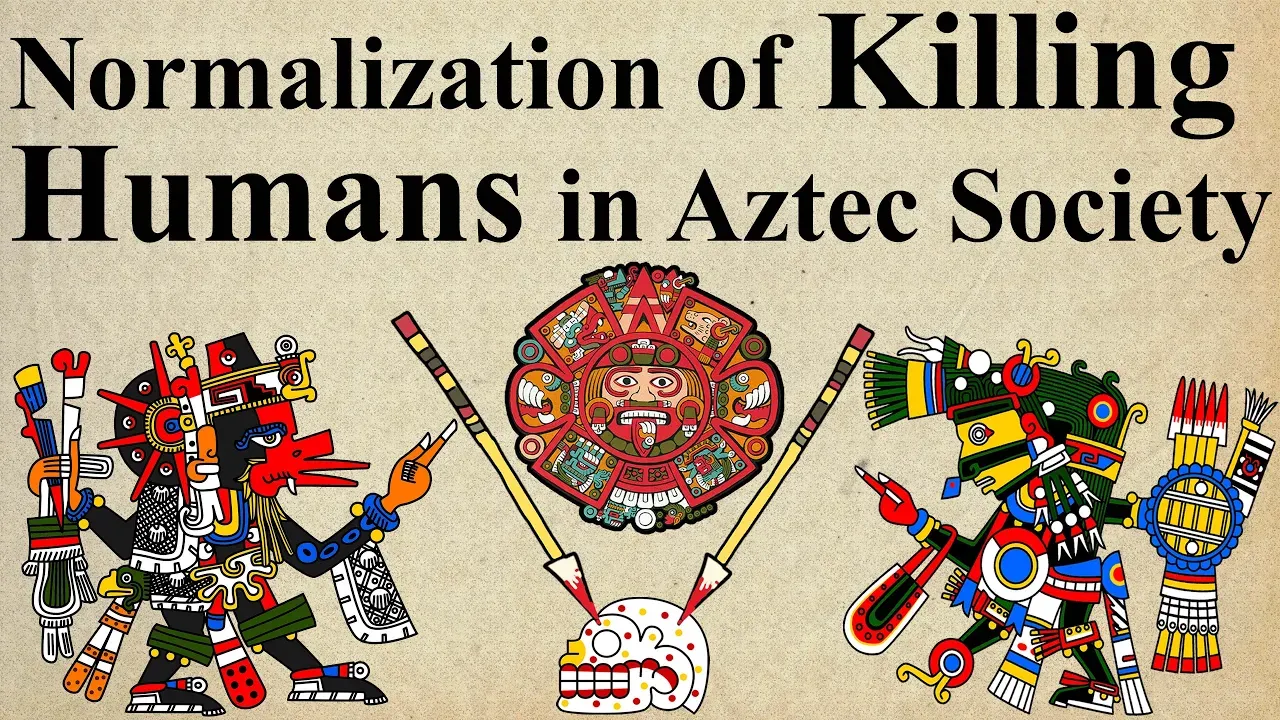
In almost every corner of the world human sacrifices, mostly based on religion, did happen at some point in history. The most treasured thing a human can give up is his life and, therefore, in the eyes of many throughout history human sacrifice is the most valuable sacrifice someone can offer to a god or gods. However, despite the fact that human sacrifices did happen at some point throughout history all across the world, no culture brought the act of human sacrifices to such a large extent as the Aztecs did.
The Aztecs were a pre-Columbian civilization living in today’s central Mexico. The word Aztec is misleading as it can refer to multiplicities of peoples and polities but when people use it today they mostly just mean the Mexica people whose capital was the city of Tenochtitlan. The Mexica, by the time of the early 16th century, when Cortes arrived to Mexico, where the hegemon of a triple alliance that ruled over a large polity we today call the Aztec Empire. Therefore, we often use the words Aztec and Mexica as interchangeable even though they’re really not.
The word Aztec can refer to many different people groups like, for example, everyone within the Aztec empire, or everyone who spoke the Nahuatl language, or everyone pertaining to the tribes that migrated from the north to central Mexico of whom the Mexica people were just one tribe. Due to this ambiguous definition of the word Aztec, it is important to more specifically define the words that I will use in this article. I will use the word Mexica to refer to the people from Tenochtitlan who ruled over what we call the Aztec Empire. I will use the word Aztec as a catch all word for the religion, because that’s what we call it today, the “Aztec Religion”, and also, I will use the word to refer to the polity of the Aztec Empire as a whole and the people within it, even though keep in mind some of these people were not always happy to be in the empire and they often saw themselves as different from the ruling Mexica.
Lastly I’ll use the word Nahua to refer to all the speakers of the Nahuatl language, of whom the Mexica were just one peoples. Also to confuse things even more the Aztec empire didn’t only have Nahuatl speakers within it and not all Nahuatl speakers were within the Aztec Empire. Therefore, if I want to talk about everyone who lived in pre-columbian Central Mexico, I’ll just say people in Central Mexico. I know it all sounds very confusing right now but pre-columbian Central Mexico was anything but simple.
So, to understand how a civilized society could create an institution so prevalent with human sacrifices, we must first understand the religion that often drove the Mexica’s, and other central Mexican people’s, need for human sacrifices.
Due to the often dubious nature of sources we have about the Aztec Empire, its people, and their religion, there are multiple versions of various religious myths including the creation myth. It is also probable that the people living in Central Mexico, who largely shared their religious beliefs with the Mexica, had all slightly different versions of gods, myths, and rituals. Such a thing is not unusual for polythiestic religions and we see a similar thing in ancient Greece for example. With that said, there are two main Aztec creation myths. I will present one of them here and you can watch the other in this Ted-ed video.
The people of central Mexico believed they lived in the time of the fifth iteration of the sun; every previous iteration of the sun ended by the destruction of the sun and the human race. The humans that are alive now, in the fifth iteration, were created by the god Quetzalcoatl. He used the bones of the humans who lived during the fourth iteration of the sun and his own blood to create the current humans. The fifth sun itself was created by the god Huitzilopochtli who sacrificed himself to become the sun so he could nourish the world. However, Huitzilopochtli’s sister Coyolxauhqui, the goddess of the moon, hated Huitzilopochtli, and wanted to destroy him. As such every night when the moon rises, trying to destroy the sun, Huitzilopochtli fights off his sister, ultimately winning and creating the next day. With that said, Huitzilopochtli needs the help of humans, through the means of human sacrifices, auto-sacrifice, and religious rituals, to keep successfully fighting off his sister every night.
Whether you choose to go with this creation myth or the other one I already mentioned or with the myriad of other variations on these two creation myths, it doesn’t really matter, as all of them have certain central themes that don’t change. Same goes for the Aztec religion as a whole. There might be sources with different variations on myths and gods but the main themes largely remain the same. These main themes being;
The gods used their own blood to create humans in one way or another and, therefore, the humans are indebted by blood to the gods.
The sun needs human sacrifices so that there is a next day. (this does not, however, mean there has to be a sacrifice for each new day, it’s not like a daily payment or something)
Human sacrifice is the most venerated way to show proper honor to the gods and, therefore, if you want something very important from them, like for example rain for the crops from Tlaloc the god of water, you have to give him a human sacrifice.
If there are no human sacrifices and no proper honor is shown to the gods not only will the sun lose to the moon but also the humans will be destroyed. This, for example, happened in the second iteration of the sun when Tezcatlipoca, the god of rulers, priests and war, was disgusted by the impiety of the humans and turned them all into monkeys.
These main factors of the Aztec religion created the bases upon which the Central Mexican societies built their institution that normalized the killing of humans.
Majority of people today, when someone talks about the quote-unquote “Aztec sacrifices”, picture the most common type of sacrifice, and that is the cutting out of the heart and presenting it to the gods. However, in reality, there were many different sacrificial rituals. Some involved drowning, others burning or forced starvation and some even involved elaborate ritualistic enacting of a predetermined battle where the unarmed sacrificial victim was killed by several heavily armed soldiers. Plus, different gods and festivals along with different circumstances like a drought or flooding required different rituals. The victims of these rituals also varied, most numerous were enemies captured in a war, but slaves, regular citizens and even sometimes noblemen were also sacrificed in certain circumstances. The age and gender of the victims also mattered as, for example, Tlaloc, the god of rain and water, required child sacrifices for the rains to come, while Toci, the mother goddess, required a female sacrifice.
Before I mention any details about the quote-unquote “Aztec human sacrifices”, what must be said is that, unless directly specified, I am not only talking about the Mexica here. Yes, many of the sources that talk about sacrifices in detail are about the Mexica but my presentation of an “Aztec human sacrifice” is a general overview of the type of sacrifice that was conducted, as far as we know, in most of late pre-Columbian central Mexico. We know from some sources that the various Nahuas and other peoples of Central Mexico did share very similar religious beliefs, customs, and did conduct similar human sacrifices, as one Nahua put it, “Before them (the gods), we kiss the ground, we bleed. We pay our debts to the gods, offer incense, make human sacrifices … We live by the grace of the gods.” Therefore, it would be reasonable to think that the details we have about the Mexica human sacrifices are similar to that of the sacrifices conducted by other Nahuas and Central Mexican peoples. Especially when it comes to the most common type of sacrifice, the extraction of the heart.
So, imagine you’re a warrior captured in a battle by the enemy who promptly brought you to their city temple to sacrifice you. This is not unusual. In fact, the society you live in has created a system of ritualistic wars, called the flower wars, one of the purposes of which was to capture enemy soldiers for sacrifices. The battles of these flower wars occurred on predetermined plains with predetermined army sizes. The point of the battle wasn’t to kill the enemy but to capture as many enemies as you can so that you can sacrifice them in your city temple. People would still die during these battles but not as many as in an actual war.
By the way, a bit of a side note, the Mexica, and other central Mexican peoples, could also wage normal war. There’s a common misconception that when the Spanish arrived the Mexica lost so easily to them because they tried to fight them in the style of the flower war and tried to capture them rather than killing them, but that’s not true. The Mexica were fully capable of waging a quote-unquote “ordinary war of conquest”. Of course, when possible, they would capture some enemies for sacrifices but that wasn’t their goal. Their goal was to win, and as Ross Hassig states in his book Aztec Warfare, “As demonstrated by the use of ambushes, circumvention of battling armies, and firing of enemy temples [and cities], the Aztec (Mexica) leadership was not overly concerned with how victories were won in wars of conquest”. If needed for victory, the Mexica were not against employing the tactics of a total war.
Anyways, back to sacrificing you. You go through a series of rituals and cleansing to prepare you to be sacrificed, after which you’re taken to the foot of the temple. As you’re waiting at the foot of the pyramid, you’re not there alone. Depending what deity you’re being sacrificed for or during which type of ceremony you’re being sacrificed, there could be any number of people waiting there with you. These could be other fellow warriors captured in the battle, or some slaves bought from the market, or some local citizens that were chosen to be sacrificed along with you. For now let’s say there are some local citizens there ready to be sacrificed along with you and a bunch of other captured warriors.
Some local people walk up to their fellow citizens waiting to be sacrificed and tell them their personal stories and problems and politely ask them to bring these issues up to the gods once they’re sacrificed. The citizens ready to be sacrificed listen carefully to their fellow citizens’ problems and in return are being given great praise and admiration by their peers. Being sacrificed for your city is given great honor in your society and the family you leave behind could even be able to move up social ranks thanks to your sacrifice.
With that said, you, in your current situation, are given little honor. Sure there is honor in being sacrificed but there is little honor in being sacrificed by the enemy to the enemy’s gods. However, being sacrificed is the nature of life for you. It is how it is and it has always been this; and even though there’s no honor in being sacrificed by the enemy, there is still huge dishonor in not being sacrificed when you have already been chosen and prepared to be sacrificed. Not being sacrificed at this point is worse than being sacrificed by your enemy to their gods. This is why when Cortes’ expedition freed some sacrificial victims they “indignantly rejected [the] offer of release and demanded to be sacrificed”.
As one 16th century Nahua put it “it was never found out, whether anyone of those that were chosen [to be sacrificed] had fled, for to flee seemed a thing unworthy of men that represented such great majesty as this idol, so as not to be held as cowardly and fearful with perpetual infamy, not only in this land, but also in his own, and so they wished first to die to earn eternal fame, because they held [this] to be glory and a happy end.”
However, with that said, it is also clear that not all people viewed it this way. Dying is still dying and some people did not want to die even if it brought honor to them and their family. That is why “when some captive lost his strength, fainted, only went continually throwing himself on the ground, they (the priests) just dragged him [to the altar] … But when one made an effort. . .he went strong of heart, he went shouting. He did not go downcast, he did not go spiritless; he went extolling, he went exalting his city.”
Whether you choose to go to your sacrifice at the top of the pyramid with a strong conviction and head held high, or by throwing yourself on the ground and shouting, is up to you but, it does go to show that there were people in pre-columbian central Mexican society that did not want to be sacrificed and had to be dragged to the altar unwillingly.
Nevertheless, climbing the very steep steps of the pyramid which were bloodied by the corpses of the people sacrificed before you and whose lifeless bodies were thrown down the steps next to you must have been a very daunting task even for the most devot of people.
Looking down from the pyramid you see a great gathering of people singing ritualistic songs specific to that particular sacrificial event. Many of the people in the crowd also participate in auto-sacrifice which involves the letting of blood for the gods. It must have been truly a fervent spectacle. We also know that the central mexican peoples used hallucinogenic drugs like shrooms and others and we’re pretty sure they were somehow used in ceremonies mostly by the nobility and the priests, but the exact extent of the use of drugs in sacrificial ceremonies is unknown. As one historian said “Despite claims that coercive chemicals were extensively used in Aztec culture, they are very rarely mentioned in accounts of sacrificial ceremonies” therefore, we don’t really know the extent of the use of these drugs in ceremonies.
With that said, keep in mind as you’re trying to climb the steep bloodied steps of the pyramid, with the bodies of the sacrificial victims before you falling down the steps, and the citizens behind you singing while bloodletting, you and the priest sacrificing you could also be hallucinating.
Once you make it to the top of the pyramid, one of Cortes’ conquistadors tells us the “men and women who were to be sacrificed to their gods were thrown on their backs and of their own accord remained perfectly still”. Again this probably goes back to the fact that some people went to the sacrifice with their heads held high, with no fear, with the belief that they are doing the right thing. However, there most certainly were others who had to be held down on the sacrificial stone as attested to by one source which stated that “The five priests of sacrifice followed them. They were to hold down the feet, hands and heads of the victims … Each prisoner they took to the [sacrificial] place … when they had forced him to stand upon the stone which was the figure and likeness of the sun, they threw him upon his back. One took him by the right arm, another by the left, one by his left foot, another by his right, while the fifth priest tied his neck with a cord and held him down so that he could not move.” It is clear, again, that some people had to be held down for the sacrifice as they presumably did not want to be sacrificed.
Once the heart was extracted by a priest with an extremely sharp obsidian knife it was presented to the specific idol of the god the ceremony was for and, afterwards, the heart was often burned with the ashes being kept as an important relic. The now lifeless body was then tossed down the steep steps of the pyramid and preparations were made for the next person in line to be sacrificed.
The bodies that piled up at the bottom of the pyramid where ceremoniously butchered and the various parts of the body were used in multiple ways, the skull was put on a skull rack called Tzompantli, other parts of the body were given to the zoo animals to eat, and some parts of the body, on occasion when the victim was captured in battle, were given to the warrior that captured the victim and he would ceremoniously eat it with his family.
This heart extraction sacrifice I talked about is the quote “most common type of sacrifice” and it was practiced by all the major Central Mexican peoples during the period of the Aztec Empire. The second sacrifice I am going to be talking about is, as far as we know, specific to Tenochtitlan and the Mexica people.
The preparation for this sacrificial ceremony started a year before the actual ceremony in the month of Tōxcatl, which is roughly the month of May. During this month a young male was chosen to be the impersonator of Tezcatlipoca, the god of rulers, priests, war and a bunch of other things. This chosen young man was either a slave or a war captive. Once chosen to be the impersonator, the man was taught various skills like how to play the flute, sing, and speak in the manner befitting of god. He was also painted completely black barring his eyes and adorned with precious jewellery and cotton embroidered clothes. Then, for a year, the young man would walk around the city of Tenochtitlan, playing the flute, smoking tobacco and interacting with the people as the earthly manifestation of the god Tezcatlipoca. It is said that no one could refuse the request of the impersonator and several times he would even meet with the Mexica ruler. The young man was also ritually wed to four maidens with whom he spent a lot of time.
When the year passed, on the same day in May that he was chosen to be the impersonator of Tezcatlipoca, the young man walked up the steps of the pyramid, broke his flute in half, and made preparations to be sacrificed. As always a great crowd of people would gather in front of the temple, sing songs and participate in auto-sacrifice. The priests could only sacrifice the impersonator once he gave them the approval, this way the impersonator of Tezcatlipoca chose his own time when to die. Once dead, the body of the impersonator was flayed and the flesh was distributed among the nobles of the city and eaten; his skull, as always, was put on a Tzompantli. Also during the ceremony other people and other gods’ impersonators were sacrificed, and the next year’s impersonator of Tezcatlipoca was chosen; and so the cycle continued.
As stated before, there were many other types of sacrificial ceremonies than just the two I talked about, but hopefully this closer look at these two sacrifices gave you an idea of how these ceremonies looked like.
Now that we have discussed why the sacrifices happened, and how the sacrifices happened, let’s talk about why the sacrifices happened … Yes you heard right, so far we only mentioned that the “Aztec religion created the bases upon which the Central Mexican societies built their institution that normalized the killing of humans” but religion wasn’t the only factor for why it happened, it was undoubtedly a major aspect that created the tools, the means, and the bases for sacrifices to occur but according to some historians it wasn’t the only reason.
Historians have come up with 3 ideas for why sacrifices were so prevalent in Central Mexico. One of which we already discussed, religion, but there could have also been a political and ecological aspect to it.
First, the Ecological argument. This argument focuses on the cannibalism aspect of human sacrifices and was proposed by historian Michael Harner and later revised by Marvin Harris. The main core of the argument claims that cannibalism was a dietary necessity in Central Mexico since the area lacked any kind of domesticable large herbivores. This meant that pre-columbian Central Mexican society was deficient in essential amino acids and the only way to get them was through cannibalism. This is why many of the sacrificial rituals we talked about involve some kind of cannibalism and why the religious institution that normalized the killing of humans was retained in the society.
This theory came under a lot of attack by other historians who argued that there were plenty of huntable animals in central Mexico like salamanders, fowls, armadillos, weasels, etc. and there are also accounts of the central Mexican people raising large numbers of dogs to sell and eat. Plus nutrients needed from meat could also be found in local plants like the leaves and seeds of amaranth. There is also a case to be made that the cannibalism aspect of Central Mexican sacrifices we find in the sources could be overblown due to the nature of the sources but more on the nature of the sources later in the article.
Second we’ll look at the Political argument. The political argument was championed by historians Godfrey Conrad and Arthur Demarest. This argument, rather than trying to explain the practice of human sacrifices in central Mexico as a whole, focuses more on the rulers of the Aztec Empire, the Mexica. This is because even though, as discussed, human sacrifices were prevalent in all central Mexican societies, it can be argued that the Mexica brought the scale of human sacrifice to an extent previously unseen in central Mexico. From the sources we have, it seems like the Mexica sacrificed way more people than any other central Mexican society did and they may have even used these extensive sacrifices as a scare tactic against their enemies and to keep their vassals in check.
The political explanation argues that the Mexica, when they became the hegemon of the triple alliance that formed the Aztec Empire, created an imperial cult around their patron god, Huitzilopochtli, that imposed on the Mexica the religious duty of warfare, conquest, and sacrifices. In essence, the religion of the Mexica was manipulated for political reasons to create the basis upon which the policy of imperialism could be conducted more freely and efficiently. The religion that already practiced human sacrifices, but not to such an extent, was altered to fit the political agenda of expansion and conquest. Through the religious demand for more sacrifices the Mexica could easily conduct and justify their frequent wars and subjugations which on top of expending their economic and political power also gave them a steady supply of the much needed sacrificial victims.
The political argument has also come under attack from some historians who believe it overshadows the pure religious importance of human sacrifices in the Mexica society. Herbert Burhenn states that “We are asked to accept the intensification of human sacrifice and cannibalism as rational because it led to Mexica prosperity and hegemony. The Mexica leaders were not blinded by superstition into ordering vicious and brutal acts but were rather pursuing eminently rational, if somewhat short-sighted, dictates of Realpolitik … We may be able to recognize the rational shape of the actions of Mexica leaders, but we do not know whether they considered their actions in terms of the reasons we infer.” They may just have been acting the way they did because of increasing religious fanaticism which was correlated with the expansion of the Empire but did not dictate it.
I am not convinced by the Ecological argument. I also believe religion had a very strong role to play in why, essentially, the killing of humans in a ritualistic manner was so normalized in the societies of central Mexico. However, the Aztec Empire and Central Mexico as a whole was quite a diverse place and the reasons for human sacrifices by one peoples could have been different from other peoples. All of them definitely had a religious reason but when it comes to the powerful states such as that of the Mexica I don’t think religion was the only factor that drove the sacrificial rituals. There must have been some kind of political involvement.
Lastly, I also don’t think the sacrificing of humans was as normalized in central Mexican society as much as we may think it was. On top of the sources mentioning that being sacrificed was an honor, something a person would want to do, there are also snipits showing that some people did not want to be sacrificed as I have demonstrated when talking about the specific rituals. There are also hints in the mythology that not everyone in the Central Mexican society were happy with the sacrifices, for example, the god Quetzalcoatl is mentioned in multiple myths as being against human sacrifices, to quote “it is told and related that many times during the life of Quetzalcoatl, sorceres tried to ridicule him into making the human payment, into taking human lifes [as payment/tribute]. But he always refused. He did not consent, because he greatly loved his subjects.”
There were also many people in the society who probably never thought much of the human sacrifices and or, even though against it, went with it because that was the nature of life for them. As historian Camilla Townsend put it “Surely there were many more of the Mexica who simply never thought much about it—like people in so many times and places who choose not to see the pain inflicted on other people when it is more convenient not to.” It would, therefore, be inappropriate to talk about all the Central Mexican peoples or even all the Mexica as being completely fine with human sacrifices but, at the same time, it is definitive that human sacrifices were normalized to a large extent and seen as a fact of life for the majority of the population.
Lastly, now we come to the problem with everything I just talked about. Basically all we know about the people in the Aztec Empire and the surrounding area comes from mostly colonial era sources. These sources include accounts of conquistadors, general colonizers, Nahua songs, and books written primarily by Nahuas or Nahuatl-speaking peoples, but not only them, which are called codices. The Nahuas “wrote” codices before the Spanish arrival but the majority of them did not survive as they were extensively burned by the Spanish and the Catholic church. Today there are only three complete pre-colonial Mexica codices (Codex Borbonicus, the Matrícula de Tributos and the Codex Boturini), and even these three codices are being questioned by historians whether they truly were made in the pre-colonial era as they do have some similarities to colonial codices.
Nevertheless, since we have only three surviving possibly pre-colonial Mexica codices, today’s historians have to rely a lot on colonial sources. You probably know that relying on colonial sources isn’t the best, as accounts of conquistadors and colonizers were often biased against the natives to justify their conquest. For example, Cortes’ first letter to the Spanish king Charles the Fifth was found to be heavily edited by a royal committee before it got to the king. The committee wanted to present Cortes’ actions in Mexico the most favourably for the Spanish Crown and, therefore, they altered parts of it before showing it to the king. This existent bias is why I mentioned the cannibalism in our sources could be overplayed. It is also due to this Spanish bias why a lot of the numbers about how many people were being sacrificed by the Mexica, or central Mexican peoples in general, are sometimes laughably over exaggerated. To give you an example. When the main pyramid of Tenochtitlan, known today as Templo Mayor, was refurbished and reworked in 1487, a giant 4 day dedication ceremony was held at the top of the temple with 4 separate sacrificial altars. Some of the Spanish colonial sources state that during this ceremony 80,400 people were sacrificed. Which is roughly 14 people a minute or 3.5 people per minute per alter for 96 hours straight. This is obviously logistically impossible and such a high number is certainly a Spanish fabrication. Most historians today put the number of sacrifices for the dedication of the temple somewhere between 4 to 20 thousand, which must be stated, even at its lower end, is still a very sizable number for just a single event. According to one source the smell of blood was so strong in the city that it became “unendurable to the people”.
Over all you can clearly see the problematic nature of using colonial sources. However, as always, there’s much more nuance to this statement. For example, as already mentioned there are colonial codices that were written by Nahuas. This would in theory be great as we get their own opinion but there’s more caveats to that. For example, as mentioned at the start of the article, not all Nahuas were the Mexica or were within the Aztec Empire. Also not all Nahuas liked the Mexica or other Nahuas, and it is sometimes hard in the colonial period to separate the various Nahuas from each other, as the Spanish, and sometimes even the various Nahuas themselves, just called everyone Nahuas or, even more broadly, Indians or Amerindians. It is also due to this Spanish treatment of grouping all the Amerindians together that the societal and cultural differences that existed in the pre-colonial period, among various Nahuas and also other Central Mexican peoples, got muddied and often coalesced in the colonial era. As historian Ramos Gabriela put it, “An important change that marked the colonial period was that indigenous intellectuals had to negotiate the Spanish idea of the colonial Indian”. Because the Spanish just put them all together. All of this makes the interpretation of the colonial sources even harder as they can represent a collage of traditions from various pre-Columbian peoples.
Yes, there were codices that did talk about the history of other peoples or tribes than just the Mexica. For example, Codex Xolotl that, even though, talked about the history of the entire valley of Mexico, focused more on the people of Texcoco rather than the Mexica. However, just a few generations after the conquest the tradition of separate peoples or tribes living in central Mexico mostly died out with larger cultural and ethnic groupings forming, like that of the Nahuas or again, even more broadly, the Indians/Amerindians, and the colonial written histories, even though some more than others, reflected this change.
On top of dealing with this cultural and ethnic nuance of the sources, we also have to deal with the fact that many codices like The Florentine Codex (probably the most important ethnographic research study on the Mexica written in the 16th century) were written by native Nahuatl speakers but under the supervision of Spanish friars. In the case of the Florentine Codex it was Bernardino de Sahagún. Therefore, whether the Florentine codex represents the genuent information of a native Nahua population or a heavily edited version of it by a Spanish friar is unknown, and many other codices like Codex Mendoza were written in a similar context. This colonial context should, however, not always be considered bad. For example, a Dominican friar, Diego Durán, who grew up in Mexico as his family moved to the colony very early after the conquest, knew Nahuatl as he grew up there. He was also friends with many local Nahuas and interviewed many elder Nahuatl speakers for his book The History of the Indies of New Spain. During his time he was even criticized for being too favorable to the natives.
So as always there’s a lot of problems with the sources but there’s also some good in them. Which makes the whole thing of relying on them that much harder because we cannot simply disregard them but also have to be very careful with what we take from them. This is for example the reason why I did not talk about any specific numbers of how many sacrifices were conducted per year by the Mexica or the whole Valley of Mexico in general because with the nature of the sources it is really hard to tell. There definitely were human sacrifices and cannibalism happening in pre-columbian central Mexico, the sheer amount of written and archaeological evidence for that is unquestionable, but extrapolating numbers of victims being sacrificed every year from that is really hard.
Lastly, it is prudent to mention that the Spanish weren’t the only ones that altered sources we rely on today, the Mexica did the same thing. King Itzcoatl who ruled over the Mexica from 1427–1440 destroyed most of the early historical codices of the Mexica people, and of their conquered subjects, because he said it is “not wise that all the people should know the histories.” Itzcoatl did this right after he came to the throne of Tenochtitlan and secured the independence of the Mexica people from their enemies, therefore, his action of burning books can be interpreted as a way of solidifying a single national historical narrative which might not have been completely true. It is also this event that proponents of the Political argument point to when they talk about the creation of an imperial cult that drove the large number of sacrifices conducted by the Mexica.
So to summarize. The history of the Mexica people, or the Aztec Empire in general, that we know today, and that is presented in books and channels like mine or Invicta, is a history that was altered by King Itzcoatl who was trying to build a national narrative, whose history largely survives in colonial Spanish sources that were written with their own biases but all of that does not mean that all the sources are unusable. There are many facts and themes shared among all the sources, there are also genuent Nahua statements in many colonial codices, and by cross referencing all this and using the historical method we can reach a very well informed understanding of not just the Mexica, or Nahua societies but of all the pre-columbian Central Mexican societies. Through this we can gain a much better picture of how these societies functioned and how they came to normalize, even though not fully, and ritualize, the act of killing humans in a religious context.