Buffalo buffalo buffalo: One-word sentences and how they work - Emma Bryce
‘Buffalo buffalo Buffalo buffalo buffalo buffalo Buffalo buffalo’ is a grammatically correct sentence. How? Emma Bryce explains how this and other one-word sentences illustrate some lexical ambiguities that can turn ordinary words and sentences into mazes that mess with our minds.
Mon Aug 17 2015 - Written by:
TED-Ed
You may think you know the words that sit plainly in black on your page, but don’t be fooled. Some words are capable of taking on different guises, masquerading as nouns, verbs and adjectives that alter their meanings entirely. This seeming superpower is called lexical ambiguity. It can turn words and sentences into mazes that mess with our minds.
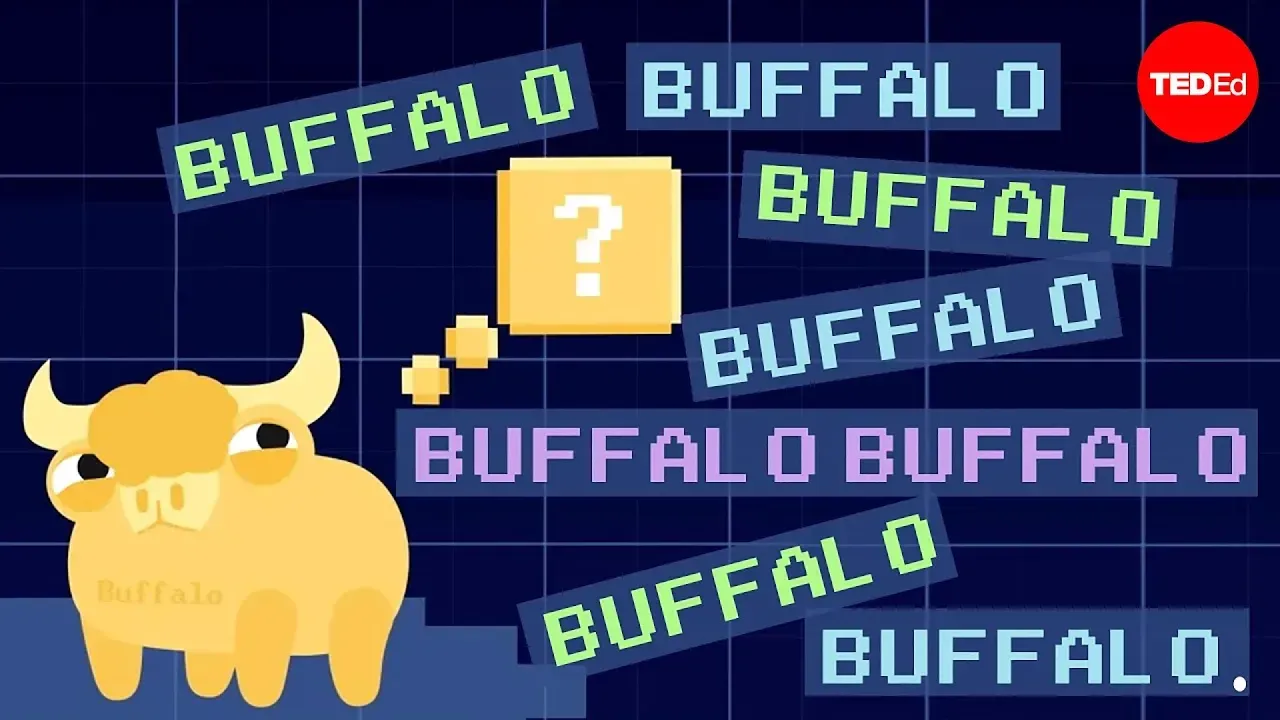
For example, consider the following: Buffalo buffalo Buffalo buffalo buffalo buffalo Buffalo buffalo. That may sound like nonsense, but it’s actually a grammatically correct sentence. How? Well, Buffalo is a proper noun, a noun, and a verb. It refers to an animal also known as a bison, an American city, and it can also mean to bully. These different interpretations create a sequence of words that is grammatically correct as it stands, though it helps to add in a few implied phrases and punctuation marks to reveal what’s really going on. Buffalo buffalo are bison from the city of Buffalo, and this sentence has three groups of them. Group A, which is bullied by Group B, bullies Group C. In other words, bison from Buffalo that other bison from Buffalo bully also bully bison from Buffalo. If you let each buffalo perform its role, the meaning becomes apparent.
What if the bunch of bullying buffalo decides to cross the ocean? Not just on any ship, but a ship-shipping ship shipping shipping-ships? That sentence sounds just as outrageous, but there’s logic to the babble. Ship can mean a vessel and to transport. When we sub in those meanings, a clearer picture emerges. Here we have a huge ship-carrying vessel transporting ships that themselves are designed to carry goods across the sea. A ship-shipping ship, shipping shipping-ships.
How about some entertainment on board this unusual vessel to offset the scuffling buffalo? Consider the can-can. Can-can can-can can can can can-can. Here, the word can comes in many guises. There’s can-can, the flamboyant dance, can, that means able to, and can, figuratively meaning to outperform. By sticking in a comma and including the implied meanings, this sentence becomes clearer. Can-can dances that can-can dances are able to outperform, can also outperform other can-can dances.
You wouldn’t necessarily use any of these sentences in a conversation. They’re just too ridiculous. Yet they serve as an extreme example on just how tangled everyday language can be. Lexical ambiguities sail into our speech and writing all the time, spreading confusion and misunderstanding wherever they can-can.