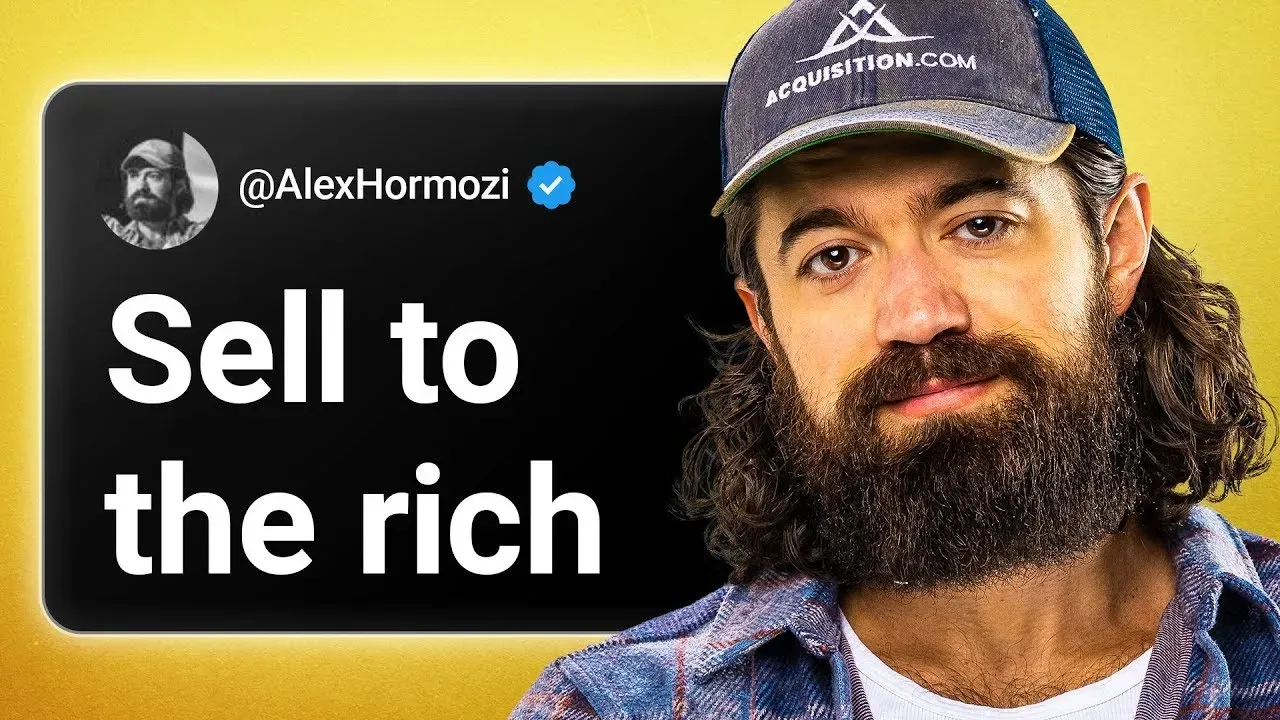
I’ve been in business for 13 years. I’ve sold nine companies. My last company I sold for $46.2 million. I own Acquisition.com, which right now does about $17 million a month across our portfolio. I’m going to compress 13 years of brutal business truths and lessons into this one article.
Brutal Business Truth Number One: Sell to rich people until you have the money to sell to all the poor people. The middle is where you get killed.
Elon said you can either do a lot of good for a small amount of people or a little good for a large amount of people. And I will tell you personally, it’s way harder to do a little good for a lot of people than a lot of good for a small amount of people.
There is a reason that Tesla started at the top. They started only selling to rich people. They had the Roadster, which was $250,000, and so they sold those. And then he was able to go down market one and sell $100,000 cars to just the upper echelon of society, the wealthy. And then after that, he made the X, which is a little bit cheaper than that. And then underneath that, he made the Model 3, which was going to be the mass model, right?
And each time, it was significantly harder to do than the one before. Because if you want to sell based on value in terms of low cost, you need to build the infrastructure for huge amounts of demand. Because the only way that you make money selling to poor people is selling tons and tons and tons of them. Look at Walmart. Look at Amazon. These are businesses that were built for volume day one, and they win on efficiency.
That was the whole point. Amazon, he wanted to have the best selection and the lowest prices. Walmart, everyday low prices. They win on efficiencies. Like, they all fly coach. They use fold-out chairs. They drink out of paper cups. They purposely breed the culture of efficiency because it’s the only way that you can win if you sell to poor people. And I say “poor people” to be hyperbolic in terms of my language so that it drives the point home. Obviously, I buy from Amazon. But the point is that the strategy is based on volume.
And you’ve probably heard some of my other tweets around this, which is: solve rich people problems, they pay better. Or if you solve rich people problems, you get to charge rich people prices. This is what I think the key insight is: to someone who only has $11,000, when they pay you $100, they pay you 10% of their net worth. Their expectations of what they’re going to get for that $100 is the same as a rich person giving you $10 million of their $100 million. It would be gigantic, right, in terms of their expectations. But getting a rich person to give you $100, they might not even notice.
And so the thing is, it’s actually easier in some ways to solve rich people problems because they’re willing to pay more in an absolute sense for lower relative value. And so with that extra profit or gross margin, you can absolutely over-deliver for them and still make money, and not have to learn all these things with infrastructure.
So for example, if I wanted to start a bank, I would have to have $25 to $100 million to start it up. But if you do that, then you have to build the infrastructure that you can handle money for zillions and zillions and zillions of people. A very hard business to get into.
And so the idea is that you want to sell at least—this is my belief—is that you want to sell premium. You want to sell to wealthy people. You want to sell to a niche person that you can do a lot of good for in a very small slice, because you don’t have to compete against everyone. You can have inefficiencies and still make money without having to have tremendous infrastructure and skill around building it.
Once you make a ton of money doing that, you can obviously just do more of that—which, big fan—or you say, “You know what, the next thing I do I want to do for zillions and zillions of people.” And so then you build a business like a Netflix.
Think about how insane Netflix is, just as a concept. You pay $13 or $15 a month or whatever it is now, and they create movies and shows and they spend millions of dollars, and they sign comedians, and they’ve got all these shows that are streaming, and you pay $14 a month. It’s absurd. Think about if you said, “Hey Mom and Dad, I want to start this video subscription, and I’m going to just pay millions of dollars to get all these shows and movies made for us, and I’m just going to charge 14 bucks.” It would be absurd. That’s how much value you have to provide to someone who doesn’t have money to capture huge slices of the market.
How are you going to beat Prime? $99 a year or $129 a year, whatever it is now, right? And with Prime, you get basically all of Netflix with Prime Video. You also have next-day shipping, same-day shipping with anything that you want to buy—99 bucks a year, $129 a year. If you build to sell to the masses, you need to build like you’re going to sell to the masses. And you’re usually going to have to put a ton of money in for a long period of time, because you have to have that infrastructure upfront to deal with that volume, to have such a crazy value discrepancy that someone who has no money still never wants to cancel. That’s the key.
Whereas if you go to wealthier people, you can get a premium. You can have five clients that all pay you $5,000 a month and make an amazing income, and have the resources to actually do a good job and hire a couple people to help you out who are competent. And you can do that when you charge more money. And those people are not the ones who are like… and everybody’s heard this meme, where the $50-a-month customer is like, “Hey, so for this $50 a month, what am I going to get?” Now we make fun of that, but that’s the reality of if you’re taking 5% of someone’s paycheck, it means a lot to them.
Whereas if you’re going to somebody who’s making a million a month and they pay you five grand, if they get one good thing a year, they’re stoked. And they’re like, “Oh yeah, I sent the wire, did you get it?” Like, the difference between working with somebody who’s on the lower end versus the higher end.
And so being very clear about who you serve, not serving other people. Going down market only if you have the infrastructure to support huge amounts of volume, and usually the capital to front it. Either you build for volume day one and win on efficiency, like Amazon or Walmart, or you build for a premium, which means you niche down and you completely solve problems for people. So you completely solve a problem in a very narrow niche.
And so let me give you a completely polar opposite examples here, which I literally live on both sides of the spectrum. On one side, Acquisition.com is my premium brand, right? This is the brand that we do deals with. This is where we have hundred-million-dollar companies and stuff that we invest in, that we own. That’s my family office, and we do one or two deals a year. Just to be really real, we make very rich people way wealthier. That’s what I do there. So someone comes in is already worth 50 million bucks, and we’re like, “Cool, how do we get to 250?” And that’s what we invest in. That’s what we scale the company.
On the other extreme, we’ve got School. So School is for everyone who’s starting out. Now, School took 5 years to get to the level of product that it is now, and millions and tens of millions of dollars of development where it lost money the entire time, and still loses money right now, in order to create such an absurd value for the $99 a month or whatever it is. Because we know that that $99 a month for somebody who’s trying to start their business, that’s the entirety of their business budget. And so we have to solve all of the business problems that those people have at that level.
And so these are two completely—I mean, honestly, the most polar extremes of value creation in terms of who we’re selling to, or who we advertise to, and who we’re attracting and how we help them.
And so there’s no coincidence that I did Acquisition.com before investing in, being a co-owner of School, because I had to make enough money to be able to afford to sell to people who don’t have much, to be able to help build the infrastructure and invest millions of dollars to build that so that we could accommodate millions and millions of users. Right now we have many millions of users on the platform.
If you are confused about how to sell rich people stuff, first off, the easiest hack for selling to rich people is: do what somebody else is doing that sells to rich people, and do it in half the time and charge twice the price. Number one, rich people pay for time above all else.
But if we look at the value equation, you’ve got the outcome—so you got to make sure they want the outcome that you’re promising—and you got the three other variables: you’ve got risk (How likely is it that they’re going to get what they want when they buy?), time delay (between when they buy and when they get), and the effort/sacrifice.
The richer they are, the more guaranteed they want it to be. Now, you don’t have to guarantee things, but you need the perception of the guarantee. That’s why reputation matters. If you’re the best plastic surgeon in the world, you don’t give a guarantee. They just have a high perceived likelihood of achievement. They believe that if they pay you, the likelihood that their nose isn’t messed up when they do the surgery is high.
If time delay, they want it to be as fast as possible. If they give you money and have it tomorrow, rich people pay a lot of money for that. And then you’ve got effort and sacrifice: “Well, I don’t want to do anything. I want you to do everything.”
And so the thing is, a lot of times that makes sense to have very white-glove, concierge, high-touch things for people who are willing to pay for it, because for them, the incremental difference in cost for them is actually very small. So the difference between $5,000 a month and $10,000 a month to a multi-millionaire, not a huge difference. But if you’re just better for $10,000 a month, they’ll happily pay you than the $5,000-a-month guy.
You’re not going to sell someone who’s wealthy on how much money you’re going to save them. You’ll sell someone who’s wealthy on how much time you’re going to save them.
Brutal Business Truth Number Two: You lack priorities, not information.
Problems are easy to solve if you know what you’re after. If you know what problem you’re actually trying to solve.
I’ll tell you a story. So I was talking to an entrepreneur who’s done about $10 million a year, and that was between all of his companies. And we were talking, and he mentioned one, and then he mentioned the second, they mentioned the third, they mentioned the fourth. I was like, “Dude, how many companies do you have?” And he’s like, “Oh, I don’t know.” I was like, “You don’t know?” He’s like, “Yeah, I have an Excel sheet.” And so I was like, “Well, pull it up.” And so he pulled up his Excel sheet, and he had like 56 companies that in total were making like $10 million a year. And obviously, one of them was the biggest one that was doing like half of that revenue, and that was actually the company that I had heard of that he founded.
I said, “Dude, if you just only had that one company, how easy would it be to like 5x that business?” He was like, “Oh my God, if I didn’t have these other 55 companies, it’d be a joke.” I was like, “So if I waved a magic wand and that happened, you think you could do it?” And he was like, “Yeah.” And I was like, “Then do it. You can wave the magic wand. You can end these other 55 partnerships so that you can do this one thing.”
And what’s crazy is that a year later, I talked to him and he had done just that. He was like, “Dude, I like didn’t sleep for three days after we talked because I was like, ‘Oh my God, that’s it.’”
So I see strategy as priority. It’s prioritization of resources, right? You have unlimited options. You have limited resources: time, money, people, etc. And so how you choose to allocate those resources against the unlimited options is your strategy. It is how you prioritize. And when you have one clear goal for one clear company for one clear customer, the prioritization actually gets pretty easy.
And so a lot of people keep looking for these unique insights, when the reality is you don’t even have a goal. Have you defined the problem that you’re trying to solve? And most people haven’t. And that ends up being usually the first question I ask someone. They’re like, “Hey, I’m stuck with my business.” And I just say, “Well, what’s the goal?” And then they say something. They say, “Well, what problem are you solving right now?” And so if you can’t clearly state current state, desired state, obstacle, you’re running around like a chicken with your head cut off. You’re not going to solve anything. You’re going to do a lot of work, but you’re not going to move forward.
So I had a media company approach me. They’ve got 40 million subscribers across their channels, obviously very, very good at media. They said, “Hey, we’ve been listening to your content, and we think that our constraint, like the problem that we need to solve that will get us the most bang for the buck, is that we need to optimize our SOPs for the media company.”
I said, “Okay, well, what’s the goal?” I was like, “Is it to just get more famous, or is it to make money?” And they’re like, “No, we want to shift into monetization now.” I was like, “Okay, so let me ask you this: what product do you sell?” And they were like, “We don’t have a product.” I was like, “Okay, so hear me out, crazy idea: if you had a product, you would make a lot more money than trying to get your 97 out of 100 media company to 98 and a half.”
Not to say that there’s nothing. Like, if they said, “I want to be more famous,” then I would have said, “Absolutely, you should do that. That makes sense because monetization isn’t the goal.” But if they were trying to make money, they had nothing to sell. And I promise you, if you have nothing to sell, you make a lot less money than if you do have something to sell.
And so they could be a two out of 10 on product, but with that amount of media, that amount of traffic, they would be able to get so many sales that they would blow it out of the water. And so they were spending all this time trying to get in the intricacies, trying to get information on how to solve the wrong problem.
And so most times, it’s not that you lack insight. It’s that you’re solving the wrong thing. And I think the reason that that happens so frequently is because those entrepreneurs are media entrepreneurs. They like media. They feel comfortable in media. And so they like solving media problems. And so they like solving problems that they know how to solve because they’ve solved them before.
I’ll tell you a different story. I had a guy who came out for a workshop here at Acquisition.com, and he said, “Hey, can you go over the closer framework?” And I said, “Okay, you flew across the country, you’ve been here for a day, you had this one opportunity to ask this question to me. I was like, is sales a problem in your business? What’s your close rate?” He said, “40%.” I said, “So sales is not the constraint of your business.” He was like, “No.” I was like, “Then why are you asking me about the closer framework?”
And I actually think that that lesson was way more powerful than me trying to go over the closer framework, because the reality is, he was a sales guy. He loves selling. And so he wanted to hear me talk about sales. But sales isn’t the problem in his business. There’s something else that’s the problem. He might not be getting enough leads, or people are turning out to click on the back end, or he can’t even take on more customers because he doesn’t have enough team. Like, those were all other examples of problems that might exist. And I’ll bet you one of those three probably is the problem in his business. But that was the question he asked. He asked about the thing that he enjoyed, reading about the thing he enjoyed learning about.
And so right now, if you’re an entrepreneur, it is true that you want to double down your strengths. But the business as a whole has to be balanced.
So hear me out. If you think about business like a body, okay, and you’re a bodybuilder, and so you want to have ideal ratios for everything. In terms of like, if your arms were like this big and your quads were tiny, then you look weird, right? So you want to be a specialist. Like, you, sure, as an individual contributor, keep doubling down in your strengths. But the business as a whole will only be as strong as its weakest link.
And so this is where people get confused with “double down in your strength” versus “be well-balanced.” The business needs to be balanced. Your physique in total needs to be balanced. But you, as an individual contributor, can double down your strengths. You want a team of people who are all doubling down on their strengths. But you, as the organizer of the business, need to make sure that the business as a whole is balanced. Otherwise, it will get constrained at some point, and then that point will be your point of failure. That will be the weak link. That will be the part of the bridge where only $1 can get across, even if you’ve got 10x the front end and 10x the back end. That one bottleneck is what’s bottlenecking the business.
And so making sure that… often times, the thing that you’re not the most excited about… if you’re a marketing entrepreneur, marketing is probably not your problem. If you’re a product-driven entrepreneur, product’s probably not your problem. If you hate people… and that’s like, that’s probably your issue. Like, “I hate meetings, I hate leading people, I hate trying to reinvest in my team.” I’ll bet you that you probably are having limits on your business because you don’t know how to recruit, hire, train, manage. And so that’s actually what you need to either learn or recruit someone who already knows how to do that.
And so people spend too much time mentally masturbating to the concepts that they love and the idea that because it worked to get them to where they’re at because they needed to start marketing to make money, they think, “Okay, now if I 10x marketing, that that’s what it takes to make more money.” And unless that’s the constraint, that’s not true. And often times, businesses do grow to the constraint of the founder. They do grow to the constraint of that individual founder’s highly specialized skill. And then, at that point, it’s constrained with something else that the founder doesn’t like as much.
And so either you got to learn it and get comfortable learning stuff that you don’t like as much initially, or you got to find someone who does.
And so if you’re like, “Okay, well I’m either a product entrepreneur and I need more marketing, or I’m a market entrepreneur and I need more product, or I’m either of those things and we don’t have an operator, we need somebody who likes to lead and manage people and invest in teams…” Then how do you know what good looks like?
So first off, one of the biggest advantages of business, of doing this for a while, is you start to recognize patterns. So you hire five guys that suck and then finally find a sixth, then all of a sudden you’re like, “Okay, so this is what a good sales director looks like.” This is why the businesses, for example, that we start now grow so much faster, because one, we know who’s going to be needed next, and two, we know what that person looks like.
And so think about how much time you save where, if the constraint let’s say is sales, and you hire, onboard, train, and that takes a month, and then that person sucks, and it takes you 6 months to fire them, and then you do it again, and that takes another 6 months to fire them, and you do it again, and then this time it works… well, you just wasted a year and change of growth that you should have been growing, but you weren’t because you’re the wrong person at the point of constraint.
And realistically, this is why so many businesses get stuck. And the wrong conclusion is the person says, “Oh, I tried hiring sales directors, that doesn’t work.” No, you tried hiring John, and John sucked. It doesn’t mean that there is no sales director. Doesn’t mean you’re the special snowflake that no one can ever replace you, that no one can do this role. It’s just that you can’t. Like, there’s Microsoft, there’s Facebook, there are gazillion-dollar companies. Someone out there on Earth is better than you, literally at the thing that you’re best at, and definitely better than the thing that you suck at.
Now, how do you actually tactically find these people when you don’t have the experience? So I’ll give you the tactic for how I think about this. One is, I interview lots of people. And so if you think about the interview process as an education process in asking them as much as you possibly can… act like an ignoramus. Just be like, “I don’t know anything about this. Tell me about it.” And then don’t immediately jump on the first person. Go on 10 dates. Go on 20 dates.
I’ll give you a little sideline story for School. Sam, the founder, interviewed 600 developers before he found his co-founder. 600. And the way that he did that is the process of him outlining. So first, he said, “Hey, who here knows anything about development in his network?” So he got, he started interviewing those developers. And then he said, “Hey, can you introduce me to the best developers you know?” And so then those people introduced him because they had a better context. He’s like, “I’m not hiring any of you. I want to know the best people you know.” And so eventually, he kept going up the ladder. He talked to those people, said, “Who’s the best one you know?” And he kept going up and kept going up, only to fact-find, only to find information, until he found somebody who’s like, “Oh my gosh, this guy said more things and made more sense.” And at this point in the process, he’d already spoken to so many people he had a good context from which to make a judgment.
And so that is the process.
I will tell you what I personally look for now. I look for the quantity and quality of metrics that someone has to describe their role. And so I’ll give you a binary example. So on one hand… let’s say I was hiring someone for customer success. Let’s say that’s like you’re getting a lot of churn, you’re not getting a lot of ascensions, you’re not getting good reviews, your NPS scores are low, etc. You then saying, “Okay, Mr. Customer Success candidate, tell me about customer success. What metrics do you measure?”
Now, if they say like, “You know, I just want to make sure people are happy, that they’re having a good, you know, a good time, and that they’re, you know, they’re getting results and they’re having a good experience,” I’d be like, “Cool, what do you measure?” And if they start squirming around like, “Well, what do you measure?” and they can only come up with one or two things, then I already know that this person obviously can’t drive an outcome because they can’t even define an outcome.
Now, on the flip side, if that person says, “Okay, well we like to define an activation metric up front that we can do within the first 48 hours. Then we have, like, what is our time to value? And what’s our, you know, what’s our North Star there? We also like to measure CSAT, but I don’t like to do it too often because then customers don’t like filling out the surveys. And so we want to make sure that we can do it ideally within the customer journey during a value-driven exchange that they’re going to have with the customer service rep or some sort of account rep that they have to manage, and then we can just tack it into that process. I like to look at churn, but churn I see more as a lagging indicator, and I look at these other things, especially what’s our time… like, how long does it take from sale to onboarding? What’s that handoff look like? What percentage of customers are backing out in the first 24 hours, 48 hours, 72 hours? And what percentage of these customers are leaving us a review by day 30?”
And so all of a sudden I’m like, “Okay, well he just said like nine different metrics and had reasoning for that.”
And so then the follow-up to this question of understanding the quality and quantity of the metrics that someone’s going to bring to the table is… awesome. This is going to freak some people out: “How does what you do make the business money?”
And if the person cannot accurately describe how their function—because every function of a business makes a business money; that’s why the function exists—now the thing is, some functions of a business are indirect versus direct. So if I asked a CFO, “How do you make the business money?” they should say multiple things. “Well, one, I control expenses, so everything that I save goes to the bottom line, and I have a process of consistently cutting out excess costs every 30 days. And so by doing that, I can usually drive an extra 3 to 5% to the bottom line, which more than pays for me.” So I’m like, “Okay, great, they’re already even thinking about my return as an owner versus them.” On top of that, they say, “Okay, also, I see finance really as a function of decision-making. And so if we can collect the metrics that drive decisions around what things have the highest gross margins, what’s our utilization rates, how can we make the decisions that will get us the highest return on capital, both human and money capital in the business, then we will grow faster.”
And so if someone talks like that, then I’m like, “Okay, they understand how finance is actually a data function.” By the way, it is literally that’s what finance does: is gives you reports. It’s reporting so that you can make decisions about the business so that we make more money. Cool.
Now, sales. Let’s say… and I’ll give you an example for a sales director. So if I say, “Hey, how does what you do make us more money?” Now, if they say, “Well, I’m going to drive sales,” I’d be like, “Well, duh. But like, you’re not going to sell anyone because you’re a director. So how do you make the company more money?” What you want them to say is that, “I’m going to increase the average conversion percentage across our leads for the team.” Because that is the output of the sales manager is closing percentage. Like, at a fundamental rate, it’s closing percentage is one of the metrics, but just total conversion rate of leads. So if I get 100 leads, and there’s lots of mini steps—you got to schedule, you got to show, you got to close, you got to offer, whatever, there’s cash collected—there’s other mini metrics along the way. But you just want to see what percentage of eyeballs and earballs, and people who give us their information, we can contact do we convert into sales.
And if you say, “I, as a sales director, will be able to increase that percentage,” then that’s the job. And that’s how I make the business more money.
Because here’s the thing: if they cannot describe an output of their job that ties to revenue for the business or ties to profit for the business, then you can be absolutely certain that they don’t know how to do it and that they’re not going to do it for you because they can’t even tell you how it works.
And so I use those as the litmus test. Test one: I interview as many people as I possibly can so I can get a basis from which to make a judgment. Two, from there, I’ll learn the metrics because I won’t know them that people use to describe the role to drive outcomes. And I will look for the quantity and quality of metrics that people will track and what they would do to influence those metrics. Step two. And then step three: “How does what you do make the company more money?” Don’t let them get away with, like, with the sales example, “Well, we’re going to make more sales.” No, but how do you influence that?
Business Truth Number Three: Things are hard because your team isn’t as good as you think they are, and that’s because your standards are too low.
A mentor of mine said this to me, and I’ve always kept this in mind. He said, “Your best talent you haven’t even hired yet. Your best talent is in the future.”
And so let’s run a thought experiment for a second. Everybody who’s listening to this has that one teammate who’s just an absolute stud. Hopefully, if you don’t, I’m sorry for you. But at least one person on your team is pretty good. If you had ten of those people, would you be able to make way more money? The answer is almost always unequivocally yes. I’d be able to make way more money.
And so then the follow-up is, then why is all of your attention not to getting more of those people?
If you listen to the Steve Jobs, the Bezoses, the Bill Gates, Elon, so many of them, Zuckerberg, so many of them talk about talent. And in the early days of entrepreneurship, I thought that they were trying to hide the secrets. But it’s really that they were talking about what they were focused on. And as I continue to do business, the more I just care about who rather than what or how. Because if you really do have the right “who,” you’re one hire away from somebody who’s 100 times smarter than you, who’s done this way longer than you have, who can help you grow the business.
I’ll give you this story that really drove this home. So when we were looking at selling Gym Launch, we had a lot of conversations with investment bankers. And then finally, you know, we picked an investment bank to represent us. And then we had a lot of conversation with prospective buyers, so acquirers, meaning people who like fund managers, people who have big funds of money who buy companies for a living.
And I remember a moment on one of the first of these meetings where—it was in person, they’d flown out—and all of their team was on one side and all of my team was on the other, and I was sitting at the head and the managing partner was at the other side of the table. And I just remember just kind of sitting there silently, looking down the table, looking at both sides back and forth, back and forth, and being like, “No wonder these guys are going to make $3 billion in the next five years versus my team.”
And the thing is, just to be clear, it wasn’t that my team was bad. I mean, we built a, you know, $100 million-plus business. I saw the discrepancy. This is not a slight to anybody on the team. We obviously had stars. But seeing the average level of talent on their team versus mine was a huge moment for me to understand just how important people are.
And so there’s a story in Google. I think it was Larry Page or Sergey Brin, whoever, typed into Google like “parachutes” or whatever, and the ads that came up were for like “buy a radio,” “buy a car.” And he screenshotted it and he puts it on the corkboard in the engineering room and said, “These ads suck.” He just wrote it on the screenshot, and he hit the board, and he walked out of the room. And the story goes that the next night, one of the developers just like stayed up all night and came up with AdSense. And AdSense more closely paired what people were searching for with the ads that they were shown. He didn’t say, “Here’s the 100-step process that we’re going to do to solve this problem.” He just said, “You guys are intelligent. This is the problem. Go fix it.”
And so one of the telltale signs that you have bad people on your team, or people who are too dumb, or your standards are too low, is that you have stupid rules. And I, and I’m somebody who’s done this, so this isn’t me preaching here. This is something that I’ve now realized is that if you have to have a rule that’s like, “Hey, everybody, you have to show up on time,” “Hey, don’t drink while you’re on the job,” “Hey, like you can’t watch Netflix while you’re working”—like, that’s not a good thing. By the way, all of these are rules that I have implemented at some time in a business that I’ve owned. And I’m telling you this now because it seems so painfully obvious that if I have to say, “Don’t watch Netflix while you’re on a customer service call with a customer,” that shouldn’t be a rule. That should be an obvious thing that anyone with half a brain cell can figure out.
But what that really meant is that if you start making stupid rules, it’s because your standards are too low and you’re hiring stupid people. Rule number four: lots of rules means you have dumb people.
So let’s talk about that for a second. So one of the things to prevent against this is a rule from Amazon, which is that every person you hire, you want to raise the average bar of the team that they’re getting hired into. I literally used this yesterday with someone that we were interviewing. Leila was like, “What do you think about this person?” I said, “Well, do they raise the bar of the team?” And he was like, “Hmm.” I was like, “All right, well then there’s our answer.”
Because the thing is, all companies will, unless controlled for, dilute down talent. So people, you know, sixes will hire fives, fives will hire fours, fours will hire threes. And people will always hire people that they’re not threatened from because they want security first. And so you have to implement something like this.
Because the reverse can also be true. Imagine if every single time you hired somebody, it raised the bar of the team. Then the team will just continue to get better and better and smarter and smarter people, and then the company will grow and grow and grow.
And I have a fundamental belief that the level of a business grows kind of like a Christmas tree, where you’ve got the number and intelligence of brains that goes up. So if you have lots and lots and lots of really intelligent brains, the size of this business is huge. If you only have one brain that’s intelligent and everyone underneath of that has a subset of the skills of that one brain, then it’s only one brain that’s competing against companies that have a 100 smart brains.
And that was something that in my early days, every person I hired, I could do their job better than them. And I trained them to do everything they did, which meant the limit of the business was me. I had to literally keep learning things—which you always have to do, of course—but I had to learn everything from scratch. And so the business then had to suffer what a day-one customer success rep would deal with because I didn’t know anything about customer success.
And so the idea is, I would rather bring someone in who has 10 years of experience in customer success so that we can start the business on year 10 of customer success. I want that person to have learned all those lessons on someone else’s dollar, and then when they come to me, have all those lessons so I don’t need the scars.
And so one of the telltale signs also of an early company is that you’ve got people who have zero experience in leadership roles for a function they’ve never done before. And that’s because it’s like, “Well, this is my COO, Sarah. We have five people in our company, but she’s our COO.” It’s like, don’t use the term COO because she’s going to look at Salary.com and she’s going to say that she makes more than the entire company makes in revenue. Right? No, that’s not the case. Like, she’s a manager, right? And realistically, she probably doesn’t manage the whole business; she probably just manages this portion of it, or he just manages a portion of it.
And so the thing is, like, just because it’s your mom or it’s your brother or your best friend growing up or that guy who you hired first has been with you since the beginning, it still doesn’t mean that they’re right for the role. And so this is where a lot of the money that you want to make is on the other side of a few hard conversations.
And many people never have them. They’re willing to just accept mediocrity at the point of the bottleneck and never get de-bottlenecked because they can’t say, “Hey, Sarah, I don’t think it’s working out. And I think it’s my fault because I put you in a position without the resources to win. And I think—and this is how you, this is how I manage it—what I want to do is I want to keep investing in you. And here’s how I want to do it. I want to bring someone in who has a ton of experience, who knows more than both of us put together. And I want you—I’m going to basically pay for you to learn from this person so that you can become more skilled in your career. And then, I want you to get laser-focused on this thing over here that you were doing before and absolutely tune it up. And so this way, we, you’re going to crush what you’re currently doing every day, and it’s absolutely within your scope and experience that I think you can do really well with it. And I also want to build out your future by bringing this person in. So think about it like me paying $100,000 a year for you to learn from somebody who has 10 years of experience. It’s about the biggest gift I can give you.”
And so if you frame it like that, it’s not like this is a demotion or like you suck. It’s like, “I’m trying to invest in you, and I’m going to invest in you by bringing this person in who’s going to teach you.”
Now, if that person has an ego, which is usually the next common thing, which is like, “I thought I was doing great,” then it means you probably have a communication issue. Like, you’re not telling them that Sarah’s not doing a good job. And then Sarah gets upset. And the thing is, at that point, Sarah might have an ego because she started at the front line and then became a manager, then you give her another title… progression too fast.
And to be really clear, I’ve done this two times with executive assistants. Just with executive assistants within the companies a zillion times. Me personally, I’ve done this. And I don’t really even deal with a lot of personnel in general. And it’s like, I just promoted someone too fast.
I think it’s the Peter Principle, which is that people will advance to their point of incompetency. And so someone does really well at sales, and so then you put them in a sales manager, and then they’ve never managed a sales team and they don’t do really well at that, but they get promoted to their point of incompetence. So I lost a good salesperson and I got a bad sales manager. And this is how most of corporations are run. People do well, and then their role changes into something they’ve never done before, and then they do poorly and they get stuck there, or they get fired.
And most times, because the person who promoted them feels bad, they just get stuck there. And so you’ve got all these people who you still have positive associations with the work that they did, and you feel like you owe them because they did do a good job one time before. But now they’re doing a poor job because they’re not properly equipped and you didn’t give them the skills to succeed, and they don’t have the experience. And yes, that’s your fault. But the thing is, you can’t fire you because you own the company. So somebody’s got to go.
And so either you got to move them aside, you redefine the role and move someone ahead of them, or you have to get rid of them. And again, this is what makes business hard. It’s not that it’s complicated. It’s that you don’t want to hurt someone’s feelings. And I get that. That’s what makes hard conversations hard. If you hate somebody, firing them is very easy, right? Like, someone stole from you, firing is not personal. Experience there, slept fine that night, all right?
It’s the conversation with someone that you know is trying their best, that you really like as a human being, but isn’t cutting it. And even if you think you could get them there, you’re not willing to invest the resource to do it because it doesn’t make sense. I could wait for someone to learn neurosurgery, and I think people could, but it might take a decade. And I don’t know if I really want to invest all that time when I could just go find a neurosurgeon. And yeah, I might have to pay more, but I’d rather pay that than pay 10 years.
And so to loop this back around to the story that I was talking with the private equity firmers, when I was looking at them, one of the big “aha” things too is that many of the people on the other side of the table were making $1 million, $2 million, $5 million a year. And, you know, people who were in their 20s making $300,000, $500,000 a year. And I was like, “Okay, I need to reset my bar of what I have to compensate in order to attract A-level talent.”
And once I really understood the value of people, the way that we grew businesses completely changed. It stopped being about building businesses and became way more about assembling the teams that build the business. Like, one of the core functions we do at Acquisition.com, probably the thing that we invest the most resources into, is recruiting talent. Like, there’s a reason that we go really hard on LinkedIn, because people respond to our messages. And we’re like, “Hey, you ran all the ads at this $200 million per year direct-to-consumer business. We have a direct-to-consumer business that’s at $20 million. Would you be willing to take it from 20 to 200 because we think you have the experience? Or do you know anybody who does?”
And because we have a following there, we get the responses and we can get that level talent. But that level talent’s not coming in for $100 grand a year. You can moan all you want that, “Oh, these employees want so much money.” But there’s a marketplace. There’s a rate. And if you’re not willing to pay it, there’s a company that is smarter than you that is willing to pay it because they know the return on it.
And I still think, to this day, one of the biggest arbitrages that exists in business is paying a talent A+ wages to get 10x the output.
So let me drive this home. So you can get a B player. Let’s say, let’s use $100,000 as the baseline. So I want to hire a role for $100,000 for this thing. And a B player in the role will take 80. And a B+ might take 90 or 100. But there might be an A++ guy who’s like 170. It’s like, “Whoa, that’s like twice our budget for this role.” But if that guy or gal has the output… like, an A player can get you 5x, 10x the output of a B player. Meaning, five people who are B players at $100,000 a year equal one A++ at $170. That’s still a great return, and better than hiring five Bs.
And especially in knowledge work. So if you have anything that has to do with thinking and not like, where literally more hands are required to do the work, the outsized return on intelligence is so high that I still see it as one of the fundamental arbitrages that exists in business. How much time you save by hiring somebody who knows exactly what to do, how it drives revenue in the business. And they can use 10 years of experience that you don’t have to pay. So I would rather pay 25%, 30% more for somebody, 50% more for somebody, who can move me 10 years forward. Like, it seems almost silly when you frame it like that not to.
But the thing is, every day, small business owners want to save $5,000 on an annual salary for somebody who they know is perfect for the job.
This is Truth Number Five: If you want to get bigger, get better. Better leads to growth. Bigger leads to bloat.
So I was reading S. Truett Cathy’s book, It’s Easier to Succeed Than to Fail, and he talks about the story of Chick-fil-A. And he said that what his number one pursuit was better, not bigger. And that he believed that if they were better and they just kept getting better, he said, “Our customers will demand that we get bigger,” versus trying to get bigger for the sake of getting bigger.
And so he tells a story between him, Chick-fil-A, and Boston Market. So for those of you who don’t know, Boston Market was actually a very big chain when I was growing up that grew really, really quickly. And so Chick-fil-A was, you know, privately held. They took on almost no debt. They grew really responsibly, one location at a time. And Boston Market was like, “We’re going to franchise and we’re going to raise a ton of money from Wall Street, and we’re going to make all this stuff.”
And for a period of years, they outgrew Chick-fil-A by a mile. And they were like, “Oh, Chick-fil-A is going to get left in the dust. They’re going to get out-captured. They’re going to get crushed.” But because Boston Market grew so quickly, because they didn’t—they diluted their talent because they had to hire so many bodies and not enough brains, and because they wanted to grow because they wanted valuations, they wanted money—they were what I would consider mercenaries. Whereas Chick-fil-A and S. Truett Cathy was a missionary. He believed in the product. He believed in the experience. And because he’s a faith-driven entrepreneur, he wanted his restaurant to represent the tenets of Christ. This isn’t me getting religious on it, but he believed in his mission. That’s the point.
And Bezos talks about this. He said, “You’ve got mercenaries, you got missionaries. The missionaries always win in the long term.”
And so what end up happening is that the money guys, some of these guys cashed out early because stock got inflated, all this stuff. They took on tons of debt. And then the company ended bankrupting. I don’t know, something like 10 years later. But guess what happened in that period of time? Chick-fil-A just kept growing. And the thing is, Boston Market couldn’t out-compete Chick-fil-A in their market. They just grew faster. But the thing is, if you’ve got a Boston Market and a Chick-fil-A, if you know that your chicken sandwich is better, you still always win. It becomes an inevitability. It doesn’t matter if they get there first. If you win in the end, who cares? Because quality will always win, provided it’s priced appropriately and things like that.
But better leads to bigger. Bigger leads to bloat.
And so this has been something that was really hard for me to learn as an entrepreneur, because, you know, we like the—I mean, I like the feedback of, “How much money are we making this month? I want to make sure it goes up.” I want to make sure it goes up because it’s a proxy for growth, okay? And I used to say this, and I like it, which is, either the business is growing or I am. So if the business isn’t growing or the business is going down, I’m growing. I’m learning when I’m messing up. And if the business is growing, sometimes you’re not learning because you’re getting rewarded for the work that you did while you were learning while you’re eating crap. Sometimes you get both, and that’s the ideal scene, is that it’s growing and you continue to learn, and you keep your learnings ahead of the growth. So the train’s coming and you’re building out the track. You’re getting around the ditches, you’re going through the mountain, you’re digging the hole, you’re doing that stuff so the train can keep running and keep growing.
A big lesson that I have taken from S. Truett Cathy and some of the best entrepreneurs, like Elon: if you’re going to enter a market… so Elon talks about this. If you’re going to enter a new marketplace, you want to be an order of magnitude better than the existing solutions.
And so I’ll give you an example. Elon just recently did—he talked about getting into candy or chocolate, which you might think, “Why would he even bother getting into that?” I think it’s because he had a gripe with Warren Buffett and Charlie Munger, which is really sad ‘cause I like both of them. He had a little bit of a rift with them. Oh, he was like, “Well, fine, I’ll take out See’s Candies.” And so he was like, “I’m going to get into chocolate.” And so he had all these people send him different recipes and all this stuff, and he decided not to do it. And the reason he decided not to do it is he said that there was no product, there was no version of chocolate or candies that was an order of magnitude better than what already existed. So he just didn’t want to play.
If you think about how he entered into the other markets… he got into space and was like, “Oh, we’re going to redefine how space flight works. We’re going to use reusable things that we’re going to drive down cost 10x compared to the competition.” That’s an order of magnitude better. With cars, the first real Tesla, not the Roadster, the high-end one, but the first one he made for mass commercial use, was literally the highest-rated car that Auto magazine, the premium magazine, had ever rated. It got the highest overall score of all time because he focused so much on making an order of magnitude better.
And the thing is, Tesla makes great cars by and large. And so customers have demanded they get bigger because they continue to out-purchase their supply. And so that forces supply to increase, so you grow.
And so if you’re stuck and you’re like, “I keep trying to grow and I can’t grow,” sometimes you just have to think, “Let’s not grow. What if we didn’t want to grow at all, but we just had to make this thing absolutely insane from a quality perspective? Just get better.”
And the way that you do this tactically is that you look at each function of the business and you say, “What’s one thing we can do better that we absolutely, very high confidence, like, we’re just going to go from contacting our leads within 30 minutes to five minutes? That’s the one thing we’re going to do for the next 12 weeks for sales. For marketing, what we’re going to do is we’re going to make sure that every single ad has a hook that’s been tested before. That’s what we’re going to do. We’re going to make sure every ad that goes out is going to have a hook that’s tested, and we’re going to make five times more of them. Great, that’s what we’re doing on marketing.”
And every single one of them—here’s the key point—is that once you start that new one thing, the next quarter you add to that. You don’t just swap it. And this is what most people do. They do that one thing, and then they forget what they were doing, is that you end up creating this checklist of what creates amazing ads. You create this checklist of what makes amazing follow-up. You make this checklist of what makes an amazing handoff between sales and customer success. Make this checklist of how to activate a customer.
And so it’s 100 golden BBs, not one silver bullet, that creates the outsized returns. And then once you have 100 golden BBs, you start getting the word of mouth. You start getting people who keep buying from you. And then all of a sudden, your LTV skyrockets. And then you might find out, if your LTV skyrockets, maybe you don’t have a marketing problem. Maybe you just weren’t making enough per customer.
And I can tell you this, the amount of times I talk to smart businesses who are like, “We need cheaper leads, we need cheaper leads, we need to lower our CAC.” The reality is, they just don’t make enough per customer because they’re not that good. And either you mis-priced—which does happen, for sure—or your thing’s not that good, which is 100% under your control.
Fundamentally, growth is a lagging indicator. The things you do to create growth are the leading indicators. And the things that create growth are the things that make you better. And so having growth as a desired behavior is trying to make an outcome into an input. And then what happens is you have quote “growth for growth’s sake.”
And here’s the problem with this, just as a big, big picture, is that if the reason that you’re in business is to quote “make money,” if that’s your real mission… so many things make money. And so what happens is you become distracted as an entrepreneur. This is why the mercenaries fail compared to the missionaries. Because if you just want to make the best chicken sandwich, anything that’s not a chicken sandwich isn’t a priority. They could have Chick-fil-A credit cards, right, or Chick-fil-A miles. They could do that stuff, and they probably would make the money. It’s not core. Now, go find out if they probably have a credit card, who knows. But like, the point is, it’s not core to what they know.
If money is the goal, then there are so many paths to getting there that it’s difficult to stay focused, which is why companies get spread thin, which is why they grow for growth’s sake, and then all of a sudden they have five initiatives that are going on that all aren’t working that well because they couldn’t focus on the thing that matters most, which is getting better at the core promise that they make to customers.
Business Truth Number Six: You work all day, but you can’t get anything done because you allow too many things that don’t matter to distract you. Sometimes you have to let fires burn.
And so what that means is that you have to block time for work that moves the ball forward, because a month later, it’ll be the only thing you have to show for the month before.
And so one of the things that took me a long time to realize is that there are very few things that are existential crisis within hours, even within minutes, right? And so the idea that everyone in the company and all of your customers, etc., can have immediate demand from you or responses from you as the owner is not a good expectation, because then it means that you’re on demand for everyone else’s needs, but the business needs you.
And so I’ll give you a story to drive this home. So at my first gym, I had just started sleeping not at my gym, which was wonderful for me. And so right as like I get my first few nights of sleep, I get a call that everybody hates at 5:30 in the morning, because that’s when sessions happen. And I was like, “Hello, what’s going on?” And he said, “I’ve got bad news.” And I immediately go to someone died from a heart attack in our gym. That was the, like, the immediately went there. And I’m just silent, and I was like, “What is it?” And then he says, “There’s a water pipe that broke and it’s leaking on the floor.” And I was like, “Okay, what do you want me to do?” It’s like, “Well, I don’t know what to do. I called you.” And I said, “Well, what do you think I’m going to do?” He’s like, “I guess call a plumber.” And I was like, “Okay, what would I do in the meantime?” He’s like, “Probably get a bucket.” I was like, “Yeah. I was like, have you done that?” He was like, “Well, no, I called you.” I was like, “Like, okay, well why don’t you do those first two things? Because there’s nothing I can do.”
There’s a story of Eleanor Roosevelt, I think, when someone in her family died in the middle of the night. She gets woken up by her servant or whatever, you know, however they did it back then. And he says, “You know, Mrs. Roosevelt, I have some terrible news.” And it’s like 3:00 in the morning. And she’s like, “What is it?” He’s like, “Your cousin, you know, John, died.” And she said, “That could have waited till morning. There’s nothing I can do about it.”
And so there’s very few things that will actually kill a business. And so if you allow everything to be urgent, it means that everything’s a priority, which means nothing is. And priorities literally mean “prior.” They come first. And I literally prioritize my day by the things that matter most. And so I start my day. I do, prior to my day, the thing that I think will actually move the ball forward. Because when I look back at my last month to see the progress that I’ve made, I never think about, you know, Susan who I had to give a refund to because she was dissatisfied for something, or we got a one-star review and we need to deal with that, or our chat support went down for two hours in the middle of the day and people were like, you know, “Why did the chat support?” None of these things are existential crises for the business in the short term.
There’s almost nothing that kills a business in the short term. Like, the only real thing is that your payment processing goes down, so you literally, your ability to accept money goes away. But beyond that, like, there’s not a lot of stuff. And so what you have to get comfortable with is letting some fires burn and being able to say, “Yes, this sucks, but not getting the important work done will suck more.”
And so I spend—and I still do this—the first four to six hours of my day working on the things that I believe matter most. And I think that if I had a single habit that has gotten me the furthest in my life, it’s that I work uninterrupted for the first four to six hours of my day on the things that I think have the highest leverage in the business.
And I like to think about that as, “What’s the one thing that if it were true, all of my other problems would go away?” And then I put all of my effort into making that one thing true or making that one thing happen. But that can’t happen if you have 20 other mini priorities that are urgent and not important.
Every entrepreneur suffers from this. And so you have to draw lines in the sand, or you will be spread too thin. You will work all day and you will get nothing done.
To protect that first four to six hours, in the beginning, I had to wake up early. So that meant I woke up at 4:00, I worked for 6 hours till 10:00, and I started my day at 10:00. As I made a little bit more money, I was able to like sleep in until like 5:00, you know, and then start working at like 6:00, and then I’d work from 6:00 to noon. And so everybody on my team—this has been for years—everyone on my team knew, do nothing until the afternoon. Like, Alex only takes meetings in the afternoon.
And so for me, I do my thinking work in the morning, and then I do my meetings in the afternoon. As I hired more people, more directors, more leaders, more executives, a lot of those meetings all were able to disappear. And so now it just became like weekly meetings, and the remainder of my week is just completely open.
Here, like, let me show you how this plays out in the real world. Someone reaches out and says, “Hey, I got to connect you with Jimmy. I think you guys would have a lot of synergies. I think that this would be a really important connection.” And I say, “I take meetings on Mondays.” And they’re like, “Oh, I don’t think he can do that.” And I say, “Okay, I guess we won’t meet.” We just sit there, and that’s it. And you’ll be amazed, often times, that if they really want to meet you, they’ll make it work on Mondays. And if it means that it’s also three Mondays from now, then it’s three Mondays from now.
And I will say this: if I don’t meet Jimmy… you know, many people are there on Earth. There’s 8 billion people. I’m not going to meet most people. And the likelihood that Jimmy’s going to actually do something… like, if I know what I need to do to grow my business, there’s not a lot that Jimmy’s going to offer me there. Like, if I’m very clear on my strategy and I’m very clear on my execution, anything that’s not that fundamentally loses me money. It certainly doesn’t make me money.
And so just being okay with saying no.
And so I’ll give you the tactic around this, which is just saying… I like to say, so this is how I do this in social settings. I’d say, “Hey, I’m actually not taking meetings until after my book launches.” And then once my book launches, I’ll say, “I’m not taking meetings until we sell this company.” And I’ll just always have something that I’ll just push out that’s way far in advance that seems very important that gives people a social reason to feel okay that I’m saying no to them. Not saying you’re not important, it’s saying I’ve got this other thing that’s really important to me. And so that tends to work pretty well with entrepreneurs.
But you have to be okay with it. Like, if you have a team where people manage your schedule for you… like, I had to explain this to my—we have three executive assistants that manage Leila and my calendars—and I was like, “If you put a meeting in the morning at like 10:00 a.m., I was like, you’ve killed my whole morning. It’s shot. Like, I can’t get into any kind of deep work. And then I’m going to have two hours, and I’m going to have lunch, and again, and I have other stuff. Like, no. Like, we don’t do that.”
If they are going to do something and it’s quote “very urgent,” and they have a very strong argument, I put it at the very end of my day. And I book from the back forwards. And so that means that if I say I want to end my day at 5 or whatever, then it means they’re going to put my first meeting of the day at 4 o’clock. So from 4 to 5, if it’s an hour-long meeting. And if I have a second meeting that day, then it’s going to be from 3:00 to 4:00. And so I still get my whole day until 3:00 uninterrupted so I can work on the things that matter most.
And we have just learned, Leila and I working together, that basically the more she takes off my calendar, the more money we make. And that’s because that’s where I’m most effective.
Now, the flip side is, Leila is such an exceptional operator and leader that her form of productivity is an absolutely stacked day so that she can delegate, invest in the team, prioritize resources, deal with small decisions that have to move the ball forward, check in on projects, hold people accountable, reward them for the behaviors they’ve done, like interview new candidates that we need to bring into the company. Like, that’s a super time-consuming thing that’s very, very high leverage and very high value. Like, think about it: if you have to take 20 interviews to find the right person who can then take 20 hours a week off your plate, I mean, geez, you spend 20 hours once to get 20 hours a week for life. What a great return.
And this is why entrepreneurship at the highest levels—I’m going to go on a side rant here, but I think it’ll be important—entrepreneurship at the highest levels is always hiring ahead of where you’re at. And for people who don’t like their current business, I can promise you that if you grow it enough, you’re just going to be dealing with people. All businesses at the top are: you got a marketing person, you got a salesperson, you got a product person, you got finance, you got legal, you got tech. And that’s the business. And so whether you’re selling widgets, you’re selling services, you’re selling software, fundamentally, you’re just going to have a bunch of people that are executing those things. And so at the very highest levels, business is all the same. And you have to learn how to play business at that level to keep playing at that level.
Business Truth Number Seven: Brand takes a long time to build, but it’s the most valuable thing that you can own. It gives you the ability to get insane returns on advertising, price far above the market, and keep people only buying from you. It’s very hard to imagine something that is better than that. It just takes time.
And so this was, I mean, this is probably the lesson that took me so long to learn. Like, years, I mean, many, many, many, many years. I mean, I think I would say it took me a decade to learn this. And it’s, I’ve only been able to reap the fruit of this in the last couple years.
And first off, I didn’t even understand what branding was. Branding is simply an association people make between something they know and something they don’t know. The thing they don’t know is your business, and the thing they do know should be something they like. And then over time, that rubbing of the thing that they like rubs off on your brand, and eventually you can drop this thing and only have your company, and they will make that positive association with you.
And so there’s three ways that people will make associations. This is how you build the brand. One is what you say or show. So that’s controllable. So people will associate this hat with me. And if you got value during this thing, then you’ll associate the value with Acquisition.com. Cool. So that’s what I can say/show. This is advertising. Me making this content is advertising, right? I’m letting people know about my stuff.
The second level is what other people tell them. And so that means like, either someone who’s interacted with your advertising or someone who’s interacted with your product. So it’s like, “Hey, I saw this trailer for Mission Impossible, you know, 306, and you’re like, I think I’m going to go see it now.” If your friend says, “Oh, I saw it. It was bad. Don’t waste your money,” the likelihood I go see it—if I agree with that person’s taste, that’s, you know, key side note there—if I tend to like the same movies they like, then I would take that really heavily. If it’s like my mom and I don’t agree with movies that she likes, I might just go see it more because I’m like, “Oh, if she hated it, I’ll probably love it,” right?
And so what you say as the company owner is thing one that you can control the most. Thing two that you can’t really control is what other people say about your stuff, which then goes to three, which is what the customer ends up saying once they experience it. So it’s what you say, what other people say, and what they actually experience.
And so as you can imagine, what they experience is going to be the strongest thing. So you see the ad, you think about going to the movie, someone tells you something about the movie, maybe that influences your decision. Once you see the movie, then you have a much stronger opinion. And you can see another ad about the movie, but you’re like, “I don’t care what the ad says, I saw the movie.” I bought the sandwich. I went to use their marketing services. You have a very informed opinion because you had an experience.
And so this is why brand and product are always going to be interrelated. Because how do you get what other people say to be good to your potential prospects? You make sure that their experience was exceptional so that when they do see it, they say, “Hey, the movie was awesome. You should go see it.”
Now, if someone who I like a lot says, “Hey, the movie was awesome. You should go see it,” and I’m like, “I saw the ads, I didn’t think it was that good,” and they’re like, “Dude, believe me, see it,” now all of a sudden, I had poor advertising. They have a high likelihood of seeing. And then if I go see it and I say, “Wow, he was so right, this was awesome,” then I’m like, I tell other people.
Now, here’s what gets kind of interesting. If I go see it and I think it sucks, that influences the brand of my friend who told me about it because now I don’t actually believe their opinion of movies anymore. And so that’s why, as a side note, when people refer people to your business, they have to be treated so well. Because that person who made the referral risks relational capital. They risk their personal brand to the friend. And the reason they make that risk is they actually want to get a return on it, right? Like, “Hey, you should see this movie,” because they want the friend to associate the good experience with the movie with them. And that’s why people do things. That’s why you do refer products that you actually like, because you want people to associate or have that problem solved because of the thing that you connected them to, right? And so we want to be that connection, and that’s how we make money.
Now, if we’re thinking long term though, from a branding perspective, if you make a big promise and you deliver on that promise consistently, people will say, “Wow, they are what they said they were,” which is one of my biggest rules of marketing is: state the facts and tell the truth. Don’t make promises you can’t keep, and just say, “Hey, this is what has happened. I don’t know if it’ll happen for you, but if you’re willing to take that bet, then there you go.”
And so if we think about the things that are some of the strongest levers in business… price is the strongest lever on profit of all things that you can control in business. If you get people to buy something for a million dollars that other people buy for $10, you’re going to make a lot of money. And so price is one of the strongest things that has a lever on market. And you can measure the strength of a brand by how much above the commoditized price, or what other competitors charge, you can charge because of your brand premium.
So if you look at like a Nike versus a generic brand for t-shirts, shorts, shoes, basketballs, whatever, they will charge a premium, and they will get that premium. And so they’re able to sell more units at higher prices because of their brand because of the associations people have with them.
And so then the ROI from the brand becomes: how much does it cost me to make these associations that people find positive? And then you spread that out, or you fractionalize that against how much of an increase in price you can have against the commodity. And so if I sell a million units of something and I can sell it for $3 above market, then I have $3 million of excess that that brand buys me. And so if I can get an association that yields me that outcome for—let’s say I can get a championship fighter for $250 grand a year to be in my ads—then I get a 10-to-1. Or I say, $300,000 to make the math simple. If I pay $300,000 for that association and I can now charge and make $3 million extra, I get 10-to-1 on that branding. The ROAS, as you get return on advertising spend, absolutely, all the metrics count the same for branding as they do with direct response advertising. You just have to measure over a longer time horizon. That’s the difference.
And I will say, on a personal level, branding gets you far better returns on advertising than anything else. It just takes longer.
And so think about the direct response world as like your paycheck. It’s like you write a check in and you get money out. You write a check in and the moment you stop spending that money, you stop making money. Brand is like your long-term investment. In the beginning, you’re investing money into your IRA, you’re investing money into your 401k, you’re investing money in the stock market. But it’s not really compounding yet. But the thing is, you keep doing that, you keep doing that, you keep doing that, and all of a sudden the compounding starts to become this monster that you couldn’t even spend enough marketing dollars to make up for that level of compounding. And that’s what happens over time. It just takes time to get there.
But the way that you control it are that you make sure that the things that you were saying about yourself are associated with things that the people who you’re trying to sell to associate positively. And this happens in content and also the people that you associate with publicly.
The second part that you can control is how much you deliver on the promise, because the experience is always going to be the heaviest weighted thing that people have. Now, the approximation of an experience is a review, right? The reason reviews matter so much is because we see that like, “Cool, they say they’re great. Now I go to their site and I read reviews to see, are they telling the truth or not based on approximate reviews?” And then I say, “Okay, well this guy had a one-star, but it looks like he isn’t a lot like me. Now I look at these other guys. Oh, these are a lot more like my use case, and they had five stars. Okay, well then I feel like my risk-adjusted on making this purchase is low. Now I buy it, and then I decide for myself.”
But the branding is a loop. It helps make the purchasing decision. And if you fulfill on that, then guess what they’re not going to do? They took a risk by buying your product not knowing who you were. They don’t want to take that risk again. And so if you deliver on the promise, they will just buy again from you, even with the premium.
And this is how you start—how branding of itself can create a competitive moat. People who buy Apple become Apple buyers. They just only buy Apple. And so even though somebody else’s product might even be better, they don’t want to risk trying it. They don’t want to have the cost of learning a new interface and all this other stuff.
And so brand gets you higher returns on advertising, allows you to price far above the market, and get people that once they buy from you, they keep buying from you. And you do that by what you say, what other people say, and what customers experience at the very end when they use your product. And that either gets them into the buying loop again forever, or it kicks them out.
If you look at the cutting-edge direct response world, the strategies that they use approximate a brand. And so let me explain what that means. So if you go to quote “cold traffic,” people who don’t know who you are, you have no association. Once those people go in your world, often times, unless it’s like a widget or something that’s a very impulse purchase, you have something called like a warm-up sequence or a nurture sequence, or you deliver value, or you give lead magnets. These are all things that actually approximate branding.
So if I give someone, let’s say, a PDF that is very valuable, well thought-out, has lots of research in it, someone would get a lot of value from that. And then I approximated a purchase with them. They gave—they did an exchange; they got something. And then that thing was valuable, and they used that to extrapolate into what a decision would be like or what a product would be like if they made a purchase from you. And so you have these things like 5-day challenges that people will run to try and have lots of people for 5 days, because if you spend, let’s say, 5 hours with someone, that might be the same in terms of their warmth to you or the associations they have with you as someone who might have spent a year consuming a 60-second clip, you know, twice a week.
Now, I will say, I think that extending that time horizon over time actually does have elements of trust that I won’t get into. But they try to approximate what a trusting relationship would look like, which is exactly how you build brand, but they just try and condense the time window.
And so this is why if they want to sell you swamp land, they invite you to a vacation for free and they spend two days with you pitching swamp land, because at the end of two days you’re like, “Why, I spent 24 hours with this person, like I feel like I can trust them.” And so they actually build a reputation in a very minor, in a mini way, in a tiny audience to make the sale.
Whereas if you want to build, in my opinion, big brand, you want to build that same level of trust across millions of people. And then when you say, “Hey, I’ve got something,” they all act as though they’ve been with you for two straight days to make the purchase. And if you spent two days with someone and said, “Hey, buy my basketball,” they’ll all buy it. But you just do that times a million, and that’s what big brand looks like.
Bezos’s Truth Number Eight: You need to know what inputs and outputs your money-making system are, broken down to the absolute smallest action, and that way you can crank the hell out of it.
So let me explain. So this happens all the time. So we want to invest in a company. We come in and, a lot of times, right, like, we’re in like the diligence part of the deal cycle. And I say, “Okay, so you’ve got five sales guys and you’re spending $5,000 bucks a day on ads. That’s your primary way of getting leads. Why aren’t we spending $50,000 a day?” I just asked the question like, “Why? Like, what stops us from spending $50,000 a day?” And then a number of things will come up. And then the question is, how solvable are all those things?
Now, if they say, “Well, whenever we spend more money, our ROAS goes down,” I’d be like, “Okay, I would see that as your ads suck. Great.” If they say, “We can’t handle the call volume,” then I’d be like, “Oh, you don’t know how to hire, recruit, and train sales. Cool.” If they say, “Oh, we could, it’s just that we couldn’t deliver based on the promises that we make because we have a lot of high-touch service,” like, “Okay, so you need to systematize more stuff on the back end and get better training in place on the back end. Ideally, maybe bring someone in who’s rolling, you know, ruling that, uh, rather than the founder who’s split between too many places,” right?
So like, you can quickly understand where the constraint of the business is by simply asking, “Why can’t we 10x this?” right now.
The skill of an individual is inversely proportional to how vague your direction can be. So let me explain. So if someone comes to me and says, “Hey, Alex, I have this product, can you promote it? I have no marketing department. Can you just promote it?” They can just say that, or she can just say that, and I will know everything else that that means. At the absolute lowest level, if you say that to a 5-year-old, you’d be like, “Okay, so this is what promotion means, and there’s all these different ways we can promote, and I need you to learn how to turn on a computer, and then this is how you create an email, and this is how you…” Like, you’d have to go step by step by step. And so the more vague your direction, the more skilled the individuals you need to have in order to do it. Which, by the way, is why smart people is a great investment because it’s actually more efficient from a communication perspective. I can say, “Hey, John, fix churn,” and I can just say “fix churn,” and he knows all the subtasks underneath of it.
But over time, it’s valuable for you as the entrepreneur to know as much of that dirt as you can so you can level-check and say, “How good is this person? Are they really doing their job?” etc.
Now, let’s go to advertising, a simple example. Actually, let’s use the example I had earlier. So we had three different problems that I presented. I said, “Why can’t we 10x this thing?” So the first version of the problem was their ads suck. And I say, “Okay, you can’t scale your ROAS there.” So either—so it’s not just that they’re—it’s like that the TAM could be bad, as in like they could be a local market and you can’t 10x ad spend from $5,000 to $50,000 a day ‘cause there’s just not that many people in the local market. But assuming that that’s not the case, it’s just that their ads suck. Then I say, “Okay, walk me through the process of how you make ads.”
And so then what we say is, “Okay, usually you can nail it down to like, you’re not doing enough pre-work.” And pre-work is defined as: I need you, before you start, to sit down and write ads that you’re going to… look at the top 20 ads you’ve done of all time, you’re going to rewatch them. Step one. Step two: you’re going to go through all the ads that you saw this week across all your platforms that you thought were interesting that you would like to model. Step two. Step three: you’re going to recreate the best ads you’ve done. You’re literally going to remake them. Step two: you’re going to take the best ads and just reformat them so old footage, new edit versus same message, new take. And then we’re also going to create 30 more ads that are completely new, net-new takes using the ideas that you had inspiration from, and just inspiring from old ads that you’ve used before that you’re not actually redoing the same messaging. You’re mixing and matching and doing a remix, right?
And so it’s like, “Great, this is the process. And you’re going to do this every week.” And so that means that you’re going to spend half a day prepping and half a day filming every single week.
Now, it’s very easy for me to say. When I say, “Hey, are you doing the ads process that I outlined?” they’re like, “No, we are, but it’s not really working.” I’m like, “Show me the hooks that you wrote from the ads that were already working. Show me the remixes that you did from the best performers. Show me your album that you’ve been saving for all the ads that you like.” If they can’t show me these things, they’re not doing the fundamental actions.
So that’s like example one. If I said that it was the like, they can’t scale the sales team, then I’d say, “Okay, how do we scale the sales team?” So, “Oh, we just got to go get people.” What does that actually mean from an action level? Well, it turns out it means that we need to reach out to 100 people on LinkedIn in order to get one person hired. Okay, so based on our turnover rate for sales guys—let’s say we lose one person a quarter, whatever; that happens more with bigger teams, as a side note—say, “Okay, well, if we do three reach-outs a day over 90 days, then we’re just going to replace our turnover. We’re going to have 90 reach-outs, it’s going to create one good guy, and we’re going to lose one guy, so we’re never going to grow the team.” They’re like, “Oh.” It’s like, “So if we need to 10x this team, then we need to do… well, 100 gets us one, and we lose a third of a sales rep per month”—which, if it’s we had a 5%… I mean, you get employee turnover the same way you get customer turnover. And so you say, “Okay, so our rate is 20% turnover. Now, is there things we can fix that? Sure. But just for the sake of this example, we say, ‘All right, so we need to get—if we want to double this team this quarter, we need to do 500 reach-outs.’ Now, 500 reach-outs is going to result in, call it, 50 interviews. And 50 interviews is going to take them some time. So we need to take at least, call it, 10, maybe 15 interviews a week because we want to be ahead because I don’t want to get it by the end; I want to have these people done and onboard and productive by the end of this quarter, not just finished.”
And if you’re like, “Wow, going from 5 to 10 is a lot.” Dude, we put—we went from 0 to 40 in a company. Like, it’s 100% just your belief set of what’s possible.
And I will tell you this right now, this just a life hack for making more money. You will… so many entrepreneurs, like, you’ve built a five-person sales team, and you immediately scale whatever business you do next to a five-person sales team, and then you stop there because you just don’t know how to grow past that. And so you just do what you’re comfortable with. You’re a lot of you guys are comfortable at $1,000 a day ad spend, and you just know how to do that, and you can’t get past that.
And so you have to break these limiters that you have. Say, “Why can’t I spend $10,000 a day? Why can’t I hire 30 sales guys to do outbound in 90 days?”
I heard a story of a multi-billionaire entrepreneur, ex-Blackstone guy, has raised billions and millions of dollars, whatever. And he became—I can’t share the company; company’s worth over $100 billion now, and it’s not Shopify because if you’re thinking about Harley, it’s not him—and he started this new fund. And in order to start it, and he raised, I think, like $20 billion his first… like, highly. Dude, what he did was he flew out—I think he did 200 interviews in seven days. And so he said, “Everybody come here, fly out to my warehouse.” He had his team of five killers with him that he knew from that he took from his last thing. And he did 200 interviews in seven days, and then he got his team to start the next thing.
That’s the difference in terms of level of execution that higher-level entrepreneurs do that it would take a junior entrepreneur 3 years to do that because they choose to believe they can only take two interviews a week.
If it is the constraint of the business, it is your job. And so you have to be able to break down what the inputs of the business are at the most actual level that yield output. So figure out the problem, and then figure out the action that you actually do—not the output—the action that you have to do, the inputs at the most basic level, so that you can crank the hell out of it.
Business Truth Number Nine: Stop looking for hacks. And I mean hacks different than like shortcuts. I mean, you know, when you see something on like, ‘Oh, they’re like, start doing these hashtags because that’s what’s working really well,’ or ‘start doing this new messenger thing that’s only going to work for 60 days.’
The thing is, like, if you have to jump from these little mini-trends to mini-trends to mini-trends, the moment that little mini arbitrage thing is done, you’re done. You want to focus on what the overall objective of the platforms that you advertise on are.
And so if I know that, for example, YouTube wants people to click and they want them to watch, and ideally watch something else, then if I just always optimize all my effort to getting those big things right—whether something’s trending, or like, “Oh, yellow backgrounds are doing really well in the short term”—we’re like, you want to make sure that you respond to every single comment well within six minutes, otherwise like it changes the… anytime someone tells me algorithm stuff, I basically ignore it because unless the goal of a platform has fundamentally changed, all of this other stuff is just distraction.
Because again, what’s the one thing that matters most? If I make something that’s so good that everyone is going to share, and the moment they watch, they can’t wait to tell other people about it, the platform is going to want to distribute that. I don’t care what the algorithm is; it’s going to want to distribute that. And even if it doesn’t—so this is a real talk—even if it doesn’t, the 100 people who saw it will get what I want out of it.
And so the thing is, it’s so much better to spend 100 hours making one exceptional thing than doing 100 things mediocrely. And now, some of that’s like, “Wait a second, how does that contradict with ‘you got to do lots of quantity’?” Quantity matters because it teaches you how much work it takes to create quality.
And so once you learn—and this is like if you look at, I like YouTubers because it’s they have really well-documented work cycles, and you can see all their product and marketing in the same place—is that in the beginning, many of them make more videos. And then over time, they realize that if they make a better video, it has outsized returns. Meaning, if you make a video that’s 20% better than your average video, you might get five times the views. And it might take only twice as much work to make your video 20% better. And so then all of a sudden you’re like, “Oh, well, instead of making two videos, I’ll make one that’s 20% better, and then I’ll get five times the views.” And then that becomes the new standard. Then all of a sudden it’s like, “Okay, well now we’re making videos of this standard, but if I spend twice as much time as I did on that video, I get this video that was already 20% better another 20% better.” And then that gets five times the views of the five times the views.
And so what happens is over time, you learn how much work it takes to make something great. And that is why quality starts to—over time, all these platforms will always optimize towards quality because there is no lack of information. Like, people have Google; they can find out whatever they want. What they want is value per second, not seconds of value.
And so our job, if we want to make anything—whether it’s a product, whether it’s marketing, whether it’s an ad, whether it’s a service that we give that we sell—is that it’s… I get so tired of hearing the entrepreneur story, and I used to be one of these guys, which is, “I get so frustrated.” This is me yelling at my younger self. Is, I like, “I provide so much value. Like, there’s so much stuff that I give them.” But the internet gives them literally everything for nothing. And so it’s not that people want more; they want better. They want us to do the work ahead of time. People want to bargain. They want, “How can I compress 13 years of business lessons into two hours? How do I do that? How do I get the lessons from 35,000 posts in 60 minutes?” They want that. They don’t want you to say, “Hey, you know what, dude, I put all 35,000 of my posts inside of this membership login. It’s so much value.” They’re not going to get value from it. Because what would be so much more valuable is distilling all of that down to the most concrete form where every time they consume it, the value they get per second is so high they can’t stop. That’s where.
And when you’re thinking about this stuff, like, quality is in the details that you only realize with lots of exposure.
And I think about this like coats of paint. When I write a book, it’s not like I sit down and write it. I write the first draft, and then I put another coat of paint on it, and then I put a third coat of paint on it, and the fourth coat of paint on it. And I’ll say this was a gift I got from the consulting and banking world, which is, let me tell you how they edit. Let me tell you how it works.
First, you make a deck or a brief or whatever deliverable you’re going to have to a customer or client. That’s round one. The second round, you look for just punctuation errors. The third round, you look for data errors. The fourth round, you look for misspellings and typos. The fifth round, now all of a sudden, every time you’re reading it, you’re also going to catch other stuff too, but you’re specifically looking for one type of thing.
And I’m not a video editor, but I would bet that this is exactly how you edit video. You think, “Okay, let’s look for lighting this time. Okay, let’s look at transitions this time. Let’s look at sound and music this time. Let’s look at the actual content itself this time and make sure that there’s no gaps or space.”
And so it’s coats of paint. And that exposure over time and looking at it… when you start early in the morning, and the second time you look at it it’s after lunch, the third time you look at it in your bad mood, and the fourth time you look at it you just talked to your wife about this other thing and that’s top of mind. And so you look at it these different frames, and you get away—it’s like sanding down the rough edges. And you just keep getting at it, and you put different level grade sandpaper, so it gets finer and smoother and smoother. But that only happens with exposure over time and lots of licks.
And so you make the money in the edit. You make the money in the distillation, not in the creation.
And so stop focusing on the hacks and put all your effort into the repeated bouts and bursts and going over with the sandpaper and the second coat and the third coat and the fourth coat of paint. That is how you can escape mediocrity. And that’s what everyone is—mediocre is unwilling to do. They think that the moment they put the last period on their document that they finish writing a book, when really they just put 80,000 words into a document that no one’s ever going to read.
And you can teach quality to people by teaching the process that begets quality. So if you say, “The first thing we do is we have a wireframe, and every wireframe has to have a hook, a story, lists or steps for an outcome, and then a conclusion that meets these standards. That’s the wireframe. Have we done that? Checkbox one. Checkbox two: we record the whole thing, we fill in the gaps. Great. Checkbox three: we look for transitions. Checkbox four: we look for…” And so then they can follow your step for creating quality.
And most people just never document what they do, which is why every time they have to reinvent the wheel, and they have to reinvent the wheel for every new person who comes into their company, which is why it’s so taxing when you’re small to bring people on because you feel you have no training, you have no systems. But if you can document these things for yourself, which, A, by the way, will make you better, B, it also makes it easier for you to bring your people in so you can ultimately replace yourself and keep the quality where you want it to be.
Business Truth 10: The best people cost more but make you way more than they cost. It’s still one of the biggest arbitrage opportunities that exist in business, and I think will continue to exist in business as long as humans work.
And the thing is that small business owners never get this. So it’s really just the big businesses that are competing for talent. That’s where the talent war happens is at the top. And do you think there’s a coincidence that the biggest businesses are the ones that are competing for talent? Why do you think that is? It’s because they understand that talent is what makes them a big business.
And so the thing is, and this is where small businesses get in trouble again—and I did this too—is that you have to be worthy of the level of talent that you need and have a mission that’s aligned with what they find meaningful.
So, I have an… that’s in the porn business. I have no moral qualms. He does legal; everything he does is legal. Do what you want. One of the issues that he has is it’s very hard for him to find high-level talent because a lot of people don’t want to work in the porn industry. And so I say that as a hypothetical extreme.
But some of you guys are working one degree less than that. You’re like, “I sell a day-trading thing.” It’s like, “Oh, so you are, somehow you beat the market? Well, obviously, if you sell day trading, then you should just be day trading and not selling courses on how to day trade if you were so good at it. And you definitely wouldn’t tell people what the trades were. Duh,” right?
And so the thing here is, the level of talent that you can attract for that level of opportunities can be very different from, like, “I want to create something that takes all trash and turns it into energy.” You’re going to get people who are very mission-driven.
There’s a reason that every single one of Elon Musk’s businesses is here to save the world. That’s not a mistake. Now, there’s two elements to that. One is that they could save the world. The second is that that’s what he makes it about. So Twitter, before this, wasn’t about having free speech and civilization; it was just a social media platform. But now it’s the last beacon or bastion of free speech. That’s what Elon has positioned it as. Now, ULA, which is United Launch Alliance, which is a government contractor that does a lot of space things—you might not have heard of them—but SpaceX is how mankind is going to survive if anything happens to Earth. And so we’re going to become an interplanetary species. So the likelihood that we can survive any kind of event if we’re a multi-planetary species goes up for our survival as a race. And so he made SpaceX not about doing rockets and government contracting, which although that is how they make their money, he made it about saving humanity. Tesla is about electric cars. There is a zillion other car companies that have electric cars, but why is it only Tesla is about having this because it’s the future of having Earth be environmentally friendly?
Every one of his companies he makes about saving the world. And by doing that, you get people who will work night and day to save the world.
And so I’ll give you four little personal examples that I’ve had, or sorry, three personal examples that I’ve had around this. I remember when I had my first $50,000-a-year employee because before this, I’d only worked with hourly wage employees at my gyms. And that one person gave me the time because they could manage my first location to open up my second location, which made $250,000 a year in profit. And so wait, so I paid $50,000 a year for somebody out of one location to allow me to open up my second location, made $250,000. I got 5-to-1 on that. Great investment. Now, somebody might say, “Oh, why would you give up $50,000 when you could do that?” Well, ‘cause I want to make 250 on the next thing.
The second story I had—this is a little bigger—my first $300,000-a-year employee. Guess what they did? This was my first really, really exceptional salesperson. He brought in $5 million in sales that year. I paid him 300 grand. Was that worth it? Absolutely. Was it more than I’d ever paid a sales rep for? Absolutely. So it was worth it.
And it was even worth it. My first million-dollar employee immediately in their first 90 days saved me $3 million bucks a year immediately. And she was like, “All right, I just want to make sure I paid for myself. Now let’s do this other stuff.” And then with her contacts in her Rolodex, allowed us to package our companies and then sell them through her network of bankers and private equity firms. And so I didn’t come from that world, and so I hired an executive that had 35 years of experience who had sold, who had been on the sell-side over 40 times because I was like, “I’ve never done this before.” And so I found somebody who already had. Now I had to pay him a million dollars a year, but was it worth it? More than anything.
And so the thing is, what’s crazy is that the stories I just told you, the arbitrage on value actually increased as I spent more. Think about crazy that is. A $50,000 got me a 5x. A 300 got me a 14x. A million got me a 50x. This is why I believe that talent is still the most underrated, biggest money-making arbitrage opportunity that exists. And the biggest constraint to you getting there is that your company’s crappy and you’re crappy.
Brutal Business Truth Number 11: The big, obvious thing is the problem, not the hundred other things.
I want to be clear about this: the details absolutely matter. But when I talk to business owners today, the vast majority of the time, I can just keep hitting them on this one question because they want to avoid answering it. And I’m like, “Have you tried your food? Have you gone through the workouts you sell? Have you been a customer of your own product?” And more times than not, the answer is, “No, not recently.” And they’re like, “No, but I don’t think that’s the problem.”
Because a lot of times, the hard thing is the thing that hurts your ego the most. And so this is a quote from Chris Williamson. He said, “The magic you’re looking for is in the work you’re avoiding.” And I think that’s absolutely true. Also from a business perspective is that, what thing, if it were true, would hurt your feelings the most? Often times, that thing is the truth, and it’s the one that we’re not willing to face.
Like, let’s be real: your service might not be that good. Let’s be real: the reason your restaurant isn’t growing isn’t because your SEO isn’t updated. It’s not because your website isn’t optimized. It’s because your food sucks. And the real real is that it might not even suck; it might just be mediocre. But the difference between mediocre and exceptional is those hundred details. But most people are working on all these other things beyond the main thing that matters most.
And so I remember Peloton—the story of the founders—they were talking about how they were trying to build Peloton. They said, “What we did is we fundamentally believe that if we could be the best part of everyone’s day, that if everybody who came to one of our workouts left saying that was unbelievable, and they had to tell people about it.” They’re like, “How good would we have to make it that the next person they talked to, it was the first thing they brought up?”
And I love that as a litmus test for how good is the thing that I sell. And so many people just do anything they can to have quote “something to sell,” like some crap to sell. But that’s the reason you get stuck. Because the thing is, on some level, whether you admit it or not, you know it could be better. And that then influences how hard you push, because if you really believed you had the best pizza in the world—and I hear this all the time, people like, “Oh, we’re the absolute best”—I’m like, “No, you’re not, dude. No, you’re not. Stop saying that.” Because if you say that, you’re lying on some level. And you’re lying to other people, and you’re lying to yourself.
And so I think most business owners lie to themselves about how good they are at the things that they do because confronting the fact that they’re just insufficient, they’re not good enough, they’re inexperienced, they haven’t put enough work in to be good, frightens them. And so then they want to just scatter their focus to a hundred things that they read online.
But unless the workouts are amazing, unless the food is exceptional, long term, all you do is you just let lots of people know that your food’s mediocre. And that’s where thinking about business in terms of years and decades starts really paying off. Because if you believe that you’re going to go big and you want to go big, then you honestly want as few people as possible to find out about the product when it’s mediocre, rather than as many people as possible.
And so it’s counterintuitive because you have to pay bills today and tomorrow. And so you just need to advertise enough that you can continue to iterate the product. And then when you nail it, when people are stoked, when you’re starting to grow on your own based on the word of mouth—because as soon as people leave your establishment, they leave your business, they get off a call with you, whatever it is, they then can’t help but tell everybody they talk to that day about your thing—that is when you add the gasoline. That’s when you pour it on.
So for example, my most recent investment, School.com, which is a community platform for helping people build and monetize communities. I had been watching that company since 2018 and watching what Sam, the founder, was doing and watching how he was iterating the product. And when I decided to become a co-owner of the business, it was because the business was growing on its own. It had zero marketing, and it was growing month after month and had net growth every single day based on people telling other people about the product. And so that’s when I knew. I was like, “Okay, if this thing can grow without me, then how much more will it grow with me?” And that’s what I want to get into. I want to get into a business where I already know the product’s exceptional. I already know it has a base rate of growth based on word of mouth so that now, when I introduce thousands and tens of thousands and hundreds of thousands of people to the platform, they will associate me with that value, and I know that the product will deliver and then take over from there. They’re not going to buy—they might buy because of the association, but they stay because of the product.
I’ve created all of my wealth in four distinct periods. In the very beginning with my gym, I had a 30-to-1 return on advertising. The reason that that arbitrage existed—meaning I put a dollar in and I get $30 out; I put $1,000 in, I get $30,000 out—the reason that arbitrage existed was because Facebook at the time was wildly underpriced. I’m just going to be very honest. That’s why that first arbitrage happened.
The next arbitrage that occurred was in Gym Launch, where we got 100-to-1 for the first year. I spent $100,000 and made $10 million. Yes. And as a side note, most of the very wealthy people that I know had distinct periods of time where opportunity presented itself, and then they just backed the truck up. They just went all in on that thing. What happens in between is you make normal money. But it’s those windows of time where these opportunities present themselves where we can just make crazy money.
So Gym Launch was a 100-to-1. And the reason it was 100-to-1 was because the product that I was selling was the 30-to-1 thing that I had from the gyms. And so everybody who became a client then was immediately printing money in their gym. And the product was so good, what ended up happening—I say, and so now I’m going to give you like a look behind the curtain here—I say at 100-to-1, which I did, but the reality is, I just spent $100,000 and made $10 million. And a lot of that was from word of mouth because if I had spent $0, I don’t know how much money I would have made versus spending the $100 grand that I did on ads. But I still probably would have made a decent amount of money on zero ads spend because the people came in, got the result we promised, and then told five other gyms. And especially in a niche, the people—everyone knows everyone. The smaller the niche, the smaller the local market, the more connected it is, and the more word of mouth matters.
And that’s where you can get these absurd returns. That’s when you get into this like it feels like printing money because if you have good margins on the thing and you have zero cost to acquire or very low cost to acquire because of the word of mouth, then it just goes nuts. And you just like you’re like, just accepting money hand over fist. Like, “Oh my God, this is unbelievable.” And if anything, that’s when you kind of like throttle back to make sure that you can consistently keep that word of mouth and you can deliver on your promises.
By the way, if this is valuable for you or your team or your executive team, don’t be lame, share the game. This is how we know that you want us to make more of this. Honestly, just like we look at data, the more people share it, the more we make more of that stuff. And so if you’re a business owner, specifically, like I’m calling you out, I’m making my stuff for you. And so like, please share it so I know that this is the type of stuff you want.