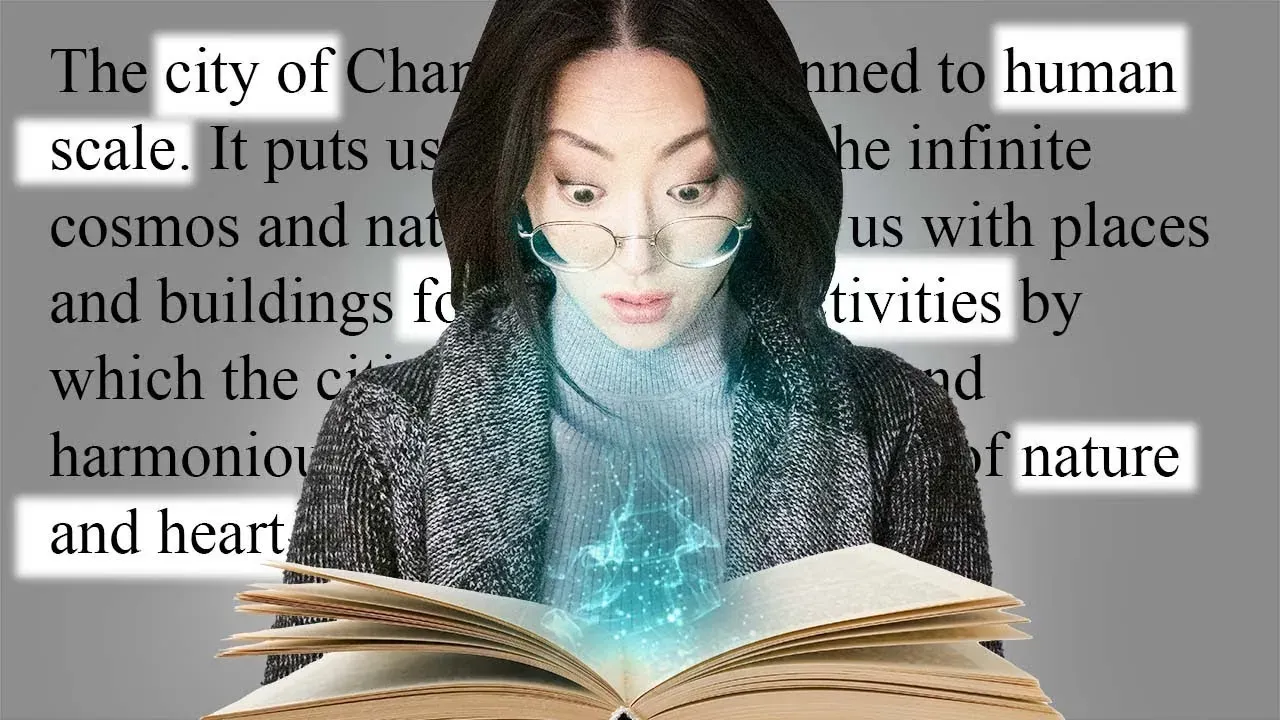

How slow reading can change your brain
How does a world of speed and information impact our brains, our culture, and the architecture that supports learning?
Sat Apr 09 2022 - Written by: DamiLee
We live in a world of speed, saturated with information, where everyone is trying to absorb as much information as possible as fast as possible. But how does that impact our brains, our culture, and the architecture that supports learning? I explore this phenomenon during my architectural thesis, which I’m trying to turn into a series.
With this explosion of information, we’re adapting our reading habits to consume as much as possible in as little time as possible. As an architect, I have to say I speed read a lot. But when it comes to books that have had a big impact on my life, my preference has always been to read slowly. But as my life gets busier, I really started to wonder, is this a waste of time? Am I really using my time and energy to its full maximum capacity?
One of the key things that I’ve learned about speed reading is to look at the first and last word of the sentence. And once you do this for an entire paragraph, you can get a gist of what the paragraph is saying. And if you practice this for long enough, you’re going to be able to do this naturally. I typically read for about half an hour before I go to bed, and so I wanted to see what would happen if I tried speed reading for 30 days.
The first record of silent reading, or reading as we know it, appears in the 5th-century document Augustine’s Confessions. St. Augustine is incredibly impressed at the mysterious reading habits of Ambrose, the bishop of Milan. He says, “His eyes traveled across the pages and his heart searched out the meaning, but his voice and tongue stayed still.”
This is because the practice of silent reading was a totally foreign concept in the Dark Ages. According to Paul Saenger, texts were read aloud because they were written in scriptura continua, which made it almost impossible for people to read without sounding out the syllables.
So why did Bishop Ambrose spend so much of his time and his energy practicing silent reading, and how did it become the normal way of reading? In the 12th century, something crazy happened: they invented punctuation. Before silent reading, reading was a communal activity, meaning sharing a commonly accepted idea was more important than having individual thoughts. But with changes in punctuation, more and more people started reading silently in private. People started reading for pleasure or to feed their personal curiosities, which led to cultural changes all over the world.
For Ambrose, reading silently meant that it was a solitary act. He could create an unregulated, undistracted relationship between himself and the words.
This is Alberto Manguel, the author, talking about the first time he’s ever experienced reading. He says, “It was like acquiring an entirely new sense, so that now certain things no longer consisted merely of what my eyes could see, my ears could hear, my tongue could taste, my nose could smell, my fingers could feel, but my whole body could decipher, translate, give voice to, read.”
Reading is a complex activity, and our understanding of how it works is still pretty bleak. However, most studies seem to agree on the fact that reading entails at least two stages: seeing the word and considering it by reconstructing the code of signs through a chain of connections in the brain. And then, depending on who we are, we decipher the text with emotion, physical sentience, intuition, knowledge, or soul. In some ways, it’s kind of like experiencing space. It’s not just our visual senses, but it incorporates memory and the core of our being.
So this is my old high school. (The narrator is walking through the location.) I have very fond memories here. This is where we used to eat lunch and wait for our moms to pick us up. This is where we used to play stupid games. And the sun’s not out today, but if you sit here at noon when it’s a sunny day, you can get the sun on your body and the shade will be perfectly on your face. If I ever went to another place that had concrete steps like this and a little overhang just like this, and the sun’s on my body just in this right way, then it would have all of these memories of me sitting here eating lunch and hanging with my friends. It wouldn’t just be a simple concrete stuff anymore.
These personal experiences are a part of you, and anywhere you go, that experience of that place is unique to you and you only. And I don’t know, I think that’s just a really nice idea. Both reading and experiencing space are a very complex process of understanding the world. So when we experience things slowly, we’re essentially giving our minds more time to create these connections, which increases pleasure and comprehension, and it increases the chances of you being transformed by the book or the experience.
This is the core idea behind the slow movement. Whether it’s the slow food movement or the slow looking movement or the slow reading movement, you know, it’s not really about doing things as slowly as possible, and it’s not even really about speed. It’s about regaining the quality of the experience that we lose in the process of speeding up.
What’s a little concerning is that this new culture of speed and this new method of reading is starting to be made permanent through our architecture. Throughout history, libraries have been reactive to new reading trends. Even today, lots of existing libraries are renovating their spaces to suit this new method of reading. The library project that I’m working on right now, which is actually going into construction next month, is getting rid of their book storage spaces to make room for an innovation lab and open reading spaces and other public services.
OMA’s Seattle Central Library is probably one of the finest examples of this new vision for the contemporary library. It’s designed to be a community hub with different programs for the community and spaces for people to work on their laptops. Despite all of these new functions, it’s hard to find a space for complete focus in these grand reading spaces. According to the architect, there’s an inner layer of perforation that deflects and diffuses sunlight, but it still seems to introduce direct sunlight, which creates uneven lighting in the reading space.
This is a huge departure from libraries during a time when reading was more of a private activity. For example, Alvar Aalto’s Vyborg Library, which was actually built not too long ago in the ’30s, he tried to eliminate all possible sources of distraction, creating a space with, and I quote, “even in direct light so that distracting shadows would not fall on one’s open book and so the bright light would not reflect from the white page back into one’s eyes.”
I think the Seattle Public Library is absolutely successful in creating an attractive and engaging public realm, but it makes me wonder: does it provide the kind of space for getting lost in a book? And is this even a relevant idea now, or is this just a relic of the past? And what do these reading habits say about our relationship to information and to knowledge?
Winston Churchill once said, “We shape our buildings, and afterwards our buildings shape us.” Architecture is a reflection of our culture, and it’s one of the most permanent ways to solidify the changes in our values. So when we see a big transformation in architecture and in the way we use space, I think it’s important to examine and think about what that means for our society.
These are questions that I’m trying to answer in my video series, where I break down some of the ideas that I was exploring in my thesis project. And I really, really want these videos to be high quality and interesting to watch, but it’s not cheap, and the production cost has been coming out of my own pocket. Please share this article and help me create some buzz around it.
Lastly, I just want to say thank you for giving me this platform. I realized that being able to talk about things that I’m passionate about and have it actually be seen by hundreds of people is a rare blessing. I’m just really excited about all the possibilities of this format. This article is a part of a series, so if you haven’t watched the other videos, they’re not really in any particular order. I’ll leave the playlist for the video series right here. And as always, thank you for reading, and I’ll see you in the next article.
You Might Also Like
![MEGACITIES: Reality or Fiction? [Architecture in Sci-Fi]](/_astro/megacities-reality-or-fiction-architecture-in-sci-fi.DVnYiCV-_S6iGH.webp)
MEGACITIES: Reality or Fiction? [Architecture in Sci-Fi]
I'm Dami, a licensed Architect living in Vancouver, BC. I make videos about architecture, career, and creativity.
Can this house slow down time?
I'm Dami, a licensed Architect living in Vancouver, BC. I make videos about architecture, career, and creativity.

Why Studio Ghibli movies CAN'T be made with AI.
I'm Dami, a licensed Architect living in Vancouver, BC. I make videos about architecture, career, and creativity.

CyberPunk Cities: Fiction or Reality?
I'm Dami, a licensed Architect living in Vancouver, BC. I make videos about architecture, career, and creativity.
![Can we REALLY build on Mars? [SPACE ARCHITECTURE]](/_astro/can-we-really-build-on-mars-space-architecture.BXkVsYCN_Z1YxzuQ.webp)