This city concept breaks architecture (THE LINE)
I'm Dami, a licensed Architect living in Vancouver, BC. I make videos about architecture, career, and creativity.
Mon Aug 22 2022 - Written by: DamiLee
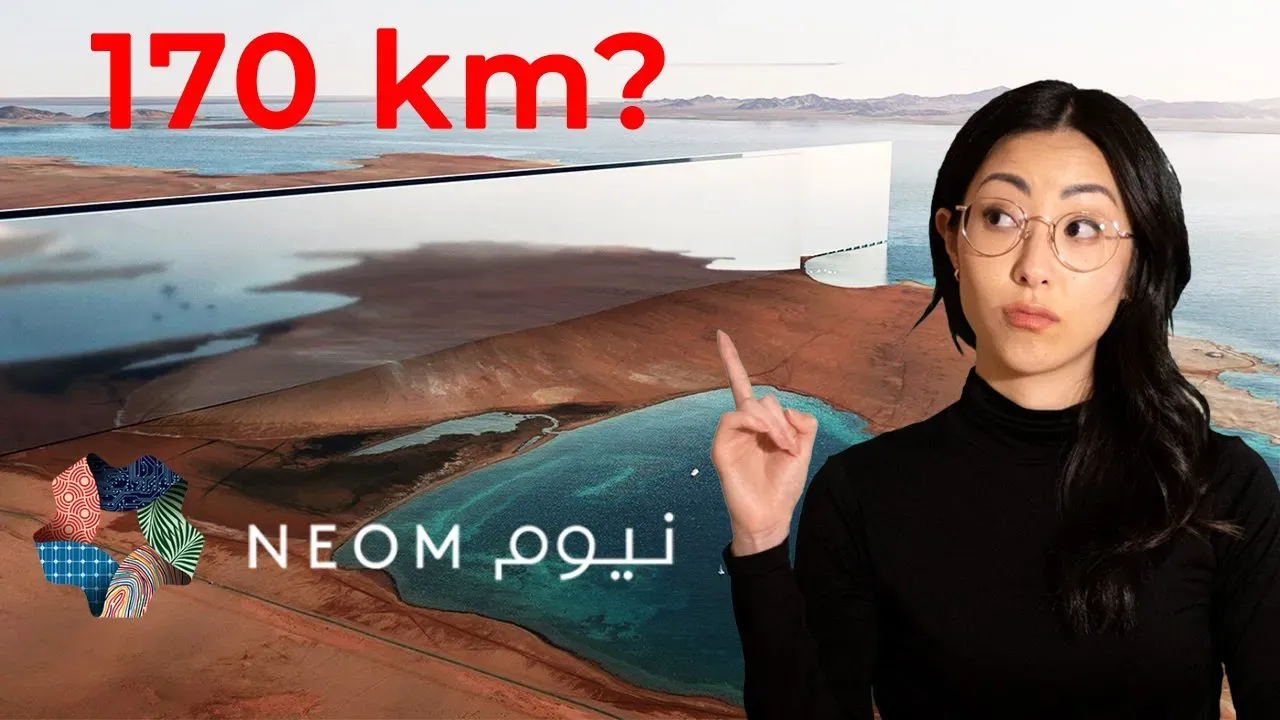
Over the past couple of weeks, some of you have directed me to this very strange project. It’s a city that’s 170 kilometers long, 500 meters tall, and it’s basically a line cutting straight across a desert with a facade made of mirrors. You can travel from one end to the other in just 20 minutes. It’s got an ultra super high-speed public transit, which eliminates the need for cars and prioritizes walking. At first, I thought it was a metaverse project, but it is a real project. The initial estimates for this project were $500 billion, and now they’re estimating it at $1 trillion. It’s expected to house 9 million residents, and there’s been a lot of marketing around this.
So let’s unpack this project a little bit from the design and urban planning point of view.
Context
A little bit of context. Neom is a part of the Saudi government’s bigger initiative to diversify the economy away from oil. As a part of their plan, they’re investing heavily into infrastructure projects as well as education, tourism, research, anti-aging technology, and there’s a really big focus on future industries like renewable power. The Saudi Arabian government set up an entire zone for the Neom development in an area called Tabuk. There are areas that have already finished construction, including a seaside resort, a massive development for the royal family, and an airport directly connecting to Riyadh, which is the capital of Saudi Arabia.
The Line is probably the most public and heavily marketed part of this Neom development. The graphics to date have been really beautiful and really compelling.
The Concept
According to Mohammed bin Salman, this concept has a bunch of advantages that’s going to make this the city of the future. By the way, it’s going to have zero carbon emissions and it’s going to run on clean, renewable energy. The city is going to be structured on three different levels. At ground level, you’re going to have your pedestrian zone. There’s going to be no roads and no cars, and there’s going to be tons of parks and trees to encourage walking. The second level functions as a service level with shops and other commercial spaces, and on the third level, you have your goods and transportation with this ultra high-speed transit system. This connects the different city modules so that all of your activities can be done by public transport or by walking, and all of your daily needs can be met pretty much within a five-minute walking distance.
This whole idea is built on the premise that most big cities are born out of the Industrial Revolution, and they were built for machines and cars and industry rather than for people. The Line would save humanity from this commuting nightmare. But is a rigid line really going to meet people’s needs? And is this really the most conducive shape for a city? There’s just a lot of questions that come up when I look at this.
Impact on the Natural Habitat
The first one was the design’s impact on the natural habitat. I mean, if the focus really is on green technology and it’s designed for sustainability, why does it literally cut through the surroundings? You know, it looks like it’s forcing its way into this irregular terrain and it doesn’t even take advantage of the coast, which to me seems like the most natural thing to do.
I studied fragmented landscapes and wildlife corridors in architecture school when I was doing my project in the Korean Demilitarized Zone. And there are thousands of instances throughout the world where natural habitats have been fragmented from roads or buildings. It stops animal migration. It kills off weaker animal species. It limits genetic diversity. It creates inbreeding, which creates genetic disorders. This is really just to name a few. And one of the things humans can do to help these situations is to create these wildlife corridors. And honestly, I don’t know if this was overlooked because the project is in the desert, but even within a desert, there are thousands of animal and plant species like lizards, snakes, turtles, sand cats, hares, like literally thousands. And I would assume, especially as you get closer to the water, you would have more animal species. So creating this massive 170-kilometer wall, it sounds really problematic.
Also, this giant mirror wall is going to reflect the light and it’s going to create these two really, really hot heat zones. And it’s going to fry everything around it. Not to mention birds flying into it.
Transportation and Growth
The second thing is transportation. How does this extremely long line cut transit time compared to a rectangle or a circle? The proposal relies on the super-fast transit system that’s going to take you from one end to the other in just 20 minutes. That would mean that the train runs at 525 kilometers per hour. If you’re not accounting for all the stops, the fastest train in the world is the Shanghai Maglev, which runs at 460 kilometers per hour. There are also successful examples of how transit has been incorporated into the streetscape at a fraction of the cost of these bullet trains.
I feel like this design and this concept of The Line is creating unnecessary issues and trying to solve that issue with expensive technology. And I think design should provide the best organic solution, and we should use technology to improve on that.
Also, organic cities, they grow. You know, how is this line going to allow for growth? Do you just keep extending the line like adding more modules, or do you add perpendicularly, in which case it wouldn’t be a line anymore? Also, if you look at studies on innovation throughout history, like “Where Good Ideas Come From” by Steven Johnson, he says innovation grew exactly when cities started to grow. And that’s because there’s a lot of cross-pollination and accidental meeting of ideas. He describes the different environmental examples that breed innovation and in every single instance, it’s more of a maze than a straightforward line. So even if the city has been programmed so that you can access your grocery store or your local coffee shop within a five-minute walking distance, if they’re spending all of this money on it, I’m assuming that they’re going to want innovators and leaders to come live here. But a linear, rigid city just doesn’t really seem like the right kind of environment for the breeding of ideas.
Logistics and Lifestyle
There’s also the pure logistics of this as well. For example, let’s say you’re making some mac and cheese, but you realize you don’t have any butter, and how can you make any mac and cheese without any butter? And so you decide to quickly go to the grocery store. If you want to do it fast, you have to walk, which with this type of verticality, you have to take the stairs if you want to do it quick. But if you have mobility issues, you’re forced to take the elevator, which we all know is a little bit slow. And as we’ve seen from the pandemic, it’s the perfect breeding ground for disease. There’s some talk of, again, another high-tech vertical transportation system, which I’m sure will help revolutionize transportation in a lot of already dense cities. But putting these constraints at the outset of the design to serve this very rigid concept, I don’t know how sensible that is.
Also, do you think we’re going to be able to cycle here? We all know cycling to your daily commute increases health and lowers stress and obesity. But you need roads of some size, which this design doesn’t really seem to allow for. So do you need to go to the basement floor to ride your bike? I don’t know.
I’m also not super sure how much daylight you’re going to be able to get in there. (In the proposed design, some residential areas are located in the interior of the structure, which would be a pretty unpleasant situation for residents, as they would not get a lot of daylight). This raises the question of whether the lower levels are intended for servants and workers, while the upper levels are for the wealthy.
If this gets built, I’m sure they’re going to figure out a way to properly ventilate and structurally support this. But I think it’s going to come at a serious cost. Every structural engineer is going to tell you that putting up a massive slab of wall is going to create some serious lateral stability issues. So that means all of this is going to need to have some beefy structure. This is the classic thermal convection diagram. The desert gets up to 55 degrees Celsius, that’s 130 degrees Fahrenheit. So if the roof of this thing stays open, like in the renderings, you’re going to need some serious cooling in there. Or maybe they’re just counting on all of these areas being shaded most of the time. But then I’m kind of curious, how do you get all of this lush greenery?
Cost and Investment
These are only a handful of the many issues with this concept. I feel like a lot of unnecessary constraints have been created to serve this very simple concept. It reminds me of an architecture student project that inevitably gets ripped apart during a review. But let’s see that they’re able to resolve the issue of daylight, of walkability. They can make trees levitate, and sunlight can bend geometry.
But in the end, the question is still who is going to live here? You know, what kind of communities are they going to have? This is a $1 trillion project and they’re estimating that it’s going to cost even more because all of these technologies still have to be developed, and they’re really trying to get the state of the art for everything.
The Saudi government is obviously not going to foot the bill for everything. You know, that’s partially the whole point of this entire marketing campaign. It’s to attract investors. In typical developments of this size, they’re going to phase it so that the profits from the first phase fund the second phase and the second to the third and so on and so forth. But that would lead to old and new sections, and with typical master plans, these sections are designed very strategically so that the first phase, even if it’s a standalone, can be a livable and pleasant community. But with just a couple of strips of The Line, which is the old section and which are the new sections? It cannot even function as a strip on its own. The idea of a massive city is really cool, but who’s going to want to move in there when it’s just one little section?
AI, Data, and Politics
The Saudi government really wants to set up Neom as a free trade zone with its own tax system and legal systems that’s separate from Saudi Arabia’s super conservative legal system. And they’re really trying to create an environment for global investors. So maybe it’ll be a trade area where people come and go, but maybe few people will actually live there.
They’re also proposing that AI is going to help us live more efficiently, reduce waste, and live more comfortably. But people are already skittish about giving up their data, even for the most utility sharing needs. And so to expect people to do that for a city that’s built and funded by an authoritarian government is, I think, asking for a lot.
I have no doubt that this project is going to push the boundaries of technology. They’re already making some really, really interesting advancements in desalination technology. But building a city from scratch instead of solving the existing problems is, in my opinion, the antithesis of sustainability. Many parts of Saudi Arabia don’t even have a proper sewer system. The country is already full of failed or abandoned projects, and I think they need to be spending this money on improving the existing infrastructure and improving the lives of the people who already live there.
You know, if sustainability and creating a better future really is their goal, what’s also missing from their marketing campaigns is that there are thousands of people already living in this area. There’s a tribal community that’s been there for centuries, and Neom is displacing thousands of tribal members. And I think that brings us to the whole ethics behind all this.
It is true that Mohammed bin Salman is making a lot of social and cultural progress in Saudi Arabia, especially for women. Since 2018, women were allowed to drive. In 2019, they were allowed to apply for passports, meaning they could travel without a male guardian. And they’re also requiring equal pay for women for equal work. And, you know, before that, women got about half of what men were getting paid for the same type of work. And all of these reforms are a huge step for women’s rights.
But the truth of the matter is, nobody can criticize the prince or his policies. You guys might have heard of the murder of Jamal Khashoggi, who was a Saudi Arabian journalist critical of the prince and his policies. He was actually dismembered and murdered in Istanbul. And CIA reports found that Mohammad bin Salman, although he denies it, is the one who ordered the killing. He’s also been responsible for some serious human rights violations, including the arrest of a massive number of political activists throughout the country, in this project as well. There’s been zero consultation of people who are going to live there or who live there already.
And so, I don’t know, maybe the purpose of this whole project isn’t to build a real city after all. Maybe the whole purpose of this project is to repair the reputation and promote this positive image for the prince and his kingdom. And they’re saying to international investors, look, women can drive now. You can wear what you want. We’re open for business.
The Role of Architecture
I don’t want to get too bogged down into the politics here, but I think this is an interesting point to end on. Architecture has been used throughout history to promote a political agenda, and the simpler the idea, the better, especially today with political messaging being delivered right to our fingertips as beautiful images and these grand utopian visions. It’s really hard to distinguish what’s what.
It really makes me wonder what is our role in this? I remember taking a course on ethics in architecture and this architect, Carl Sapers, he outlined the ethical obligations of an architect. The architect has the obligation to, number one, make sufficient income to support the architect and his or her family. Number two, he has the responsibility to the sometimes conflicting requirements of serving the client. And number three, to the sometimes preceding and competing interest of serving the public. And number four, he has the responsibility to have devotion to the art of architecture.
The second and third are actually outlined in the AIA or ABC Code of Ethics, and not all of these points are equal. If there is a conflict between any of these points, you have to put the client’s interests over your own, and you have to put the public’s interests over yours or the client’s.
What is the architect’s responsibility when they’re asked to come up with a concept like this anyways? I’ll leave you with that.
You Might Also Like
Architect reacts to 5 famous Sci-Fi movies
I'm Dami, a licensed Architect living in Vancouver, BC. I make videos about architecture, career, and creativity.

Architect’s Home Office Transformation
I'm Dami, a licensed Architect living in Vancouver, BC. I make videos about architecture, career, and creativity.
![MEGACITIES: Reality or Fiction? [Architecture in Sci-Fi]](/_astro/megacities-reality-or-fiction-architecture-in-sci-fi.DVnYiCV-_S6iGH.webp)
MEGACITIES: Reality or Fiction? [Architecture in Sci-Fi]
I'm Dami, a licensed Architect living in Vancouver, BC. I make videos about architecture, career, and creativity.

How slow reading can change your brain
How does a world of speed and information impact our brains, our culture, and the architecture that supports learning?
![Can we REALLY build on Mars? [SPACE ARCHITECTURE]](/_astro/can-we-really-build-on-mars-space-architecture.BXkVsYCN_Z1YxzuQ.webp)