![MEGACITIES: Reality or Fiction? [Architecture in Sci-Fi]](/_astro/megacities-reality-or-fiction-architecture-in-sci-fi.DVnYiCV-_S6iGH.webp)
MEGACITIES: Reality or Fiction? [Architecture in Sci-Fi]
I'm Dami, a licensed Architect living in Vancouver, BC. I make videos about architecture, career, and creativity.
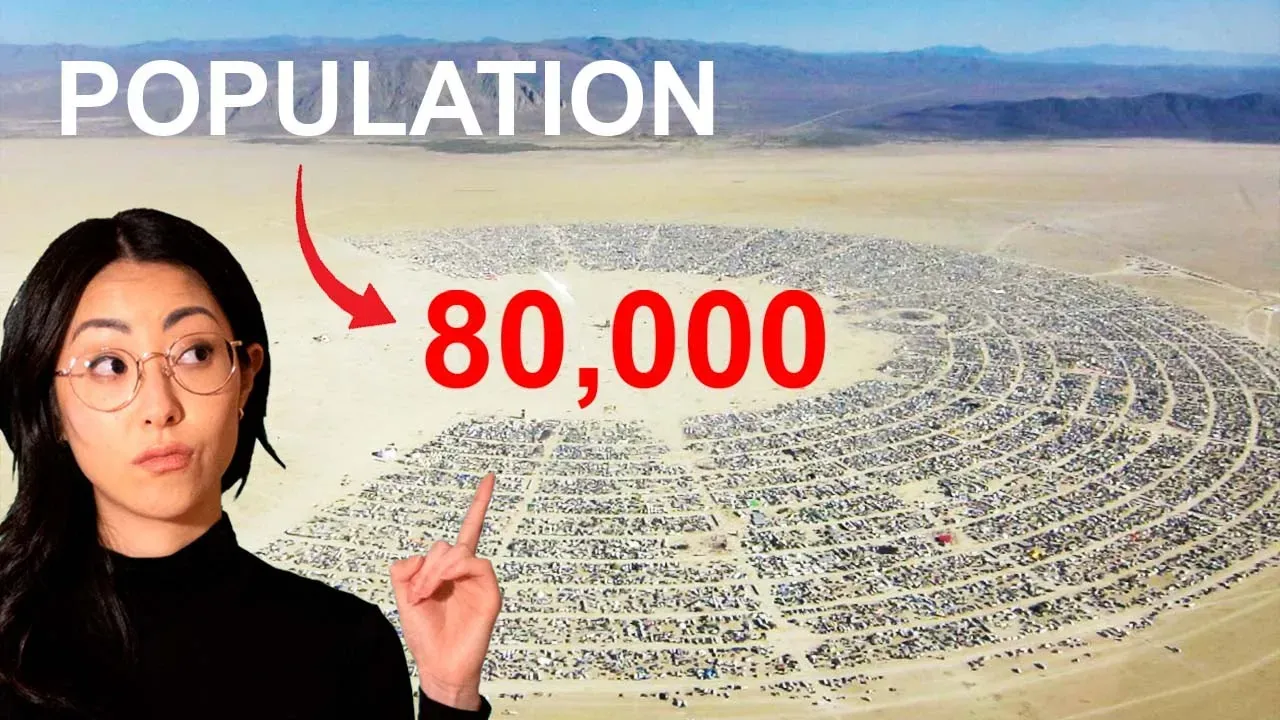
Over the last couple of weeks, you might have seen photos like this flooding your social media feed. These are the snapshots from Burning Man, which, if you don’t know, is the notorious mega-cultural event held in the desert of Nevada, which they call Black Rock City. They build stuff. They burn stuff. And over the timespan of nine days, this group of people lives together and functions together around the ten core principles of radical inclusion, gifting, decommodification, radical self-reliance, radical self-expression, communal effort, civic responsibility, leaving no trace, participation, and immediacy.
But it’s been growing by the thousands every single year, and this year it held about 80,000 people. But throughout Burning Man’s history, there’s been multiple accidents, deaths, arrests, as well as some really horrific stories of sexual assault. And in spite of their principle of radical inclusion, the desert environment doesn’t seem exactly like the most hospitable place for people with mobility issues. Some of the installations seemed to not meet any kind of safety regulation, and in fact, throughout its history there’s been concerning run-ins with law enforcement and the Bureau of Land Management. And with this type of massive growth every year, they’ve been constantly dealing with functional concerns, traffic safety concerns, and problems with scale and accessibility. So how has this event continued on for so long, why is it growing so fast, and how did it go from this to this?
What’s up, guys? My name is Dami and I am an architect in beautiful Vancouver, B.C. And when I started looking at the history of Burning Man, I was actually really shocked. And I think it’s a really fascinating case study from a design and urban planning point of view. This place has no water, no vegetation, and the temperatures get up to 100 degrees Fahrenheit and they drop to freezing at night. And they have windstorms that kind of cover everything in dust. And despite all of that, every summer, this group of people assembles a small city, and after nine days, they disassemble it and they leave zero trace of any human presence.
I think Burning Man is a really interesting example of how constraints, whether it’s legal or functional or site-specific, how these constraints have shaped a city into something that’s so successful. In fact, the very first plan of Burning Man was developed in 1992 for a population of just 600, just to satisfy the permitting requirements. In 1996, with a population of 8,000, they added avenues for the very first time and a second circle. And in order to preserve the view of the Burning Man, they created a zone called No Man’s Land, lined on either side with theme camps, and which were and to this day are kind of the heart of Burning Man. It can be anything from services, entertainment, or other interactive experiences organized by the people, for the people as gifts to the community.
Still, with more growth, they were constantly having issues with traffic, chaos, and sprawl. And every year they were losing the intimacy of the original camping circle, which led to accidents and a sense of isolation and conflict.
In 1997, Burning Man took place in a different location near Hualapai Valley. This is when they recruited Rod Garrett, who’s a landscape architect by training, and he put together the plans and documents to meet the regulations of the county. The permitting requirements forced them to include roads and street names and urban amenities. And due to the constraints of the site, also in order to condense everything within the property line, it naturally developed this arc that’s spread out laterally from the center. The year after, in 1998, when they returned to their home in Nevada, they kept a lot of the aspects from their experiment. They decided to form the city into a concentric circle around a geographic center where you could see the Man.
Just conceptually, I really love this idea of a moving city. Like it’s a city that morphed itself to meet the constraints of this new site and learned from its conditions. And then when it came back home, it became a better version of itself.
By the early 2000s, Burning Man had grown to 25,000 people, officially the size of a town. And I think here you can see one of the most understated and fascinating things about the evolution of Black Rock City. So this was the point where a lot of the problems really started to get amplified. There were staff disruptions and splinter groups and safety concerns, and the planners of Black Rock City identified that a lot of these problems can be traced back to alienation leading to the loss of human connection.
So they decided to ban vehicles except for the approved art vehicles. They tried to make the settlement a little bit more walkable. And the proposal to the plan was that instead of having this thick band of theme camps in the prime, inner ring of the city, that these camps would be distributed throughout the plan. This meant that they had to break down these monolithic sections, and when they did find some success with the strategy, they started interjecting more and more of these theme camps into the rest of the site year after year.
But of course, it’s when you start getting these mixed-use scenarios where you start to have more obvious issues. For example, having like a dance party-themed camp next to like a quiet relaxation zone, that could be problematic. And that’s actually why so many cities are zoned with very distinct uses. This requires a lot more granular planning from everyone involved. So Rod Garrett started implementing zoning to separate the potentially clashing uses. And months before the event, people have to submit the plans for their camps for approval. There are fairly strict guidelines, it seems like, for the design of these camps with like dimensions and potentially conflicting uses as well as pretty much everything else.
But can this really solve the problem of safety and accessibility? Throughout Burning Man’s history, there’s been numerous deaths and near-fatal accidents. There are open fires, there are art vehicles, and the art installations are climbable. And of course, you can’t compare Burning Man to a real city. You know, people only come here for nine days, and after that, they go back to the safety and comforts of their own homes. And none of these are like real permanent structures.
But just to put things in perspective, the safety regulations of the building code are so, so, so, so strict that, for example, something that I just came across the other day with my project is let’s say we have an existing building, right? And a fire exit this way and a fire exit this way and a path this way. And this is like a grassy area. And so we decided to put windows right here to give a little bit more daylight into this admin space. But the city wanted us to put water curtains, which are kind of like sprinklers, above these windows. And they wanted a new path here because in case there’s a fire, we have to assume that people are going to come out of the building and they’re going to be like, “Oh my God, where do I go? I must follow this path.” But there is only one path, and we have to assume that they’re either going to go this way or this way. And if they go this way, there’s like a massive raging fire that’s going to shoot out this window and people are going to get hurt.
But in reality and in common sense, when people leave a burning building, they’re going to be walking out in all directions and they’re not going to care whether it’s a paved path or if it’s a grassy area. So this is like one of the few examples. But anyways, what I’m trying to say is the building code forces us to put these safety precautions in place that sometimes go a little bit beyond common sense. And they really force us to design for the most extreme scenarios. And every time they print a new building code, it’s built upon the accidents or like the lawsuits from the years before. But the point of all of this is to provide a safe and equitable place for everyone, you know, no matter what your physical or mental capacities are. Because if you don’t put in rules like this, you’ll get designs like this.
So doesn’t this and this kind of go against one of their core principles of radical inclusion? The weird thing is, even in probably one of the most inhospitable conditions, there’s actually quite a large community of people with disabilities at Burning Man that actually come back year after year. They have what’s called a mobility camp since 2012, whose camp motto is radical inclusion through radical accessibility. And they have things like wheelchair-accessible camping, power for medical equipment. They are volunteers and they take out a tractor and like a 20-foot accessible trailer rig out onto the desert three or four times a day, so that people who can’t bike or walk, they can still experience the art.
But which they do make it very clear on the Burning Man website the reality of the conditions at the event. And they really stress that, you know, even though there’s a big support network, everyone, you know, no matter what your physical capabilities, is expected to live by the principles of participation and radical self-reliance. And I think, weirdly enough, that’s one of the reasons why they feel empowered and accepted. They’re not just seen as helpless or seem just for their disabilities. They’re just another burner, or that’s what they call themselves, that use the art to express themselves.
That’s my friend Lindsay of Who’s, an advocate for accessibility based in Toronto. And I think she really nailed it on the head. I mean, first, it needs to be functional and it needs to be accessible, but that’s kind of the bare minimum. Like once you figure that out, how can we create environments that give everyone the same quality of experience and the same quality of life? And when you start looking at the environment from that lens, you’re going to start to see a lot of problems in a lot of standard design practice and in a lot of like award-winning spaces by a lot of award-winning architects. But also, if you’re smart, I think you’ll also start to see more opportunities in this. If you think architecture is stagnant, this is one of the ways we’re going to get new types of spaces.
And I think it’s something that all of us can do kind of on a daily basis. If you’re going somewhere, just try to think: if I was on a wheelchair, like how would I get here? If I was visually impaired, how would I do that? And by understanding and recognizing that, I think we can develop more empathy and we can have better and stronger communities.
So where am I going with all of this? As an architect, I do want to attribute the success of Burning Man to the design. But it’s not… I think it’s actually the social strategy behind their design and the urban plan. This is a quote from Larry Harvey, who’s one of the co-founders of Burning Man. He said, “We’ve shown that you can actually deal with the complexity of urban problems by using specifically cultural means. The citizens participate in creating the city. In fact, half of our control is just based on watching their behavior and meeting their needs. And that’s the whole history of the development of the city.”
So what is participation? On one level, participation means that people should enter up with others and engage in the activities and not be voyeuristic. On a deeper level, participation means that aside from the limited government that handles like the basic infrastructure and like emergency services, the citizens they co-create and they maintain the city, and essentially it’s civic engagement.
I think there’s something kind of magical that comes from the process of building something together. When I interviewed Scott Kemp and some other architects who work with indigenous communities, a lot of them, they don’t see architecture or the building as their end goal. Their goal is to use the process of building as a way to heal the communities and to bring them together. And in fact, Scott went as far as to say that he’s not really the one who designs the buildings; like the community designed them, and he’s just the hand that draws what they design.
Even if you’re contributing at a really small level, like gifting someone a cookie or saying hi to your neighbors, you are participating in building the social fabric of the city. And if you don’t like something, you can talk to someone. In normal cities, there’s just like so many steps you have to get through bureaucracies and there’s political barriers. And eventually people feel pretty powerless in the end. But in essence, I think it’s the principle of participation that’s allowed Burning Man to transform from this to this. And I think this is how they’ve been able to continue growing through so many years of conflict with the authorities.
I do wonder if going to Burning Man actually affects people’s attitudes when they leave the event and come back to their normal lives. But I mean, I would kind of assume that if you’ve had a really positive experience somewhere, it kind of changes a little part of you. I don’t know. I’ve never been to Burning Man, but I would kind of like to go. It sounds really cool.
Let me know what you think. If you like this article, remember to like and subscribe. And if you like this article, you might also like my other article where I discuss a very different type of settlement in the desert. I’ll leave the link right here. And with that, I’ll see you in the next one.
I'm Dami, a licensed Architect living in Vancouver, BC. I make videos about architecture, career, and creativity.
How does a world of speed and information impact our brains, our culture, and the architecture that supports learning?

I'm Dami, a licensed Architect living in Vancouver, BC. I make videos about architecture, career, and creativity.
I'm Dami, a licensed Architect living in Vancouver, BC. I make videos about architecture, career, and creativity.
I'm Dami, a licensed Architect living in Vancouver, BC. I make videos about architecture, career, and creativity.
![Can we REALLY build on Mars? [SPACE ARCHITECTURE]](/_astro/can-we-really-build-on-mars-space-architecture.BXkVsYCN_Z1YxzuQ.webp)