
CyberPunk Cities: Fiction or Reality?
I'm Dami, a licensed Architect living in Vancouver, BC. I make videos about architecture, career, and creativity.
I'm Dami, a licensed Architect living in Vancouver, BC. I make videos about architecture, career, and creativity.
Fri Nov 11 2022 - Written by: DamiLee
One of humanity’s biggest obsessions is trying to figure out how cities will look like in the future by the year 2050. 68% of the world’s population is projected to live in urban areas, but most cities are not prepared for this. We have congestion, crime, a housing crisis, and just an endless array of problems that come up when you try to pack a massive amount of people in a small footprint.
Science fiction envisions a world that’s adapted to these conditions through technology. These problems have either been eradicated or worsened, and some sci-fi has been way off, but someone’s been spot on. But either way, they’ve pushed the boundaries in our thinking and they’ve given us a glimpse into the future and how we could be living, how we could be interacting with our environments and with each other. So today I want to look at three sci-fi movies with really interesting city concepts and break them down from a design and urban planning point of view.
The movie is based on a future world where the crime level has gotten so bad that it’s gone into a perpetual state of martial law. The police have a dual function as judges so they can give you a sentence on the spot, including the death penalty. The setting, Mega-City One, is a giant megalopolis that spans most of the eastern U.S. and some of Canada, which, by the way, is really close to the real-life East Coast Megaregion.
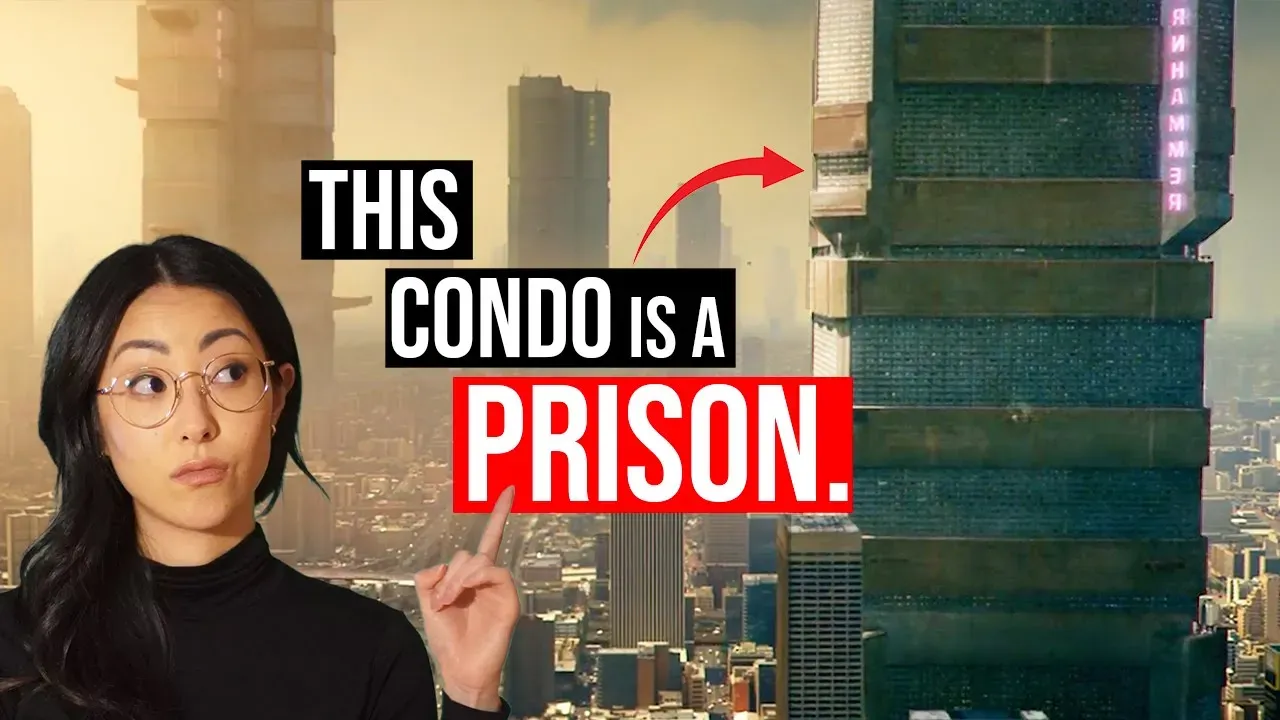
The architecture of the city actually acts as a form of surveillance in controlling the people. People live in these really dense residential towers with these nice big atriums, but when there’s a crime in the building, it automatically triggers a system that locks you in and keeps you contained in the building.
The real building, Ponte Tower, is a residential tower near Johannesburg. That tower has eerie parallels to the one in the movie. When it was first built in the seventies, it was a really desirable address, but very quickly turned into a slum. It was hijacked by gangs at some point, and now it’s like a symbol for crime and urban decay in the city. The decline was largely due to the social and political conditions at the time, but architecturally speaking, it’s brutalist.
You know, there’s a lot of similarities with the Panopticon concept, which is the universal design concept for prisons. And I think it’s this imposing architecture that turned this building into a symbol of decay. You know, architecture is not just for living in or working in. It’s also a symbol. And the movie actually uses these towers as a symbol of order and surveillance.
Like a lot of real city designs, one of the best examples would be this guy. His ideas for cities inspired a lot of developments throughout the world, and it’s had a huge impact on how cities are designed today. In the 1920s, Le Corbusier created several city plans to heal Paris from its problems. It was congested, it was dirty, it was deteriorating. And his solution was to erase the entire city and replace it with this (a city plan showing isolated towers surrounded by green space).
He believed this would create order and harmony by separating all of the different functions within a city like industrial, commercial, residential, recreational, and all the different traffic arteries. They would all be set up in different zones. Open space was a priority for air circulation because it was so lacking in Paris. So he designed these blocks to have tons of open space and circulation space by packing more density into a smaller footprint.
This was never really implemented in Paris. Thank God, but many housing projects throughout the world took this approach and they actually became kind of awful places to live. If you separate all of these functions, you get dead zones throughout the day. You go to work during the day. You come back home during the evening. And if you have to work late, walking in this office area becomes kind of dangerous because the streets are dead.
Same with the residential areas. During certain hours, there’s like nobody on the streets. All the activity, like restaurants or bar hours that would be open late are in a separate zone. And that’s why well-designed cities have a mixture of different uses. There’s shops, restaurants, offices and apartments. So you can get a constant flow of activity and eyes on the streets. Cities and neighborhoods become a lot safer and more lively when you have this kind of organic surveillance.
But in Corbusier’s designs, this was never really considered, which created really unsafe areas and the need for constant surveillance. So in a future where the crime rate is through the roof, it’s not really an accident that they use this type of city design in this movie.
The movie “The Fifth Element” depicts a megacity that solved the population crisis by building vertically. These towers go on for miles and miles and miles and they use flying cars and public transit, navigating in three dimensions to get around. Natural light and ventilation is an issue, and the further you go down, it gets worse and worse. Even above, it’s not really the nicest conditions. People live in these little pods with little to no personalization.
Building vertically makes a lot of sense, especially if it’s a city with a clear perimeter. There’s a lot of efficiencies when your infrastructure can serve more people in a smaller footprint. There’s a couple of technologies that would often evolve to make this scenario plausible. You would need flying cars or some sort of vertical transportation, which is actually not that far-fetched. They’re already testing these automated taxi drones.
We would also need new materials and new construction technology. For example, there’s this new type of bio-concrete that can heal its own cracks. There’s also been a lot of development in heavy timber construction, for example. We have the tallest wood tower being built in Japan, which is obviously huge because you can offset a lot of the carbon footprint.
I think more than the material strength, it’s the constructability that’s going to be a bigger issue. How do you get materials that high? It’s fine when it’s 30 or 40 storeys, but when it goes up to 100 storeys, the concrete starts to harden. And that’s problematic. You know, Burj Khalifa, the tallest building in the world. They created a special mixture that can travel in liquid form over a long distance. And they’re going to keep coming up with these new solutions for these new challenges.
But maybe the construction doesn’t even happen at ground level. Maybe it starts at an intermediate level that acts as another ground plane. In fact, you can see a lot of bridges connecting different buildings (pointing to two different buildings on screen). If you want to go from here to here, it doesn’t really make sense for you to have to go all the way down to get to another building.
And we actually do have cities, mostly colder, windy cities like Minneapolis or Calgary that have smaller versions of these bridges, and they’re called skyways. People park their cars, they go to work, they go shopping, and they can do all of this without going outside. One of the reasons I moved away from Toronto was because of the cold. So I really, truly appreciate these internal pathways, but it’s kind of a problem because not everyone gets to use them.
These skyways are privately owned because they connect private buildings. So the developers don’t really have an incentive to make them more welcoming. In fact, when the city of Minneapolis hired architectural consultants to improve the accessibility to the skyways, most of the developers’ response was that they don’t really want to attract the wrong kind of people. In an entire city that’s connected with skyways, it really makes me wonder where is the line between public and private?
Let’s talk about the constructability again for a sec. A lot of people think that the problem with tall buildings is the weight of the building, but actually the bigger issue is the force of the wind on the building. We call this the lateral force. Basically, the higher you go, the stronger the wind force is going to be on the building. If you have a wind force of ten kilometers an hour at the bottom of a building, it can go up to 70 or 80 on top. And apparently at the top of the Burj Khalifa, it’s like 200 kilometers an hour. And it’s also really unpredictable.
A common concept when it comes to tall buildings is torquing, not twerking, torquing. It’s like twisting. One of the solutions is exterior bracing. It holds the building in place and it stops it from twisting. A lot of these buildings will probably look more like this.
Another solution is one from Frank Lloyd Wright’s original concept for his mile-high tower. It’s dense at the bottom and it tapers at the top. When it was built, it was pretty revolutionary. But now you have the Burj Khalifa and other skyscrapers using the same concept. But the problem with this is that you need to make the bottom so fat to get a smaller top, and it’s just not really economical to drop off so much mass at the top.
So one of the new solutions is by Calatrava in Dubai, and it’s going to be the tallest tower in the world. And I think it’s kind of genius. Instead of bracing it or bundling it, they’ve got cables attached throughout the building to hold it when it sways. So, for example, when the building wants to sway this way (gesturing to one side), it’ll have cables pulling from this side. And if the building wants to sway this way (gesturing to the other side), it’ll have cables pulling from the other side.
I mean, just a couple hundred years ago, people would have never thought of skyscrapers. You know, we only started getting these since the invention of elevators. So probably in the future, with new materials and new technology, we’re probably going to be able to get like 500 stories or a thousand stories.
I think the bigger problem is going to be how we can create equitable spaces throughout. You know, like I said, there’s this blurring of the private and public spaces, but also having this height naturally creates the really desirable spaces at the top and the really undesirable section at the bottom. We would need artificial lighting that really closely mimics daylight and also a way to provide fresh air for the lower areas. But also just making sure that we have the right policies in place to not create these social divides between these sections. It doesn’t really matter how tall you can build if there isn’t a way to move around efficiently.
“Minority Report” has a much more comprehensive vision of how a city could completely reshape itself based on this new transportation system. Instead of flying cars, they have these maglev pods that travel on these dedicated lanes which are integrated into the urban fabric. And they even become a part of the building’s facade.
The design of these is actually really cool. It’s got an internal gyroscope so that you can stay upright, whether you’re traveling horizontally or vertically. It’s self-driving. It’s controlled by a centralized A.I.. So if you trust the government, you just hop in, put in your destination, and boom, you’re there. It takes out the human error factor so there’s less chances of collisions, and they can maneuver in a way that can solve a lot of these congestion issues.
Now, this type of infrastructure is kind of a similar idea to the one in “The Fifth Element”. But the biggest difference is that you can go straight from your destination to your apartment and you don’t need to go outside at all. And I think that would change the social dynamics in so many ways.
There’s a kind of forced social interaction that happens just by the fact that you live close to someone and you run into each other in lobbies or in the elevators. And if these lobbies or amenity spaces are designed in a way that encourages social interaction, then you get to know your neighbors. So even if you don’t have any friends or family, at least you have the people around you that you can interact with. That’s the traditional idea of a community and having neighbors.
With more and more towers being built, this idea of community has been slowly and slowly disintegrating, which adds to the social isolation. But maybe a system like this could actually democratize buildings. These days we have a lot of sky gardens and amenity spaces within buildings, but they can only be used through the building. So by having the ability to access buildings from different points, maybe some of these spaces could be made accessible to the public or to paid members through an app.
All of this is really exciting, but who knows? Maybe in the future, our built environments are just going to be secondary and we’re going to be spending more time in virtual reality. Or maybe cities become cool organisms to protect against natural disasters or a threat of war. Or maybe we just stop trying to improve the city altogether.
Mark Wigley once said architecture never derived its force from stability of culture, but rather from the expression of those moments when the sense of stability slipped. If we can agree on one thing, I think it’s that we’re living in really uncertain times, and this is the breeding ground for a lot of the changes in the environment.
There’s a lot to unpack here, so let me know what you think. And if you want to know more about architecture, I’ll leave a link to a playlist. And if you like sci-fi or dystopian architecture, you should probably have a look at my articles on Neom and Burning Man.
I'm Dami, a licensed Architect living in Vancouver, BC. I make videos about architecture, career, and creativity.
I'm Dami, a licensed Architect living in Vancouver, BC. I make videos about architecture, career, and creativity.
![Can we REALLY build on Mars? [SPACE ARCHITECTURE]](/_astro/can-we-really-build-on-mars-space-architecture.BXkVsYCN_Z1YxzuQ.webp)

I'm Dami, a licensed Architect living in Vancouver, BC. I make videos about architecture, career, and creativity.

How does a world of speed and information impact our brains, our culture, and the architecture that supports learning?