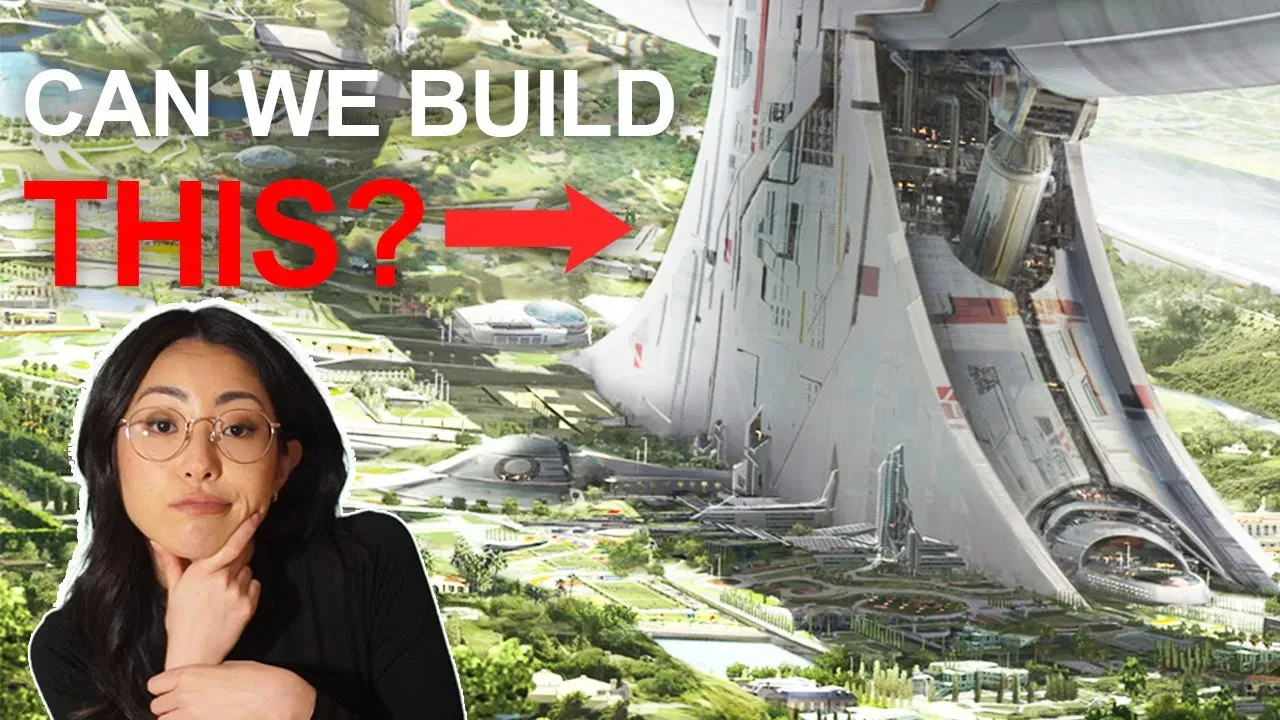

CyberPunk Cities: Fiction or Reality?
I'm Dami, a licensed Architect living in Vancouver, BC. I make videos about architecture, career, and creativity.
I'm Dami, a licensed Architect living in Vancouver, BC. I make videos about architecture, career, and creativity.
Wed Jun 29 2022 - Written by: DamiLee
Hey everyone. Welcome back to the channel. If you’re new here, my name’s Dami, and I’m an architect in beautiful Vancouver, B.C..
Today, we’re going to be doing something a little bit different. We are going to be looking at a couple of my favorite sci-fi movies that have really interesting architectural concepts.
So the very first movie that we’re watching is Ex Machina, which is a great movie if you guys haven’t watched it. And the storyline is about this software engineer who wins a lottery to do an experiment at the house of his company’s CEO, who is a cross between Jeff Bezos, Elon Musk, and Steve Jobs. And he created this A.I., this Android. And the main character is basically going to his house to perform the modern version of a Turing test to see if this A.I. can pass as a human.
Everything takes place in one house. We’ll kind of go over the house in a little bit, but it’s a really fascinating movie if you haven’t watched it. So he arrives at this very foreign landscape. He’s already kind of thrown into this very ambiguous situation. I just go down the path and he’s like, Where is the path? I like how it transitions from super, super, super loud and hectic to silent.
The house is very discreet. It’s kind of hidden in the bushes, very mysterious. And this is actually a real building, by the way. It’s a hotel in Norway. The entire movie is shot inside this hotel. The house itself almost becomes a character. His first encounter with the CEO is actually his house. The house says a lot about the person. Actually, this cladding, if I’m not mistaken, is a pine treated pine cladding. Peter Zumthor actually uses this in his home and office. The color of the cladding, I think, adds to the dark tone. You know, it’s not the light wood color.
And you have this incredibly heavy metal door. The door is the connection between the outside and inside, and I think the weight of the door has a really big impact on how you perceive the space when you go inside. And so it’s already creating this sense of mystery. This detail is really nice here, where the glass meets the stone. The original architect of the real building said they really, really try to focus on minimal intervention to the site, and that’s their approach to sustainability. This detail really speaks to that philosophy. They’re saying, no, we’re not going to touch the existing site. We’re going to transform our building, cut the glass to meet all the jagged edges of the existing stone. And you can see this detail in Fallingwater by Frank Lloyd Wright as well, which is probably one of the most iconic integration of architecture into nature.
Floor to ceiling, glass everywhere. I think there’s a really clever use of glass in this entire movie. “You’ve never been outside this building. You’ve never walked outside?” “I’ve never been outside the room I am in now.” It really confuses you. Sometimes it’s almost impossible to tell who’s the subject of the experiment and who is the experimenter. And it also talks about a contrast between confinement and freedom.
The scene is interesting, too, because I think this tree has something very symbolic to this movie. When you’re downstairs in the basement, you have this very manicured landscape, this little pot with these two little trees. And upstairs you have this expansive nature all around you. Like if you compare the use of glass upstairs to downstairs: upstairs, the glass is used to enclose the space but at the same time provide views to this expansive forest and to this lake. And you can look out into the mountains. And then downstairs, the glass is used to confine you.
Actually, the original building has frosted glass throughout and I think they use CGI to make it transparent. Or maybe they created a new set for those in the real building. They’re using the frosted glass to create privacy and create a sense of relaxation and calmness. By turning all of the glass transparent, you’re able to see everything. So it’s creating an environment of surveillance.
“Five years ago, building on the research of our predecessors at the Institute, my team and I discovered a process by which all organic material can be reduced at the cellular level by a ratio of approximately 2744 to 1.”
Downsizing is a sci-fi comedy drama, and it’s a movie that I like very much, although it got pretty bad reviews on Rotten Tomatoes. I think it’s really funny and smart. So a group of scientists invent this method where you shrink the human body into something about five inches. And this was their solution to climate change and overpopulation. By downsizing, you consume less material and you in turn help the earth. “I hold here in my hand all of the compostable waste produced by 36 people over four years.”
The story is about Paul, Matt Damon, who, you know, in his dire hours kind of going through a midlife crisis, decides to go through this procedure and it’s non-reversible. One of the benefits of downsizing, of course, is that you can take your savings and when you apply that to your downsized life, your money, because everything is so small, becomes like millions and millions of dollars. And so you can live this very, very lavish life in this tiny community. And so, Paul, he decides to go through this procedure with his wife, but when he actually shrinks himself, he ends up alone because his wife ends up ditching him last minute.
I thought this movie was really interesting because it’s focused inwards, not outwards. Like whenever we talk about the climate crisis or of overpopulation, we’re trying to change a bunch of things in our environments. We’re trying to build denser, we’re trying to build faster to house more people. But I really wonder what that process was like for them to start researching. Like, none of these solutions are working. We have to like drastically change something about ourselves.
This really reminded me of this book that I read called Learning to Die in the Anthropocene. In this book, the author, who’s a war veteran, he lists out in detail all the problems that we have. And he lists so in detail all the solutions that we’ve created, so renewable energy, solar, geothermal. And he outlines why none of these solutions are ever going to work. And we are basically screwed unless we drastically change the way we live and the way we think and philosophically, like die as civilizations and as individuals. And in this case, that drastic change was their physical change, they shrank their size.
What’s more interesting and more ironic is they’ve basically combined the most sustainable solution with the most unsustainable form of urban development, urban sprawl. All of these houses are, you know, the American Dream mansions, and they’re these massive gated communities, and they basically shrunk themselves so that they can consume as little as possible, so that they can live the lavish lifestyle that they’ve always wanted to live. In the end, they’re not really changing anything about themselves. They’re just changing their size.
Yeah, it’s kind of ironic and kind of messed up because the first part of the movie is them like contemplating whether they should go through the procedure or not. “And do you understand that there exists an approximately one in 225,000 chance that the procedure could result in injury, permanent disability, or death?” When you look at modern developments and ideas of healthier living and healthier cities, it’s denser, like denser communities with where everything is walkable and everything is bikeable. But it really makes you think if you had all the money in the world and if you had millions and millions of dollars to spend, would we still be trying to build these dense societies, or will we just be sprawling out everywhere?
So the next one is a Japanese science fiction manga made by Tsutomo Nihei, who was actually trained in architecture. He actually went to Parsons Design School in New York, but after working in construction for a little bit, he decided to leave architecture and become a manga artist. So Netflix recently made a movie adaptation of the manga, but I’m not going to talk about that. I’m going to focus more on the manga itself because I feel like the movie adaptation wasn’t really respectful to the original work.
So his background in architecture is really, really, really obvious in his manga. There’s very little dialog and you really just understand the story looking through the different environments that he creates. So the entire manga is this character Kili, who we have very, very little background on, and he says very little. And it’s just him wandering and wandering and wandering through the city, which is constantly expanding. So they’re trying to find this net terminal gene and they’re just trying to get away from the city’s defenses, which is these robots and silicones trying to attack them. So all these images make you feel very small and lost and it’s really vast in scale. And you can see why he took a lot of inspiration from brutalist architecture, you know, which is designed with that intent. It’s designed with the idea that communal is more important than the individual.
So the timeline of his career is like he was in architecture school and then he did construction for a very little time, and then he decided to become a manga artist. Actually, the skills that you learn in architecture school, I feel is closer to being a manga artist or animation than actual construction. We learn all these graphic tools to represent spaces and it’s really apparent that he has an architectural background because that’s how you represent your projects. You represent them through spaces, not through people or dialog.
I think the interesting is that when you’re designing in school, you’re designing spaces for people, not spaces that are hostile for people. I think his perspective is really unique, not just in the stylistic way he creates his work, but also in the storylines that he creates. Because I think a lot of architects, the design buildings, they don’t necessarily design the buildings through the person’s eyes. So as a manga artist, I feel like you’re working with a lot of emotions with architecture. We’re really working in the realm of beauty and proportion, and we rarely try to bring in emotion into our spaces or images, although we should. And I think even though there’s very little dialog and very little character development, that is the one point of connection that you feel with the characters, the feeling of like being lost and alone in the space as you’re flipping through these images.
I think it’s really interesting that he borrowed so much from Brutalism, and I think if architecture was to become alive, brutalist architecture would be the type that would want to destroy humans. It’s the most foreboding and dominant style of building, and I think it’s really fitting that he used this in a storyline.
So Elysium is about a dystopian society based in the future, around 2154, it’s by a South African director that actually has a huge influence on the movie. And I think he’s trying to recreate this society in South Africa where the see these huge divides between rich and poor. I think the movie has an opportunity to be a real social commentary, but I think what’s more interesting about the movie is the realism of the environment that he creates. The entire world has become a third world. So all this housing, it’s very organic development. It’s very similar to favelas. Favelas are informal developments. Basically, there is no rules and it was just built purely out of necessity by the inhabitants living there. This is favelas at a massive scale.
You can also see like little houses on top of buildings. And that’s actually what’s happening in places like Hong Kong, like they have these rooftop slums and thousands of people are living in them because they just don’t have enough space. And then Elysium is a satellite community, like a literal satellite community that’s orbiting around the Earth and all the rich people who could afford to move there. And it’s in the shape of a circle. It’s very finite. It’s kind of like saying we can only fit in a certain amount of people here.
And you can see that a lot of the structures that you see in Elysium are more fluid and organic. They try to make this Elysium really realistic as possible and really tried to think about the construction that went behind it. And you can see that a lot of these are in modules and a lot of the panels are in sizes that are, you know, realistic enough that you can transport them from Earth to space. You know, modular construction is the future. Once we start fine-tuning prefabrication and the ability to design and fabricate things offsite and bring them on site just to be assembled, that’s going to make construction so much more efficient. It’s going to cut errors, it’s going to cut costs. We’re going to be able to save so much materials and labor. We just need a couple more years to get there. In this scenario, like in space, you kind of have to do modular construction. You can’t really have any room for errors. This kind of necessitates this modular construction.
So there’s a really interesting book called Refabricating Architecture by Stephen Kieran from Kieran Timberlake. He compares architecture to industries like car manufacturing or aerospace manufacturing. He looks at how efficient those manufacturing systems are, and by adopting those methodologies, we can really, really, really improve a lot of the processes, like not just in construction, but all the way from design to processing to manufacturing to the operation of the building.
So Inception is a story about this thief whose job is to go into the dreams of these CEOs and steal corporate secrets. The architect in this case is really important because they designed the environments for these dreams to make the dreamer believe that it’s their dream.
“Now, imagine you’re designing a building, right? You consciously create each aspect, but sometimes it feels like it’s almost creating itself, if you know what I mean.” “Yeah, like I’m discovering genuine inspiration, right?”
A lot of the things that they’re saying is really accurate to the process of design. A lot of the times when you start designing, you don’t really know what it’s going to look like. And so as you go through these different options and through different sketches and models, you’ll see what works and what doesn’t work and you’ll see where the design wants to go. So it’s really like a process of discovery, I guess.
“I thought that the dream space would be all about the visual, but it’s more about the feel. I am lying on polyester… I am not lying on my carpet in my apartment. A dream is not about visuals. It’s really more about the sensation.”
And I really appreciate that they added this little detail in here because I feel like that will be something that will be really difficult to convey in a movie, because a movie is a very visual experience. When you dream, it really is more about a feeling. Actually, the other day I just had a dream where I was at my old high school, but the surrounding was a beach and there was a winding path to the high school and beyond the beach, like I could see the beautiful sunset and there was a cliff and it wasn’t really any of the details of the school. It was just the sensation.
And so in your waking life, this is very different because it’s much more focused on our visual senses. It’s not really a recent phenomena, but I feel like as we spend more time on our phones and our screens, we do spend much, much, much more time in the 2D. It’s much more of a visual experience rather than a sensory experience. And this actually leads to what we call experiential impoverishment. I actually talk about this in my other video. I’ll leave the link right here.
When we dream, our brains are much, much, much more active and it’s able to perceive things more holistically. It can perceive things with smell, sight, touch, taste. And I think that’s why we’re able to recreate these environments so much faster than when we’re drawing in real life. In architecture, it’s actually called haptic architecture. It’s when you incorporate all of these different senses into your spatial experience. You know, we should really all be designing for all of these senses. But when you design for your haptics, not just your visual, as it makes your experience of the space and your memory of the space much, much stronger, and it really solidifies that space in your mind.
I’m sure there’s tons of other good movies with great architectural concepts. If you have any suggestions, let me know in the comments. And I think I’ll definitely try to make a part two of this video because I had a lot of fun.
If you’re interested in learning more about architecture, I’ll leave a playlist of my personal favorites right here. I also have a monthly newsletter where I share my insights and things that I’m learning or reading or listening to, as well as a Discord channel where you can chat with other people in this amazing community. And if you want to support the channel and listen in on interviews by me with other industry professionals as well as access to other perks, I do have membership tiers that you can join. I’m going to leave links to all of this in the description of this video, and with that, I’ll see you in the next one.
“Wait, you’re not leaving me here? Can you understand how I feel? I feel terrible. I let you down. I feel awful. But then I realize I was just doing this because I was trying to make you happy. And I should have been thinking more about myself.”
When you’re dreaming, you’re using all of these different faculties, not just your visuals. And again, I think that’s why you’re able to recreate these environments so much faster than real life.
Best way to convey the contrast between the favelas and these informal housing and Elysium. Here is that there’s no wall between the dining room and the toilet. And yeah. So if you have guests over for dinner and you have to pee, well, you’re out of luck. I think the first luxury that goes when you’re live in poverty is probably privacy. And I think this space, this apartment actually creates a pretty strong narrative of what’s happening because it’s actually a pretty large space. It’s probably somewhere around like 400 square feet, but it’s not well-designed. It was just put together out of necessity because someone needed space ASAP. Yeah, it tells a story of a city and a population that’s been abandoned. You know, there’s like no building codes saying there needs to be a wall between the toilet and the dining room. And there’s, like, no jurisdiction cracking down on the basic spatial constraints.
I like how even in the future for the mega, mega rich, they still have like very conventional looking kind of Victorian style houses, but with circles, circular windows.
So the entire movie takes place in one building in this this house of the CEO and the upstairs. You have views everywhere. And I think it’s just so fascinating how just by using these two floors and using glass, it’s able to create so many different scenarios with a little skylight. But that’s pretty much your only connection to nature. The basement is where the A.I., the Android and the test subject are living. So it’s a pretty big contrast and it creates these two worlds. It’s floor to ceiling glass. You can see the mountains and the trees and the downstairs basement. There’s no windows. There’s this little garden with these trees.
There’s a scene with a pretty intentional lens flare, which you can see in many of the scenes taking place upstairs, a lot of lens flare and light.
I'm Dami, a licensed Architect living in Vancouver, BC. I make videos about architecture, career, and creativity.
How does a world of speed and information impact our brains, our culture, and the architecture that supports learning?
![MEGACITIES: Reality or Fiction? [Architecture in Sci-Fi]](/_astro/megacities-reality-or-fiction-architecture-in-sci-fi.DVnYiCV-_S6iGH.webp)
I'm Dami, a licensed Architect living in Vancouver, BC. I make videos about architecture, career, and creativity.

I'm Dami, a licensed Architect living in Vancouver, BC. I make videos about architecture, career, and creativity.
I'm Dami, a licensed Architect living in Vancouver, BC. I make videos about architecture, career, and creativity.