![MEGACITIES: Reality or Fiction? [Architecture in Sci-Fi]](/_astro/megacities-reality-or-fiction-architecture-in-sci-fi.DVnYiCV-_S6iGH.webp)
MEGACITIES: Reality or Fiction? [Architecture in Sci-Fi]
I'm Dami, a licensed Architect living in Vancouver, BC. I make videos about architecture, career, and creativity.
I'm Dami, a licensed Architect living in Vancouver, BC. I make videos about architecture, career, and creativity.
Sun Jun 25 2023 - Written by: DamiLee
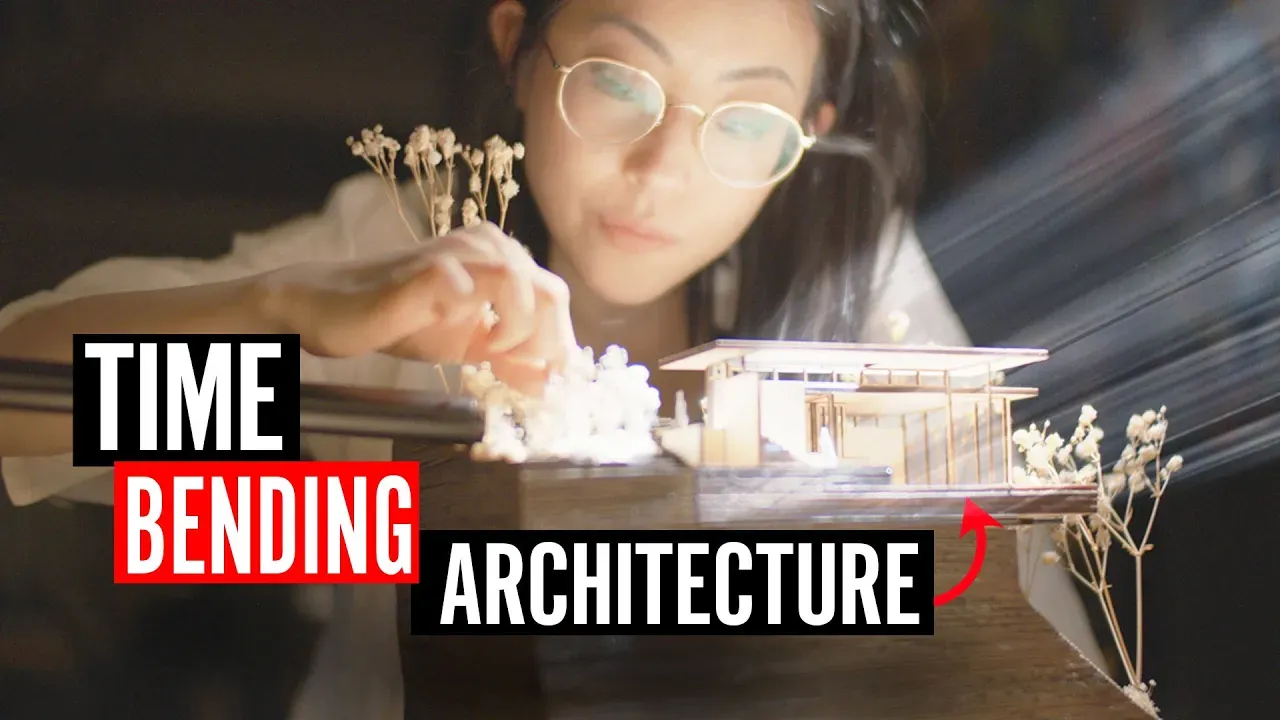
I’m constantly checking the time, sometimes for no real reason at all. I think it’s because I usually feel like I don’t have enough time, and I guess this is my attempt to control it. But this little habit has turned me into someone that I don’t really like. So when I started working with my first client, who basically gave me unlimited design freedom, I knew I wanted to explore this idea of time and if there’s any way to slow it down.
This feeling of being rushed is a universal feeling, especially in the digital age. But if you think about it, it’s actually kind of ironic. All of these tools are designed to increase efficiency so that we can have more time and improve the quality of our lives. But instead, we’re all just pushing for more—more productivity, more experiences, more excitement, more things to see, more things to do. F.O.M.O. (FEAR OF MISSING OUT). But leisure in itself has become a multi-million dollar industry that tries to keep us constantly entertained, constantly wanting more, and again making us feel like we don’t have enough time.
There are a few moments in my life where I felt the sensation of being unplugged from the world. There’s a quality about these moments that makes me want to slow down my pace, willing myself to be lost and to be alone. So when I started designing the Orinda house (San Francisco, CA), I tried to let these memories guide the design. In some ways, I think this is kind of the perfect site. You come here to disconnect from the rest of the world.
The Site Challenges
The site does come with a few challenges. It feels a little bit steeper than I thought it was going to be. The hill is extremely steep, with almost a 30-degree slope, and it’s facing north. So, the hours of daylight are actually quite limited because it’s blocked by this hill. In fact, when we did a proper sun study, the only part of the site that got lots of daylight throughout the day was at the very top of the hill.
There are also, like, a million protected trees on the site. Basically, anything over a six-inch diameter is a protected tree. So, I had to pick a spot that would require the least amount of tree cutting. We also have this 25-foot height limit. So, the lower we go down the site, the shallower we have to make the floor plate. Otherwise, we have to corner into the hill, which, based on our geotech report, will be possible, but it will be a challenge because the bedrock is very hard.
This flat portion seemed like the ideal location for the building. You get tons of daylight, there’s not a ton of trees around, and with our concept of maximizing time, this location seemed like a no-brainer. But the problem was, how do we get all the way up there? How do we get materials up there? Building a driveway would be very expensive, and we’d have to cut down a lot of trees, and the City of Orinda would not be happy.
The Solution
The solution actually came from an acquaintance. Apparently, these little hillside lifts are quite common in California because there are so many steep sites like this. So the driveway and the garage can stay right here at the bottom of the hill. You park your car and take your little hillside elevator, and that’s how you get to the house. As you slowly move up the lift, you sit and look at the trees, and you can also see glimpses of the building when you finally reach the top. All you have is a platform and a massive concrete wall on the side. And when you touch the wall, you’re totally surprised to find that it’s warm and soft.
In the summer of 2016, we traveled across Europe to look at architecture. At the last leg of our trip, we made our way to a little Swiss village called Vals to visit the home and studio of Peter Zumthor, who happens to be one of my favorite architects. Nobody was there, so technically I guess we weren’t actually visiting. But regardless, the building was designed by Peter Zumthor himself, so I took, like, a million pictures. I peeked through the windows and touched everything I could get my hands on. Don’t ask why.
It was just before we were about to leave. As I was trying to get my last few pictures, I found a nice old window recessed into a perfectly formed concrete. But something was different when I touched it. I was shocked. The concrete was soft and warm. This hard material had the texture of fabric. I think the concrete must have been formed using fabric as a formwork, and it conducted heat from the sunlight. The only proof that I have of this is a photo, which doesn’t even come close to capturing this feeling. But sometimes when I touch a soft linen, maybe one that’s been sitting out in the sun for a long time, it reminds me of this moment.
The problem is that vision is the loudest of our senses, and so by limiting our view of the house, we start to pay a little bit more attention to our other senses. You could hear the water in the distance, and when you touch the wall, you’re surprised to feel the strange texture under your fingertips. You notice your movements, the variation in the wall, and maybe you start to slow down.
Once you turn the corner, you enter into a garden. And it’s not just a garden, it’s a labyrinth. You have to take this meandering path in order to reach the entrance of the house. I’m sure over time the family would build in shortcuts—maybe here and here and here—but the main path takes you on a long journey. This very intentional complexity of the path creates a sense of mystery, curiosity. Each new turn reveals a new moment, a hidden corner, a carefully framed view, or maybe a really soft moss. Getting lost and then found—that’s the whole point. That feeling of being blindly led by your feet. Labyrinths were actually used for meditation by priests during medieval times. They’re non-linear and can be disorienting, but you know that you’ll eventually get to the end. These long walks were used to reach a state of contemplation.
When you reach the end of the garden, you land on a large stepping stone, which marks the end of the labyrinth and the beginning of the house. According to Juhani Pallasmaa, images of water emphasize architectural permanence and concretize the passing of time. The reflective surface of the water hides depth and projects a second hidden world. The double world activates our imagination for the duality of past and future. So, in order to get this kind of effect, the water needs to be getting direct sunlight. The light hits the water, bounces off, and the refraction from the water is projected onto this concrete wall. After iterating through a couple of different options, we decided to place the pools at the top of the site—on the south end, one reflecting pool here and one accessible pool here. We maximize the sunlight, and this refraction of the water becomes a part of the entry experience.
In this area, you can take a moment to pause. We landscaped this area so that the seating becomes a part of the hill. And instead of paving this area with concrete, we continue the stone paths so that this entire space feels like one continuous garden.
Entering the House
When you enter the house, you enter into a hall with wood slats on one side and a personalized concrete wall on the other. The patterns on the concrete panels create rhythm as you enter. The entryway is a transitional place, and it’s a place of movement. It’s a place where outside becomes inside. It’s your first few moments into the house, where you leave your keys, your coat, where you leave your outside self behind and you enter your home. It’s not a moment, but it’s an in-between moment. And these are the moments that usually get forgotten about. These moments make up only seconds in our days, but added up, they become hours and days. And so by elevating this experience with the light and texture, we can make even these transitional moments memorable.
As you descend the stairs through this narrow transitional space, you experience expansion for the first time. You really see the beautiful view over the hill, the interconnected spaces of the house, the reflection of the water on one side. And for a brief moment, you take a pause.
This isn’t my typical process for designing, but there was an object that kept coming to my mind as I was designing the building: a sundial. I think there’s something really poetic about it, how the hands stay still while it quietly witnesses the fleeting hours and seasons. But compared to a digital clock, it’s not dictated by the seconds or minutes. Instead, I feel a more gradual passing of time. Ha ha ha. I think about the sun’s journey across the sky and it reminds me of our connection to the universe. It makes me think about my existence in the context of this vast space and time. As the sun moves across the sky from morning to evening, I wanted the building to kind of dance with the changing angles of the sunlight. We tried a bunch of iterations of the roof because it changed how the light stretched into the living room and into the office and into the kitchen. Maybe this movement can even guide some of the activity in the house.
But there’s another moment in the house where you experience light in a totally different way, and that is underneath the pool, where we get the refraction through the water, which is a totally different quality of light. This room actually drove a lot of the relationships between the spaces in the house. I wanted the refraction to be a part of the experience of the house so that the living room and the kitchen can borrow some of that refraction. But because of the depth of the pool, it was really hard to do that without placing the relaxation room on a completely different basement level, which is why each of the spaces is set down a half-story. This creates separate spaces that still feel interconnected and works with the natural topography of the site, which gradually steps down as we move towards the east. Ha ha.
Concluding Thoughts
Time is a human-made invention. We create time as a framework to get organized, measure progress, and make sense of our lives. So maybe architecture can slow down our perception of time. Maybe it can make us pause, and maybe it can make us notice the moments that usually go unnoticed. You know, this whole craze about the circadian rhythm—it’s really all about resetting our systems back to their natural state and realigning them to the movement of the sun. I think as architects, we often design for the hours and the days in our lives, but we often forget about the seconds and minutes. So how do we make these more granular time intervals more memorable in our lives? I think those are some of the questions that we’re going to try to answer as we progress the design.
We’re still in the schematic design phase, so things are still really conceptual, and there’s still a lot of things to figure out. And in fact, since making this article, the design has actually changed quite a bit. And because our business is not just architecture, it does take a little bit longer for us to do things, so please be patient with the project updates. But that’s also one of the best parts for me, that we can explore some of these concepts a little bit more in depth.
What do you think about the project, and what other concepts do you think we should explore?
I'm Dami, a licensed Architect living in Vancouver, BC. I make videos about architecture, career, and creativity.

I'm Dami, a licensed Architect living in Vancouver, BC. I make videos about architecture, career, and creativity.

I'm Dami, a licensed Architect living in Vancouver, BC. I make videos about architecture, career, and creativity.

How does a world of speed and information impact our brains, our culture, and the architecture that supports learning?
![Can we REALLY build on Mars? [SPACE ARCHITECTURE]](/_astro/can-we-really-build-on-mars-space-architecture.BXkVsYCN_Z1YxzuQ.webp)