![MEGACITIES: Reality or Fiction? [Architecture in Sci-Fi]](/_astro/megacities-reality-or-fiction-architecture-in-sci-fi.DVnYiCV-_S6iGH.webp)
MEGACITIES: Reality or Fiction? [Architecture in Sci-Fi]
I'm Dami, a licensed Architect living in Vancouver, BC. I make videos about architecture, career, and creativity.
I'm Dami, a licensed Architect living in Vancouver, BC. I make videos about architecture, career, and creativity.
Thu Apr 20 2023 - Written by: DamiLee
Cyberpunk is dark, brutal, and hopeless, but it’s also a really cool way for us to think about what our future could look like. And you might think of it as just fiction, but in the last couple of years, you’ve seen just how fast things can change in ways that we would have never even been able to guess. Let’s try to look at Cyberpunk from an architecture and urban planning point of view to see if it’s just fiction or if there’s a real connection to our reality. Are we already dreaming of electric sheep?
Cyberpunk is a subgenre of science fiction, but it focuses on the darker side of technology, often bleak dystopian futures. You have a technologically advanced, yet declining society where people constantly struggle to maintain a sense of self in the face of technology that’s becoming so superior. It’s typically set in a dark, urbanized, and globalized world with a gritty underground subculture, with things like cyborgs, virtual reality, A.I., and cybernetic implants. Big corporations control everything, and technology is both a lifeline and a leash. It’s what you need to survive, and yet it’s the tool that controls them.
One of the key features of a cyberpunk city is the density and complexity. We have towering skyscrapers, usually overpopulated and polluted. We have labyrinthine streets and alleyways and a vast network of interconnected technologies. It’s basically an urban jungle where people are forced to navigate a complex and dangerous landscape to survive. But at the same time, cyberpunk cities can be places of opportunity and possibility where the marginalized can carve out a niche for themselves.
I don’t think it’s an accident that the most common recurring cities in cyberpunk are set in cities like Tokyo, L.A., Hong Kong or London in North America. North America is the place of hope, the American dream, but it’s also an icon of capitalism. And Asia has super dense, technologically advanced cities, but there’s a lot of uncertainty about the future. But there’s another, more obvious reason. Cyberpunk emerged in the eighties and nineties, where the U.S. and Japan were at the forefront of technological innovation. We saw the rise of Silicon Valley as well as the rise of Japan’s tech industry. So these areas became associated with cutting-edge technological development and served as a natural backdrop for these cyberpunk stories.
In the original Ghost in the Shell, there’s only one scene where you can obviously distinguish kids in the environment. Having children in cities is not just important for social stability, economic growth, and cultural continuity, but also for urban planning. They bring life and energy to public spaces. They bring spontaneity and play and fun, and in fact, public spaces that are designed with kids at the forefront can actually lead to a more vibrant space for everyone. Just look at this project, Superkilen in Denmark by Bjarke Ingels Architects. Instead of creating isolated playgrounds for kids, they integrated the play areas within the larger public realm. And by doing that, they made the entire area more interactive, more inclusive, more accessible, and more fun for everyone.
The absence of children in cyberpunk is very obvious in the design of these cities, and it just speaks to a society that’s not only struggling with crime or the cost of living, but also a society that has no hope and no vision for the future. And this isn’t just fiction. Places like Japan and Korea are already experiencing a pretty scary birth decline. And you can actually see how that’s already impacting the economy and the real estate market. The problems are obviously pretty complex, with many factors at play, such as a kind of social tolerance for completely shutting yourself off from society. But it could also simply be that the lifestyles are really demanding and the long working hours just leave very little time for personal life. That plus the rising cost of living. It’s not really the ideal condition for starting a family. Whatever is the crux of the problem, if this continues to happen in the next couple of generations, we’re probably going to be seeing what we’re seeing in these dystopian cyberpunk worlds.
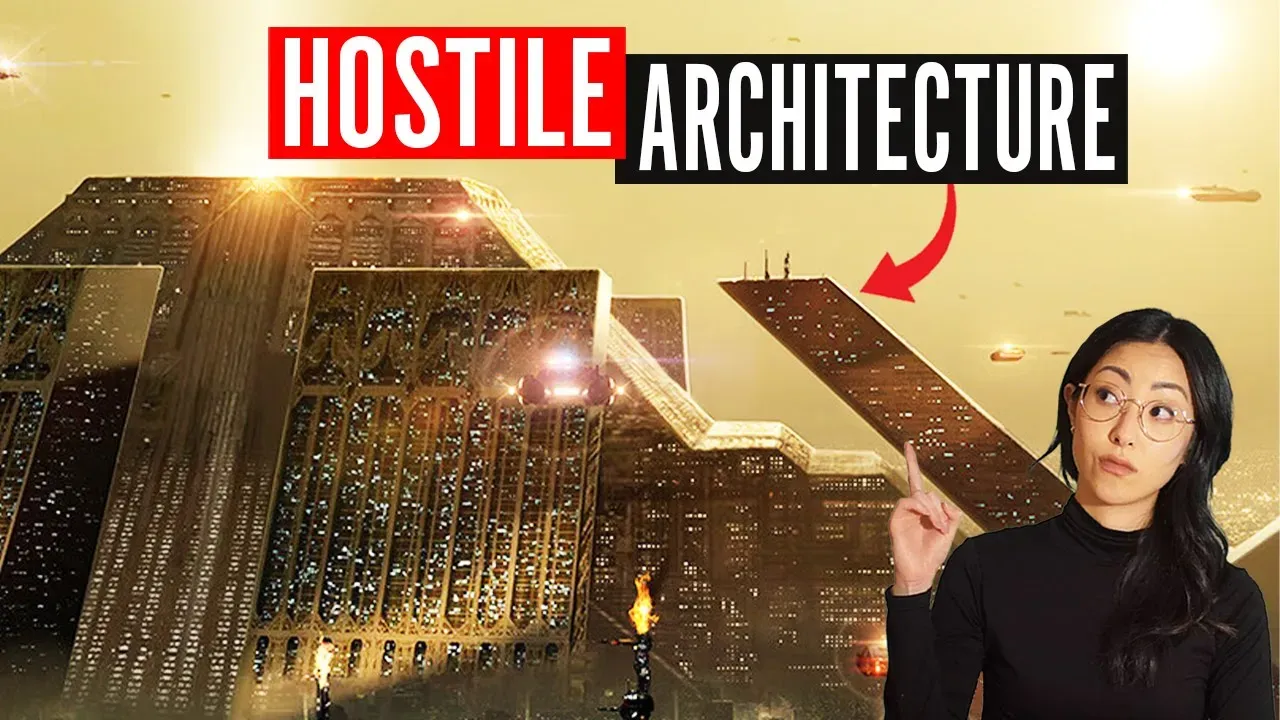
This is a very iconic scene in both Blade Runner and Blade Runner 2049. The corporations are represented by huge, brutalist-style buildings that are kind of shaped like Mayan pyramids. At first glance, it kind of looks like the design was optimized for planes compared to a traditional tower. These stepped pyramids have a very large landing surface. I think the reference to Mayan pyramids was actually really intentional. These were religious and political structures. They used them for ritual sacrifices, for observing the stars, and some even had tombs of important rulers. So these corporate towers get an almost religious connotation, which actually makes a lot of sense because this is the place where they create the replicants. But unlike these real Mayan pyramids, the sheer scale and density of these structures suggest that they have zero regard for life on the street.
In city planning, we have density limits: the area of the site times the allowable density for that zone. Basically, if the building’s taller, it needs to be slimmer. If it’s fatter, then it needs to be shorter because the mass of the building affects the daylight, the wind, and it affects creating safe and pleasant spaces for people on the street. So these massive structures completely dominate the cityscape and also reflect the power and control that these corporations have over society.
Later, when you look at Deckard’s apartment, you’ll see these tiles. These details are actually from Frank Lloyd Wright’s Ennis House, which is an example of the textile block house or the Mayan revival house. These interlocking concrete forms create a geometric pattern that was inspired by the Mayan pyramids. I don’t know if this was intentional or not, but maybe it’s suggesting that these corporations reach all the way into the depths of people’s private lives. And fast forward to Blade Runner 2049, you’ll see a very similar motif in the tiles at K’s apartment. So maybe not a coincidence after all.
It really seems that cyberpunk cities have eyes everywhere. There are so many different ways to profile you: cameras and I.D. devices. Even the structure of a building is designed to create this aura of surveillance in Bladerunner. The LAPD building is also a building in the brutalist style. It’s designed to have a large landing surface for the flying vehicles. And it’s almost an inverse pyramid with a wider top and a smaller bottom. This towering gesture suggests surveillance, of overlooking, and when you’re on the ground plane, it feels really overwhelming.
An IHS study predicted that the number of surveillance cameras worldwide would reach 1 billion by 2021, and that was already two years ago. 54% of the world’s CCTV cameras are actually located in… can you guess? China, equating to 540 million. That means there are 372 cameras per 1000 people, given the country’s population of 1.46 billion. Remember Minority Report? That’s already kind of happening in China.
In both of the Blade Runner movies, there are lots of great examples of what you would call brutalist architecture. Brutalism emerged in the 1950s, and when Philip K. Dick wrote Do Androids Dream of Electric Sheep? in 1961, which is the book that Blade Runner was based on, brutalism was thought to be futuristic, ahead of its time, and actually it was considered kind of radical, especially compared to the smooth, clean, sterile quality of modernism which came before it. It was even considered a socialist form of architecture. These bare structures, the idea was that they provided a kind of blank canvas that could be influenced by people’s experiences over time. It was the kind of architecture that instead of saying, “Look at me,” it came alive only by involving people. It was democratic, it was social, and it was morally right. Or that was the idea.
Just look at this. Concrete deteriorates and weathers really badly over time. Despite these grand social visions, it turns out people don’t actually like hanging out in these massive raw concrete spaces. So eventually these buildings became neglected. But the problem was, because these buildings are just so massive and dense with concrete, apparently it will create a huge amount of carbon footprint to demolish it. So we’re stuck with these cold, raw, concrete monsters.
By contrast, this is also another very common scene in cyberpunk: bright neon streets with buildings covered in advertising. In most cities, city planning restricts and controls this type of signage, except for special zones. For example, Times Square, Piccadilly Circus, Shibuya Crossing, or Dundas Square. From a purely capitalistic standpoint, of course it makes sense to use surfaces for advertising, since for most buildings, the facades don’t really serve a functional purpose. But not only does it create visual pollution and light pollution, leading to constant distraction and fatigue in people and any kind of wildlife around it, not only does it encourage overconsumption, not only does it encourage onto spaces that are supposed to be public spaces, but commercializing building facades leads to a loss of identity.
You know what you see as a soccer player who’s hogging the ball and going in circles? They say he’s “doing a Venetian,” because that’s how people move through Venice, through the labyrinthine alleys. Venice is one of those places where the city is an integral part of the person’s identity. So in Venice, when buildings are being renovated, they cover it up with a tarp with an exact photo of the facade. Because to go months or years without that building, it would be like losing a limb. Benjamin once said that “to do all is to leave traces.” Buildings are supposed to reflect the local flavor or the culture, the history. And it’s supposed to be a reflection of the people who live there. So when we cover up building facades with ads, it takes away the unique character or the spirit of that place. And we start to lose identity, not just in our cities, but also in ourselves.
A public square is a space that’s owned and maintained by the government or a public entity, and it’s accessible to everyone. Public squares are considered to be a part of the public domain, and they’re governed by laws that regulate the use of public spaces. In contrast, a privately owned square is a space that’s owned and maintained by a private individual or a company or an organization. These spaces are typically located on private property, like a shopping mall or a corporate campus. And although they might feel public, they’re actually only accessible to people who are permitted to enter the property.
I talked about the skyways in my last video about megacities and how, even though that’s how most people get around in the winters, it’s not actually a public space. If you linger for too long or you look like an unsavory character, or you’re just a demographic that’s not deemed desirable, they’re in their full rights to kick you out. So when our public spaces start to get taken over by private interests, in the end, they can set the rules. And it might not seem like a big deal until it is. For example, Zuccotti Park, or Liberty Plaza Park in New York City, is a privately owned public space. And in 2011, it was the site of Occupy Wall Street, where protesters camped out for several weeks for a peaceful protest. But in November 2011, the protesters were evicted, despite their right to free speech and assembly, because the owner of the space, Brookfield Properties, allegedly complained to the city about them being there.
“Abolish all forms of rent control, abolish all forms of social and affordable housing, privatize all street squares, public spaces and parks, whole urban districts.” These are not the government mandates of a cyberpunk movie. This is directly pulled from the eight-point manifesto proposed by a prominent partner at Zaha Hadid Architects, one of the most well-known architecture practices in the world.
When I asked ChatGPT, my new best friend, for honest thoughts on cyberpunk and its depiction of corporate dominance, it said, “Although cyberpunk movies can be a source of inspiration, caution or critique, they should not be taken as a prescription of the future.” I beg to differ. Commercial interests are blending so seamlessly into our lives, and as technology gets better and better every year, and as we rely on them more and more, we are giving away control over our privacy, over our identity, even over our own thoughts. While it’s impossible to predict the future, I think we’re at a critical time right now. How we address these challenges and the choices that we make could really change the trajectory of our future. That’s why it’s so important that we stay informed, that we advocate for change, that we get involved in our communities, and we also consume responsibly. And that’s the only way we can avoid a dystopian future and pave the way for a more equitable and promising society. Because in the end, dystopian dreams are reflections of our current fears.
Blade Runner sounds much better than Do Androids Dream of Electric Sheep? Do we agree? Cells? Yes. This article is getting a little bit too long. Cells. I love you guys. Please don’t leave me alone here. I just want to be interlinked. If you are still watching, maybe consider subscribing and liking the video. Interlinked?
I'm Dami, a licensed Architect living in Vancouver, BC. I make videos about architecture, career, and creativity.

I'm Dami, a licensed Architect living in Vancouver, BC. I make videos about architecture, career, and creativity.
I'm Dami, a licensed Architect living in Vancouver, BC. I make videos about architecture, career, and creativity.

How does a world of speed and information impact our brains, our culture, and the architecture that supports learning?
![Can we REALLY build on Mars? [SPACE ARCHITECTURE]](/_astro/can-we-really-build-on-mars-space-architecture.BXkVsYCN_Z1YxzuQ.webp)